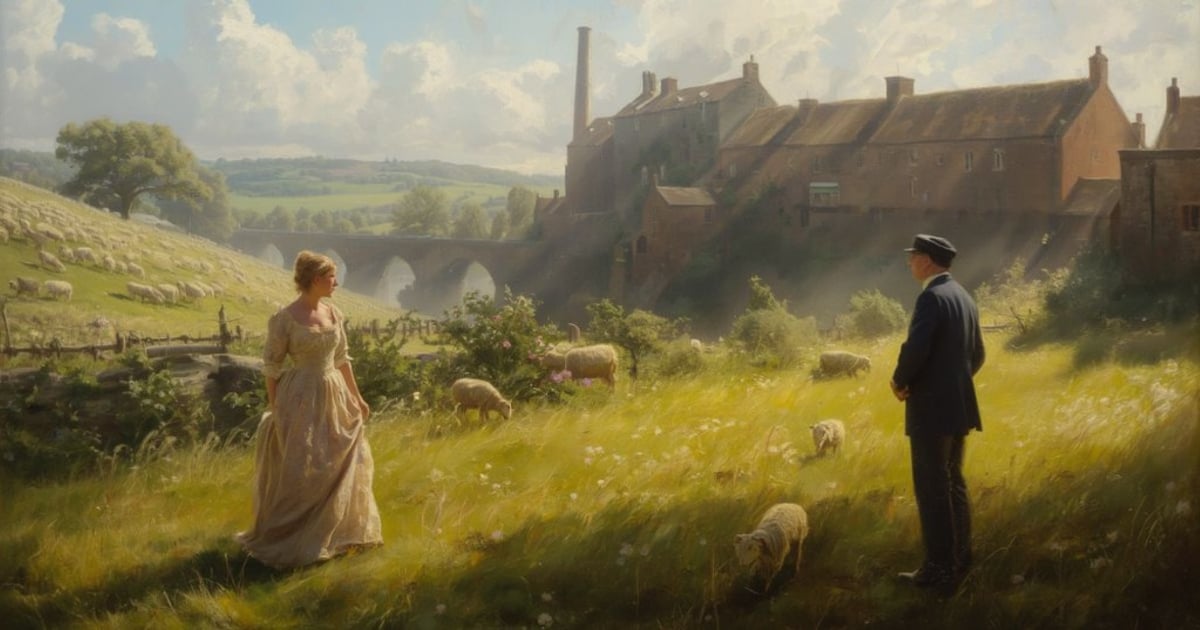
Margaret and her family struggle with their harsh new reality in industrial Milton. The thick November fog mirrors their despair as they realize they're trapped, Mr. Hale has spent nearly all their money on the move, and there's no going back. While Margaret reads Edith's cheerful letters about her glamorous life in Corfu, she reflects on how different her own path might have been if she'd married Henry Lennox. The contrast is stark: Edith lives in sunshine and luxury while Margaret faces smoke, fog, and the challenge of finding decent household help in a town where everyone works in factories.
Margaret ventures out alone to search for servants, something that would have been unthinkable in her sheltered London life. The factory workers intimidate her at first, the women boldly comment on her clothes and touch her dress, while the men make openly appreciative remarks about her appearance. But gradually, she begins to see past her initial fear to recognize their basic humanity and even kindness. A pivotal moment comes when she meets Nicholas Higgins and his dying daughter Bessy on the road.
Margaret impulsively gives Bessy some wildflowers she's gathered, and despite Higgins' gruff manner, a tentative friendship begins. This simple exchange of flowers becomes Margaret's first real human connection in Milton, transforming the industrial town from a place of exile into somewhere she might actually belong. The chapter shows how genuine human interest can make even the bleakest circumstances bearable.
Amplified Discussion
The Economics of Belonging
Gaskell wrote this chapter during the height of industrial capitalism, when class divisions seemed absolute and crossing them nearly impossible. Margaret's terror of the factory workers reflects the genuine fear that privileged people felt when forced into proximity with those they'd been taught to see as dangerous or lesser. But notice what actually breaks down the barriers, not charity or condescension, but genuine human interest. Margaret doesn't offer money or advice; she offers flowers and attention. The workers respond not to her status but to her willingness to see them as individuals rather than types. This dynamic plays out everywhere today. In workplaces where management fears unions, in neighborhoods where longtime residents view newcomers with suspicion, in families where educational or economic success creates awkward distance. The pattern remains: people can smell authenticity from a mile away. They know when you're trying to help them versus when you're trying to prove something about yourself. They know when you see them as a problem to solve versus a person to know. The most effective bridge-building happens in small moments, the supervisor who asks about a worker's sick kid, the new neighbour who borrows a cup of sugar, the college graduate who admits they don't know how to change a tire. These tiny exchanges of vulnerability create space for real relationship. What small gesture of genuine interest could transform your own sense of belonging somewhere?
Explore this chapter with AI to uncover deeper meaning and practical takeaways.
A new place becomes livable not through general adjustment but through one specific connection that gives it human meaning. Margaret spends months in a fog-shrouded industrial town she cannot love, enduring bleak November light and the rough freedom of mill workers, until she meets Higgins and Bessy and discovers that from that day Milton looks different to her because it now contains a human interest. When a new environment feels barren, look for one person whose daily life you can genuinely engage with, rather than waiting for the whole place to become familiar.
Lessons
PracticeThis week, notice when someone seems unfriendly, ask yourself if they might be testing whether you see them as fully human, then respond with genuine curiosity about their experience.
Psych reading
The Belonging Exchange
Genuine human connection transforms outsider status into belonging when we engage with authentic curiosity rather than protective judgment.
In the mind
This chapter reveals a crucial pattern: genuine human connection can transform exile into belonging, but only when we drop our protective barriers and engage with authentic curiosity. Margaret starts as an outsider, intimidated and judgemental, viewing the factory workers through the lens of her class prejudices. But the moment she offers flowers to a dying girl, a simple act of human kindness, everything shifts. She discovers that beneath the rough exteriors are people dealing with the same fundamental struggles: illness, poverty, family loyalty, and the desire for dignity. The mechanism is straightforward: isolation breeds fear, while genuine interest breeds connection. Margaret's initial terror comes from seeing 'types' rather than individuals.
The workers comment on her dress because they're curious, not hostile. When she responds with openness rather than withdrawal, real relationships become possible. Her prejudices dissolve not through lectures about equality, but through direct human contact. This pattern appears everywhere in modern life. The new nurse who feels intimidated by veteran CNAs until she starts asking about their techniques and showing genuine respect for their experience.
The parent who dreads school pickup until they start actually talking to other parents instead of judging their appearances. The person who avoids their neighbour until a small crisis, a lost cat, a power outage, creates an opportunity for real connection. The employee who feels like an outsider until they stop trying to prove themselves and start showing genuine interest in their coworkers' lives. The navigation framework is simple but powerful: when you feel like an outsider, resist the urge to withdraw or judge. Instead, look for the shared humanity beneath surface differences.
Offer something small but genuine, help, kindness, or just authentic attention. Don't try to prove you belong; focus on recognizing that others belong too. The connection often happens in the margins, in unexpected moments, through simple gestures that acknowledge someone's full humanity. When you can name this pattern, that belonging comes through giving rather than getting, through curiosity rather than judgment, you can navigate new environments with confidence. When you can name the pattern, predict where it leads, and navigate it without losing your judgment or your boundaries, you keep control instead of letting pride or fear write the next move.
Find the right chapter
Each mood maps to a life skill. Each skill connects to the patterns in classic literature.
😔How do you feel😊
Personalize your match
Optional—life stage, what you need today, and what you're navigating help us pick chapters that fit—not generic lists. You may also freeform using the feeling search below.