
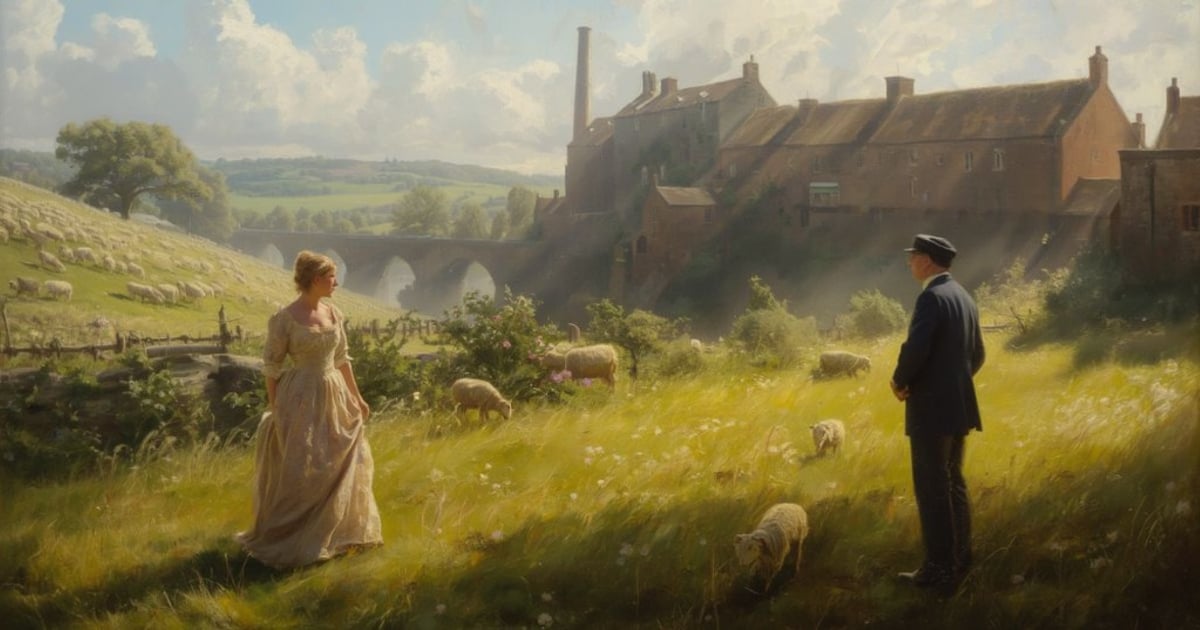
Margaret Hale sits in Mrs. Shaw's Harley Street drawing room while her cousin Edith dozes on the sofa, still wrapped in wedding talk about dresses, Corfu, pianos, and Scotland visits. Margaret has grown newly aware of Edith's beauty now that marriage will end their daily companionship. In the next room Mrs. Shaw hosts a farewell dinner for Edith's union with Captain Lennox, telling friends she wanted love over rank even as she recalls marrying the General without it. Margaret overhears talk of trousseau expense, Indian shawls, and social calculation that sounds less like romance than management. When Mrs. Shaw needs Edith's shawls, Margaret climbs to the old nursery, remembers her first lonely night in London nine years earlier, and returns to be used as a living mannequin while the shawls are displayed under the chandelier.
Henry Lennox, the groom's lawyer brother, arrives and mocks the fuss over finery. He draws Margaret into conversation about Helstone, where she will soon return with her parents. She says she would prefer a quiet summer wedding, a walk through trees to church, no crowded breakfast. He calls that stately simplicity suited to her, a label she resists because he often tries to define her character for her instead of listening.
Captain Lennox enters unexpectedly; Edith wakes and rushes to him. Mrs. Shaw begins planning her own Italian winter for health, a pleasure she presents as hardship. Henry watches the household with amused, slightly sarcastic attention while his handsome brother receives tea and praise. Margaret sees marriage treated as security and spectacle in both generations: Edith wants comfort, Mrs. Shaw wanted establishment, and Captain Lennox represents the conventional match she will accept with little real will of her own.
When Captain Lennox arrives ahead of schedule, Edith throws down her piano playing and rushes to him, leaving Margaret to face a roomful of bewildered guests with no explanation. Mrs. Shaw welcomes him in her characteristic plaintive style, already promoting the Italian winter her doctor has “prescribed”, a prescription she has clearly engineered herself. Henry Lennox watches the tableau from the chimney-piece with sardonic amusement, his intelligence turned outward onto everyone else’s compromises while his own developing interest in Margaret stays carefully unstated. Gaskell opens her novel by putting every major tension in the frame at once: performed sentiment, managed desire disguised as obligation, and one young woman who has not yet found the language for what she wants, or the freedom to claim it openly.
Margaret's discomfort in that London drawing room reveals something profound about human nature: we often absorb the values of whatever environment surrounds us, even when those values conflict with our authentic selves. In 1854, this meant pressure to marry strategically and value social position over personal fulfillment. Today, it might mean pursuing management roles we don't want because that's 'advancement,' or feeling ashamed of jobs that matter to us but don't impress others. The mechanism is identical, external voices gradually become internal voices until we're criticizing ourselves for not wanting what we're 'supposed' to want. Margaret's resistance to Henry's attempts to categorize and redirect her life shows the way forward: polite but firm boundaries around who gets to define your path. The most insidious part isn't outright pressure, it's the subtle message that your current choices aren't enough, that you should aspire to something 'better' according to someone else's scorecard. When you can recognize this pattern, you gain the power to ask: whose definition of the good life am I using? Your discomfort in certain environments isn't a character flaw, it's valuable intelligence about what doesn't fit your authentic self.
Explore this chapter with AI to uncover deeper meaning and practical takeaways.
AI Discussion