
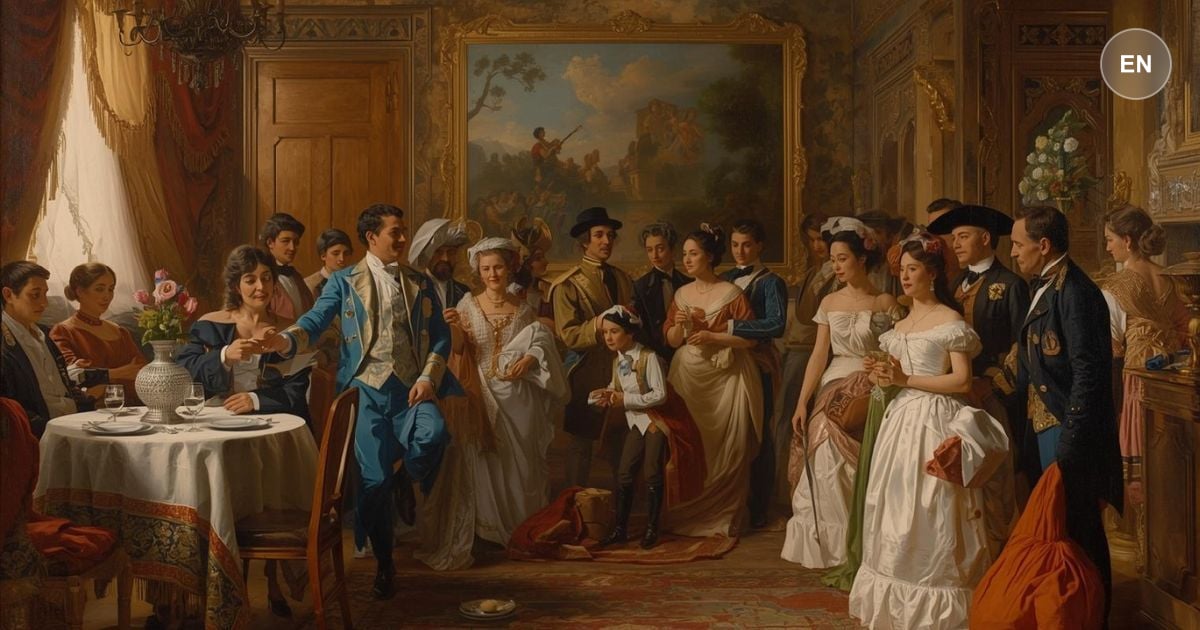
After the fiesta the town wakes poorer and headache-ridden yet vows to repeat the custom next year, because misery here is seasonal and pride is rented by the candle. Maria Clara lies ill while Capitan Tiago debates which miraculous cross deserves offerings, as if holiness were an auction and recovery a purchase rather than a daughter's breath returning in a room already crowded with friars' plans and Captain-General compliments still echoing in the sala while Andeng fans a mistress who may never choose her own husband.
Dr. Tiburcio de Espadaña arrives with Doña Victorina and young Linares: a fake physician married to a Filipina who spent decades chasing Spanish status, and a nephew sent from Madrid as Damaso's candidate groom. Rizal's flashback exposes Tiburcio as a failed customs clerk posing as doctor until authorities winked, and Victorina as a social climber who dominates her lame husband with false teeth and invented de's, bleaches and frizzes, scolds him for limping, and treats Spanish surnames like armor against ridicule she still hears in every glance while Tiburcio prescribes syrups and avoids patients who might die visibly, surviving because rich patients prefer hope in a bottle to truth in a diagnosis.
Linares is introduced to the sick girl as Damaso enters pale and subdued, already negotiating futures at a bedside where love is the only medicine no one will authorize. The chapter satirizes mutual delusion: prestige built on fraud, marriage as transaction, and healing reduced to syrup while real devotion waits outside the shuttered room where Maria Clara sweats through dreams of a fiancé her father may forbid her to name when the fever finally breaks and Linares learns to smile for an audience of friars and creditors, and Rizal shows how colonial society rewards performance over pulse, surname over skill, and friar matchmaking over a daughter's whispered name, the whole sickroom a marketplace where Tiago sells obedience by the dose and Victorina sells Europe by the syllable while Linares practises Madrid manners for a girl too ill to refuse or accept, and Damaso's shadow falls across the pillow like a second fever.
Rizal shows us something uncomfortable: sometimes society rewards elaborate pretense over genuine competence because the pretense serves institutional needs that competence can't meet. Doña Victorina's fake Spanish status and her husband's fake medical degree work because they provide what the colonial system requires - visible hierarchy and plausible authority. The community participates in the charade because challenging it would destabilize the social order everyone depends on. This pattern hasn't disappeared; it's evolved. Today we see it in corporate consultants with impressive presentations but no real expertise, in wellness influencers selling courses they're not qualified to teach, in politicians whose main qualification is looking the part. The mechanism remains the same: institutions need someone to blame when things go wrong, someone to validate decisions already made, someone to provide the appearance of expertise without the inconvenience of actual knowledge. The fake expert gets money and status, the institution gets cover and scapegoats, and everyone pretends not to notice the emperor's new clothes. But here's what Rizal understood that we often miss: these arrangements aren't just about individual greed or stupidity. They're systemic solutions to systemic problems. When institutions can't admit their real motivations, they hire people to perform fake motivations. When communities need hierarchy but lack legitimate authority figures, they'll accept illegitimate ones rather than face the chaos of admitting the system doesn't work. The question isn't whether these people deserve their positions - it's what needs are being met that competent people couldn't or wouldn't meet.
Explore this chapter with AI to uncover deeper meaning and practical takeaways.
AI Discussion