
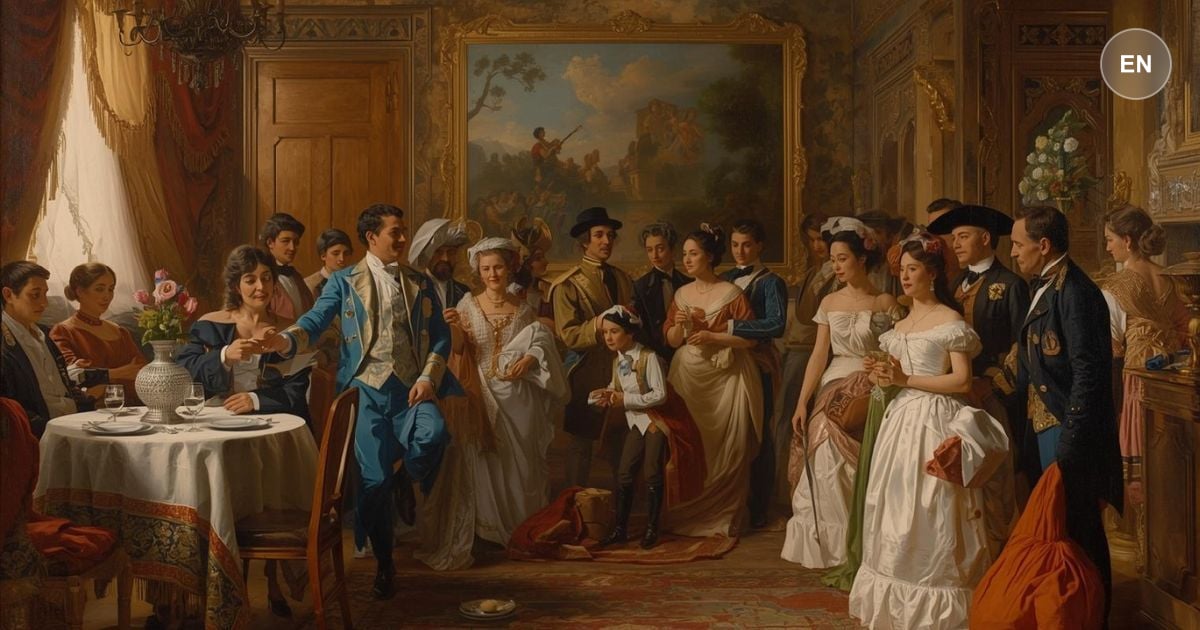
Early mass and sealed letters have left Padre Salvi sleepless, thin, and yellow since he changed bedrooms; his cook notes he touches barely two of six dishes. He sneaks into the picnic woods and spies on Maria Clara bathing with friends who joke about following someone unseen from a heron's nest, not knowing the curate listens from the branches. Then he joins the feast where officials debate missing sacristans as if boys were inventory, and where reform talk proceeds only because no one yet names what the priest did above the brook while servants lay out roasted chicken and wine as if innocence were a menu item served beside unspoken threats.
Sisa appears muttering about dark nights and vanished sons; Salvi drops his knife at her sight and she flees the alferez who once paraded her through town. Ibarra offers to place her under a physician and search for her sons while Salvi and the alferez trade sarcasm over stolen gold versus missing altar boys, each institution protecting its own story. The forest idyll is compromised: predators watch while heroes plan mercy, and a mad mother becomes the mirror no official wants to face at a table set for celebration.
Ibarra receives a telegram approving his school and legal suit; he announces the school as Maria Clara's gift and tears the paper with Sinang while reform feels briefly possible in open air. Salvi destroys the Wheel of Fortune book and Albino tells him it is a greater sin to dispose of what is not yours than to tell fortunes. Soldiers arrive seeking Elias the pilot; Ibarra refuses to account for guests and shields the man who saved him in the lake. Rizal pairs predatory clergy, institutional blame games, and reform hope in one afternoon where every grace is watched, every mercy has a witness, and the state hunts the laborer who made the hero look heroic. Even victory on paper cannot hide that the curate who tore a student's book still commands the moral vocabulary of the feast, and that Sisa's wandering mind will return whenever power needs a scapegoat.
Rizal exposes how institutions become both weapon and shield for corrupt individuals. Padre Salvi uses his religious authority as cover for voyeuristic behaviour, then weaponizes conflict with civil authorities to deflect from his own failures. This pattern transcends historical context. Modern workplaces, healthcare systems, and government agencies often protect corrupt actors who know how to manipulate institutional language and hierarchies. The mechanism is always the same: authority creates moral credibility ('who would suspect a priest?') and institutional protection ('I was following protocol'). When challenged, these figures redirect blame while wrapping themselves in organizational mission statements. The tragedy isn't just individual corruption, but how institutions enable it by prioritizing their own reputation over accountability. Genuine leaders like Ibarra operate transparently, share credit, and build something positive for their community. The contrast reveals that authentic authority serves others, while corrupt authority serves itself. Recognition becomes protection - when you can identify the pattern of predatory authority, you can predict their deflection tactics and navigate around their manipulation while protecting yourself and others.
Explore this chapter with AI to uncover deeper meaning and practical takeaways.
AI Discussion