
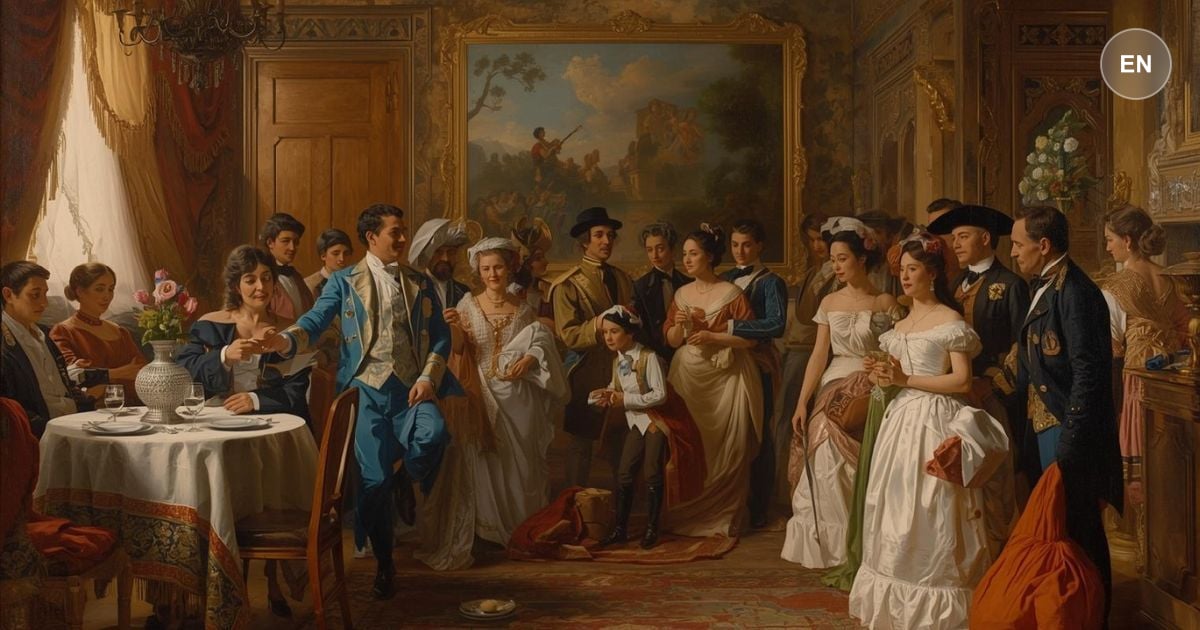
On the last of October Capitan Tiago announces a dinner at his house on Calle Anloague, and Manila's parasites, bores, and hangers-on rush to polish shoes and rehearse familiar greetings. The house fronts the Binondo arm of the Pasig. Upstairs, a caida set as dining-room hangs paintings of Purgatory, Hell, and the Last Judgment beside a glass case of Our Lady of Antipolo visiting a sick woman who already looks like a corpse. In the sala, guests split by gender as in church. Cadets gossip in a corner. Two foreigners in white pace like bored passengers. The host is nowhere to be seen.
The evening's tension gathers around a small table of sherry and biscuits: Fray Damaso, Fray Sibyla, Señor Laruja, a young traveller four days in the country, and a lieutenant who listens with growing anger. Damaso brags of twenty-three years of bananas and morisqueta, claims he knew every sin in San Diego, and calls Filipinos naturally indolent when the newcomer links that charge to the colonial system itself. Laruja backs him. Sibyla then asks, almost idly, why Damaso left San Diego after twenty years. The Franciscan's laugh dies. The lieutenant tells what the room already knows: while Damaso was away, his coadjutor buried Don Rafael Ibarra, a worthy man who never went to confession; Damaso had the corpse dug up and taken from the cemetery; the Governor-General punished him with a transfer to a better town.
Damaso answers that no king may override a priest who expels a heretic, and names friars who once dragged a governor down a staircase. The lieutenant warns he will report the insult to the Captain-General. Sibyla tries to smother the scandal in distinctions between words spoken ab irato and in corde, but the soldier walks off, and Damaso fumes over lost letters and furniture. Doctor Espadaña and Doña Victorina take seats. The traveler still has not been introduced to the host, and the table argues whether gunpowder was invented by a Franciscan or a Dominican, and in which century. Doña Victorina asks if the fourteenth century was before or after Christ. Two people enter the room.
Rizal wrote this scene in 1887, but walk into any workplace today and you'll find Fray Damaso's descendants. They're the supervisors who humiliate staff while claiming it builds character. The family members who control others while insisting they're just protective. The politicians who cut services while talking about fiscal responsibility. The pattern is sacred masking: wrapping cruel behaviour in noble language to create moral immunity. When someone claims to act for God, country, or the greater good, they become untouchable. Who wants to argue against serving God? The higher the claimed purpose, the more protected the person becomes. They stop seeing their own actions clearly because they're blinded by their righteous mission. The mechanism works because we're trained to respect noble intentions, even when the results are terrible. We debate their motives instead of examining their impact. But here's the key insight from Rizal: ignore the mask, measure the results. Damaso claims to serve God but creates hatred and division. Your controlling supervisor claims patient safety but drives away good nurses. The test isn't what they say they're doing - it's what actually happens. When you can spot sacred masking, you stop getting trapped in arguments about intentions and start focusing on outcomes. That's how you protect yourself and others from people who weaponize good intentions.
Explore this chapter with AI to uncover deeper meaning and practical takeaways.
AI Discussion