
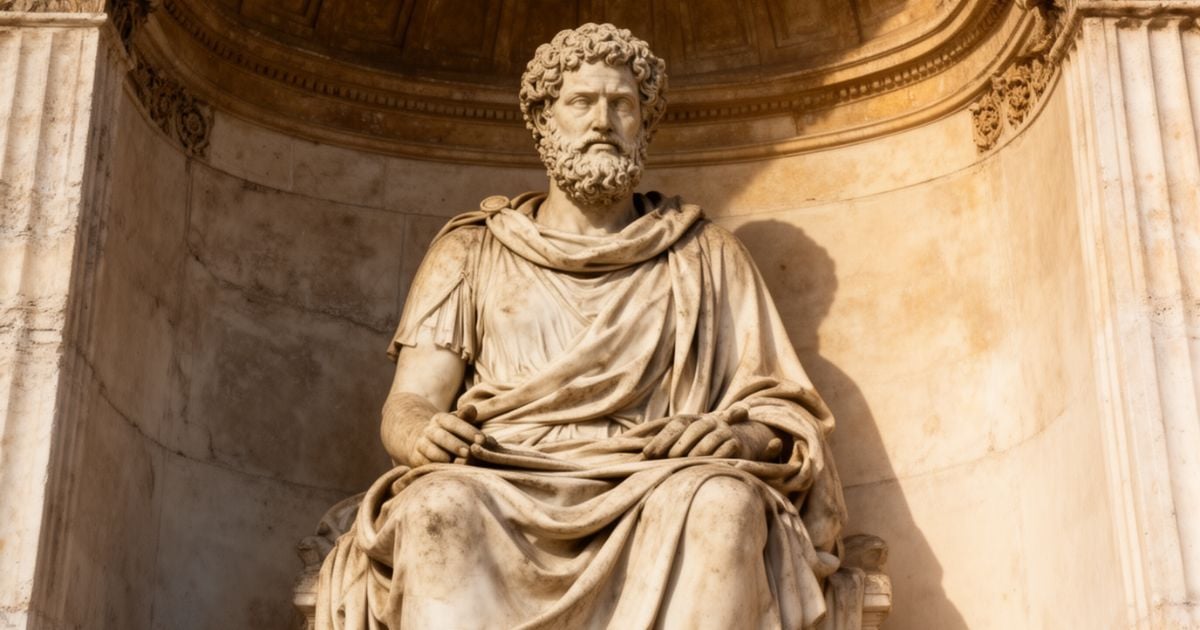
Marcus opens Book VIII by puncturing vainglory. He cannot claim the praise due a philosopher who lived that life from youth; empire and his own compromises have made the title hard to recover, and his office repels it anyway. If he truly grasps what matters, he should stop chasing fame and let whatever life remains, long or short, suffice if he lives as nature requires. He has already wandered through syllogisms, wealth, honour, and pleasure without finding happiness there. True good is what makes a man just, temperate, courageous, liberal; true evil is what produces the contrary. Before each action he must ask how he will regard it when done, and whether he will repent; Africanus and Augustus are fading names already.
Diogenes, Heraclitus, and Socrates penetrated causes; Alexander, Caius, and Pompey remained slaves to the extent of their error. People will keep doing what their opinions dictate though you hang yourself; do not be diverted from speaking justly and kindly without hypocrisy. Nature transfers matter without novelty; reasonable nature speeds when it refuses false fancies, aims only at the common good, and gladly embraces what the whole appoints. No time to read? There is still time not to wrong yourself, to master pleasure and pain, to contemn vainglory, and to care for the unthankful. Stop complaining about court trouble in public or private. Repentance belongs to neglected good, never to missed carnal pleasure. Examine every object for substance, use, and duration. Wake for common good, not unreasonable sleep only. At first encounter ask what a man thinks good or evil; then fig trees bear figs and acts will not surprise you. To change your mind when shown better is as ingenuous as finding truth alone.
Death changes form within the world; elements murmur not at change. Fame and body are bubble and candle; Lucilla buried Verus and was buried in turn, and Augustus's whole court died like any one man. Bathing is oil, sweat, filth, and mixed excrements; such almost is every worldly part. Contract life to one fitting action; if outward hindrance blocks it, accept another fitting action in its place. Receive blessings without clinging when fate takes them back. Cut off from unity by offense or uncharitableness, you may rejoin; the universe turns obstacles to its ends. Only the present truly troubles you, and briefly if circumscribed. Pain need not shame the governing mind if opinion stays out. Hold first apprehensions bare: he spoke ill is reported, hurt is added opinion. Bitter cucumber? Set it away. Under curse, mind stays clear as a fountain. Throw me where you will; the spirit within stays content. Unconquerable mind seeks only not to be forced; wickedness hurts the wrongdoer most. All men are made for one another: teach them better or bear with them. Rational light extends through obstacles without shattering. Do not fear death as loss of sense or as change of life.
Book VIII opens with vainglory punctured. Marcus knows others know he has lived beneath his stated ideals. That admission is not self-destruction; it is clearance work. If the philosopher title is already gone, what remains is the only question worth asking: how will the rest of the life be lived?
Michael's hospital version is familiar. Executives publish values statements, then make compromises they hope no one tracks. When exposure comes, the reflex is either spin or collapse. Marcus offers a third move: inventory, pre-action testing, first apprehensions, alternate fitting action when blocked.
The closing social rule is blunt. All men are made for one another: teach them better or bear with them. That is not softness. It is how a mind stays usable inside power without turning every injury into identity.
Explore this chapter with AI to uncover deeper meaning and practical takeaways.
AI Discussion