
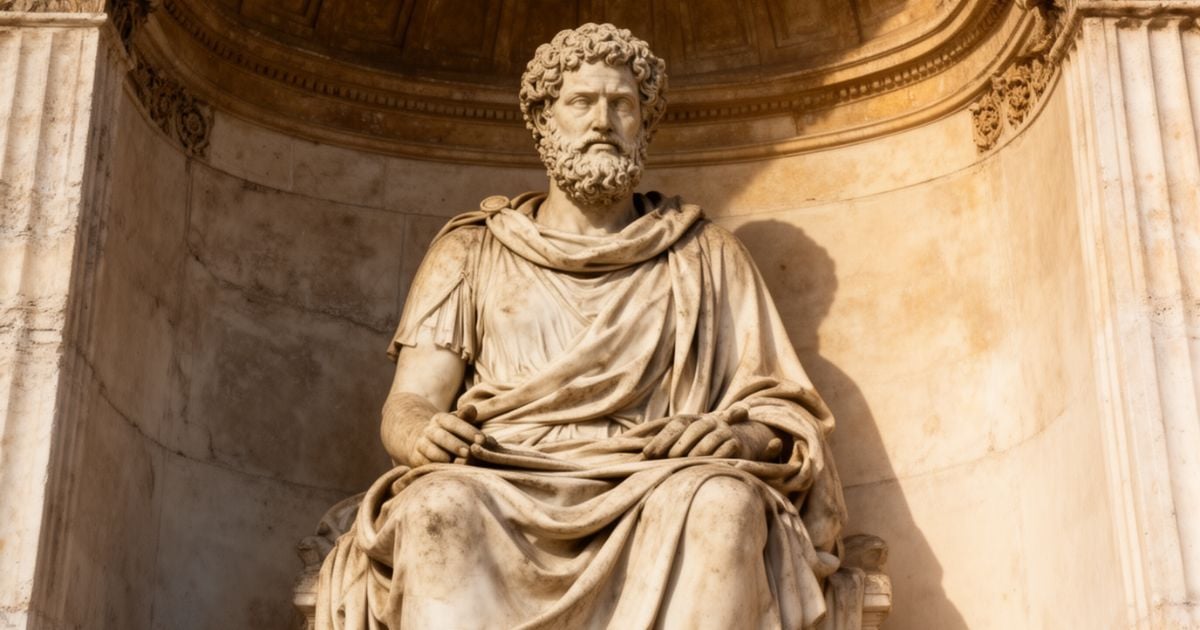
Your mind has an expiration date separate from your body. Marcus confronts himself with a second urgency beyond death: the intellect that lets you judge rightly may fail before you die, so stop deferring the inner work. He trains the eye next: cracks in baked bread, wrinkling figs, a lion's brow, aging itself can be beautiful when you see how nature actually finishes things.
Mortality is democratic. Hippocrates healed others and died sick. Alexander, Pompey, and Caesar conquered towns and still surrendered their lives. Heraclitus wrote on cosmic fire and drowned in mud; lice killed Democritus; wicked men killed Socrates. You took the voyage; go ashore. Either there are gods elsewhere, or sense ends and the body ceases to master you.
Marcus turns to mental discipline. Do not burn your days tracing what others do, say, or intend unless public good requires it. Practice thoughts you could answer aloud without shame. Choose the rational soul over applause, riches, or pleasure; nothing is profitable if it costs faith, modesty, or truth. Ask of every temptation what virtue the moment requires. Analyse each object plainly: what is it, what is its use, what is your share as a citizen of the universe? He refuses the deferred life: you will not read the commentaries you stacked for old age. Hasten. Keep dogmata ready like a physician's tools. The good man embraces what happens, obeys the god within, speaks truth, does justice, and stays ready to depart without anger at unbelievers.
Marcus was emperor when he wrote about not wasting mental energy on what others think. This was not because he was above human nature. He understood that your mind is your most valuable and limited resource. Every minute spent wondering what someone meant or why they looked at you that way is a minute not spent on problems you can solve. The pattern shows up everywhere in working life: the supervisor who reads mood instead of metrics, the clinician who replays a difficult handoff instead of sleeping, the leader who knows every rumour but not their own priorities. Culture encourages this waste. Gossip feels productive. Speculation masquerades as intelligence. Marcus names the hidden cost: while you read minds badly, real work accumulates and opportunities slip. The closing move is not isolation. It is disciplined focus so you can actually be useful to others.
Explore this chapter with AI to uncover deeper meaning and practical takeaways.
AI Discussion