
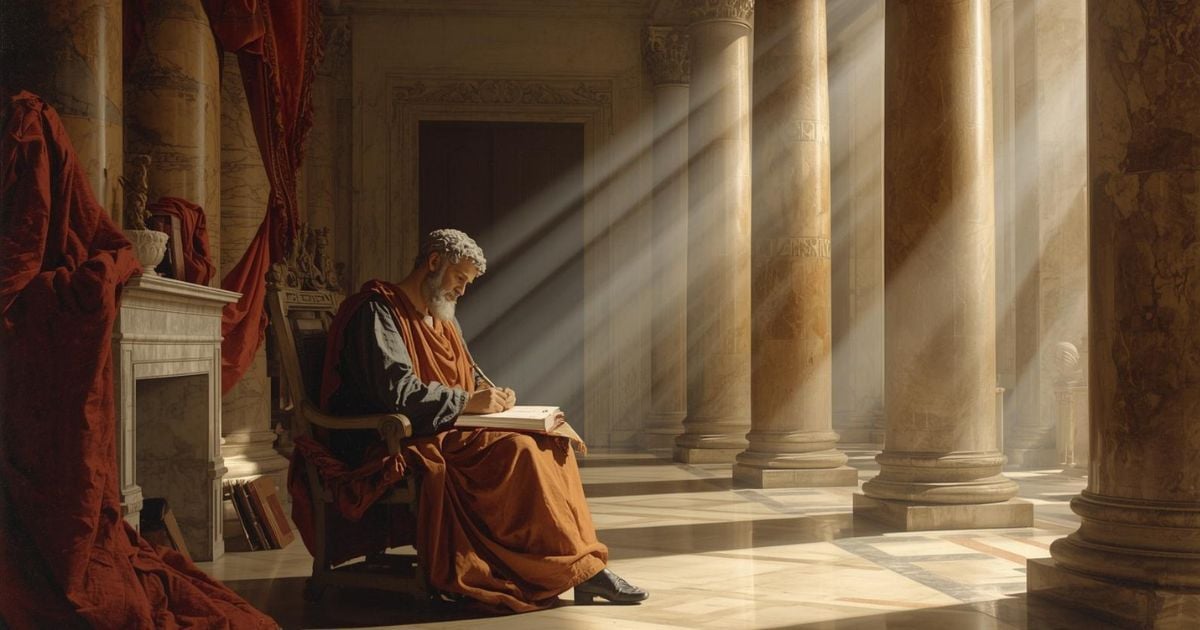
You are more visible than you think. Letter 43 opens with Seneca telling Lucilius that his private thoughts have already begun to circulate, not because he is famous, but because in any given place, whoever rises above the ordinary level becomes remarkable to those around them. A ship that looks large in a river looks small at sea. Greatness is relative to its context. In your province, you are being watched.
This isn't cause for anxiety, it's cause for consistency. Seneca's instruction isn't to perform virtue for the watching eyes, but to live in a way that needs no concealment. Doors and walls protect us, he observes, but we increasingly use them not for safety but for secrecy. It is our conscience, not our pride, that has put doorkeepers at our doors.
We live in such a way that being suddenly seen is equivalent to being caught. His final test: a good conscience welcomes the crowd. A bad conscience, even in solitude, is disturbed and troubled. If your deeds are honourable, let everyone know them.
If they are base, what does it matter that no one else knows, when you yourself know? How wretched, to despise that witness.
Seneca wrote about fame being relative to your environment—you're a big fish in a small pond until you swim to the ocean. This hits differently in working-class communities where everyone knows everyone. Get promoted at the plant, and suddenly your grocery shopping becomes neighbourhood news. Your kid makes varsity, and parents start comparing their children to yours. Move to a nicer street, and former neighbours wonder if you think you're better than them now. The visibility can feel suffocating, but Seneca's insight cuts deeper: the discomfort isn't really about being watched—it's about what the watching reveals about our own insecurities and choices. When we live authentically, scrutiny becomes accountability that keeps us grounded. When we're performing or hiding, every glance feels like judgment. The factory worker who got clean doesn't hide from former drinking buddies because he's ashamed—he's open about his journey because it might help someone else. The single mom who went back to school doesn't downplay her degree because others dropped out—she celebrates it while staying connected to her roots. The key is learning to separate healthy privacy (protecting your energy and boundaries) from toxic secrecy (hiding choices you can't defend). Your community's attention isn't punishment—it's a mirror reflecting whether you're living with integrity or just getting by.
Explore this chapter with AI to uncover deeper meaning and practical takeaways.
AI Discussion