
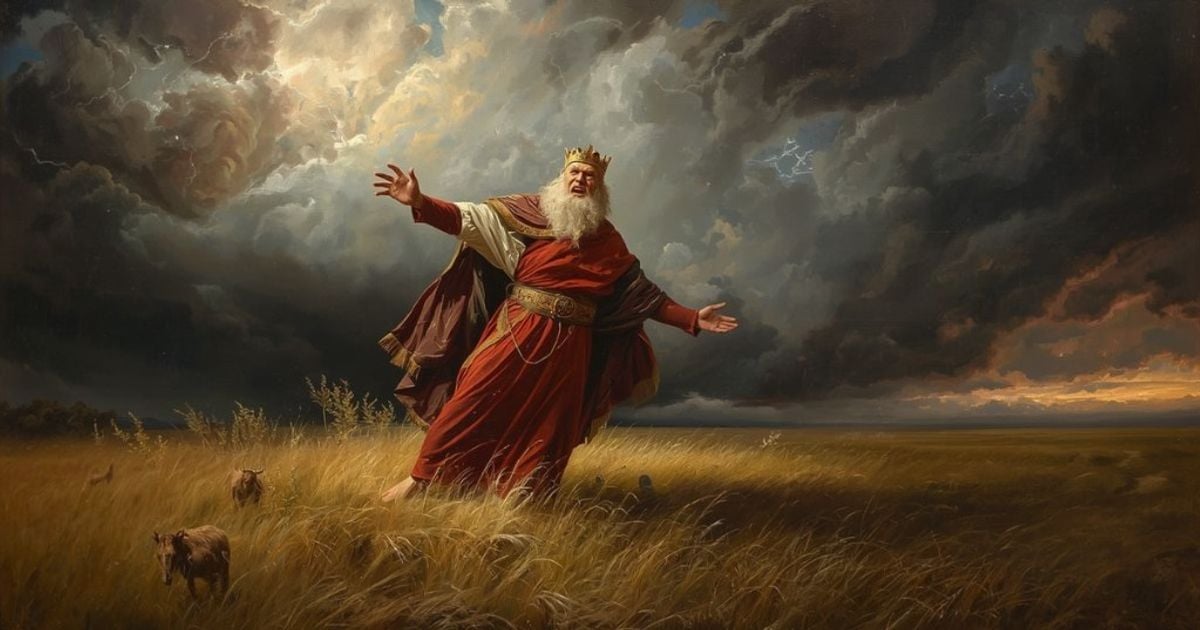
Lear reaches the hovel and refuses to go in. Kent urges him; Lear explains why the storm does not register the way it should. "Where the greater malady is fix'd, the lesser is scarce felt": the tempest in his mind has taken over all other sensation. He stops himself mid-thought: "O, that way madness lies; let me shun that; no more of that."
He sends the Fool in ahead of him, then pauses to pray. What comes out is unexpected. Standing in the storm, he thinks for the first time about people who always stand in the storm: the "poor naked wretches" with their "houseless heads and unfed sides" and "loop'd and window'd raggedness." "O, I have ta'en too little care of this," he says. It is a confession with no audience. No one is listening. He has simply, for the first time, thought about someone other than himself.
Then Edgar erupts from the hovel crying "Poor Tom!" The Fool runs out in terror. Lear looks at the filthy, half-naked, apparently mad figure before him and immediately concludes: his daughters must have done this. "What, have his daughters brought him to this pass? Couldst thou save nothing?" Kent tells him the man has no daughters. Lear will not believe it. "Nothing could have subdu'd nature to such a lowness but his unkind daughters."
Edgar's performance as Poor Tom is brilliant sustained chaos, ravings about fiends, confessions of past vice, scraps of folk rhyme. But it stops Lear cold. Looking at this "unaccommodated" man, owing nothing to silk or wool or perfume, stripped entirely of the social coating: Lear asks: "Is man no more than this?" Then: "Thou art the thing itself: unaccommodated man is no more but such a poor, bare, forked animal as thou art." He begins tearing off his own clothes.
Gloucester arrives with a torch and offers shelter. Lear barely notices him. He wants to speak with his "philosopher", Edgar, and ask him the cause of thunder. Kent observes to Gloucester: "His wits begin t'unsettle." Gloucester, not recognising his own son standing in the torchlight, says quietly: "The grief hath craz'd my wits."
Lear goes in at last, but only if his philosopher comes too. "Come, good Athenian."
King Lear's storm scene forces us to examine an uncomfortable truth: sometimes people only develop empathy after losing the privileges that protected them from others' pain. Lear rules for decades without truly understanding his subjects' suffering. Only when stripped of royal comfort does he think about 'poor naked wretches' enduring storms by necessity, not choice. This raises difficult questions about human nature and social responsibility. Are we inherently limited by our circumstances, unable to truly understand experiences we haven't lived? Or do we choose comfortable blindness because acknowledging others' pain might demand action or sacrifice? Shakespeare suggests both. Lear's transformation is genuine, but it required complete personal devastation. In our own lives, we see this pattern repeatedly. The manager who never understood work-life balance until their own family crisis. The healthy person who dismisses medical concerns until facing their own diagnosis. The financially secure individual who minimizes poverty until economic hardship hits home. Yet some people do develop empathy without personal catastrophe. They listen to others' stories, volunteer in different communities, or deliberately expose themselves to unfamiliar perspectives. The question becomes: must we wait for our own storms to teach us compassion, or can we learn to see clearly while we still have shelter?
Explore this chapter with AI to uncover deeper meaning and practical takeaways.
AI Discussion