
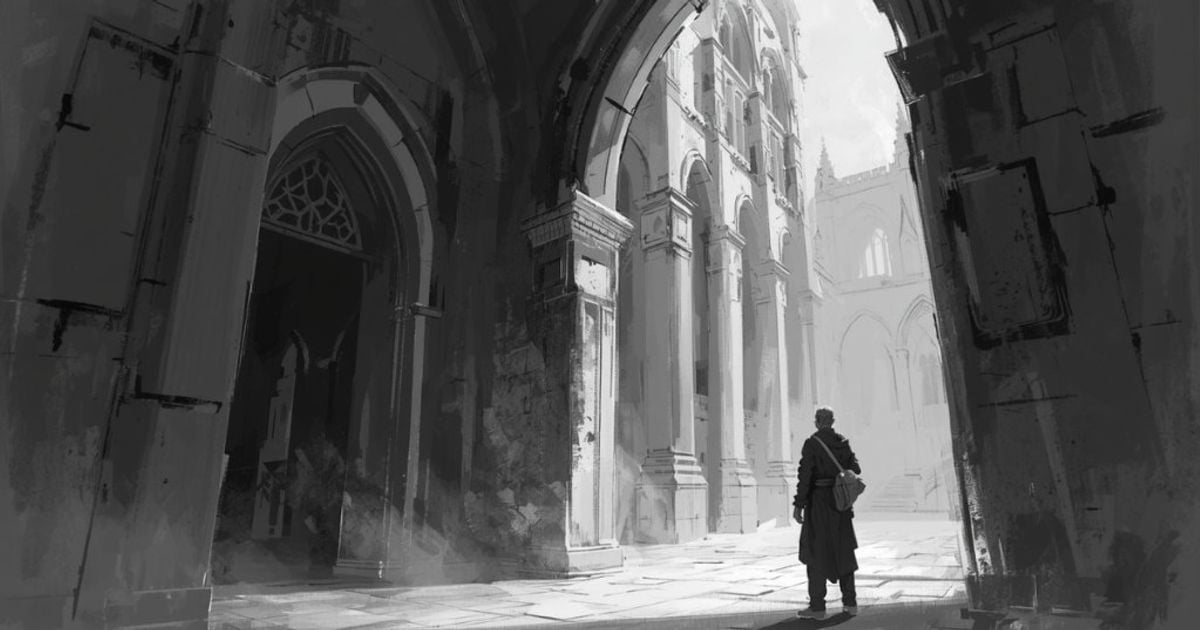
On a warm Saturday, nineteen-year-old Jude walks home from Alfredston with his tools at his back and Latin running in his head. He inventories what he has learned: two books of the Iliad, Euclid through Book Twelve, the Greek Testament, a little Hebrew, the Church Fathers. Christminster looks a year or two away. The reverie climbs higher: D.D., then archdeacon, perhaps a bishop who would give away four-fifths of his income. Twice, laughter comes from behind a hedge. He does not hear it.
A piece of pig offal hits him on the ear and lands at his feet. Three young women are washing entrails in the brook. The boldest, Arabella Donn, meets his eye. He retrieves the offal and crosses to her on a plank above the stream. She works two dimples into her cheeks by a small suction he does not notice. A wordless flash of recognition passes between them that he takes for instinct, not a decision. She gives her name, says nobody is courting her, and that she might be free on Sunday.
He agrees to call. For one clear moment he sees that she does not fit the life he has been building, the way an inscription shows in a falling lamp and then goes dark. On the far bank her friend Anny tells the others the colder sum: he is as simple as a child, has never looked at a woman before, and is to be had by any woman who sets herself to catch him the right way.
The pig offal is the novel's hinge. Everything before it is Jude building toward something; everything after is Jude being deflected from it. Hardy makes the interruption physical and ridiculous on purpose: not a letter from Christminster, not a mentor on the road, but a scrap of pig intestine thrown by a girl washing chitterlings in a brook. The smallness of the inciting incident is proportional to the enormity of what follows.
Explore this chapter with AI to uncover deeper meaning and practical takeaways.
AI Discussion