
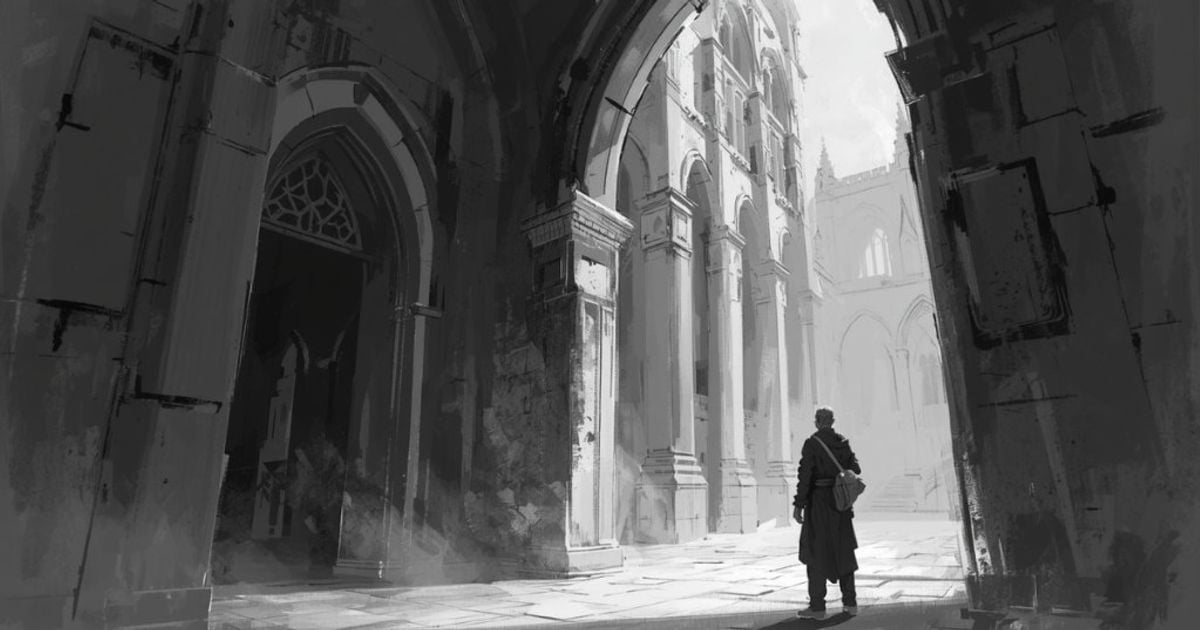
Shaston sits on a scarp above Blackmoor, a town of vanished abbey and living vans. Jude climbs to it for the first time and arrives too early. The children hum like gnats. He waits among the abbey gardens, then waits too long: Sue has gone into town at the heels of the last scholar, Phillotson being at Shottsford. In the empty schoolroom he finds the old Marygreen piano and modulates into last week's hymn.
A small hand settles on his bass notes. Don't stop, she says; they played it at the training school. Their hands meet as before her marriage. She calls Old-Grove Place antique and dismal: previous lives crush her there. The spirit-lamp kettle is one of his wedding-presents and sings with satire. A second silent conversation runs under talk of apocryphal gospels. When she offers to visit his church he says no, then that he will not be kind, then that she is a flirt. She flushes, packs him off, and from the high casement names him Joseph, Don Quixote, and Saint Stephen. The social moulds, she says, fit actual shapes no better than constellation drawings fit the stars. She is called Mrs. Richard Phillotson and is not.
He misses the coach. In the dark he finds Old-Grove Place and sees her, hat still on, press a photograph to her bosom and shut the shutter with a tearful face. Whose photograph, he asks the road. He knows he will go again. The saints would have shunned the house. He might fast the whole interval. The human is more powerful in him than the Divine.
Hardy sets Sue's story in Shaston, an ancient town where 'the weight of so many previous lives' literally depresses her. This isn't just atmospheric—it's a precise diagnosis of how accumulated expectations can create false imprisonment. Sue feels trapped not by bars or chains, but by the accumulated weight of social expectations, family obligations, and her own past choices. The house she lives in, the role she plays, the marriage she's in—all feel inevitable because they're built on layers of previous decisions and other people's stories about who she should be. This pattern shows up everywhere in working-class life. Children of immigrants carry the weight of sacrifice stories: 'Your parents gave up everything for you.' First-generation college graduates feel obligated to certain career paths because 'you represent the whole family now.' Women stay in relationships because they've already announced the engagement, planned the wedding, told everyone it's working. The weight isn't real—it's psychological—but it feels absolutely binding. The key insight is recognising when you're living under the weight of accumulated expectations rather than making choices based on present reality. Most of what feels like obligation is actually inherited story. The question becomes: whose life are you actually living?
Explore this chapter with AI to uncover deeper meaning and practical takeaways.
AI Discussion