
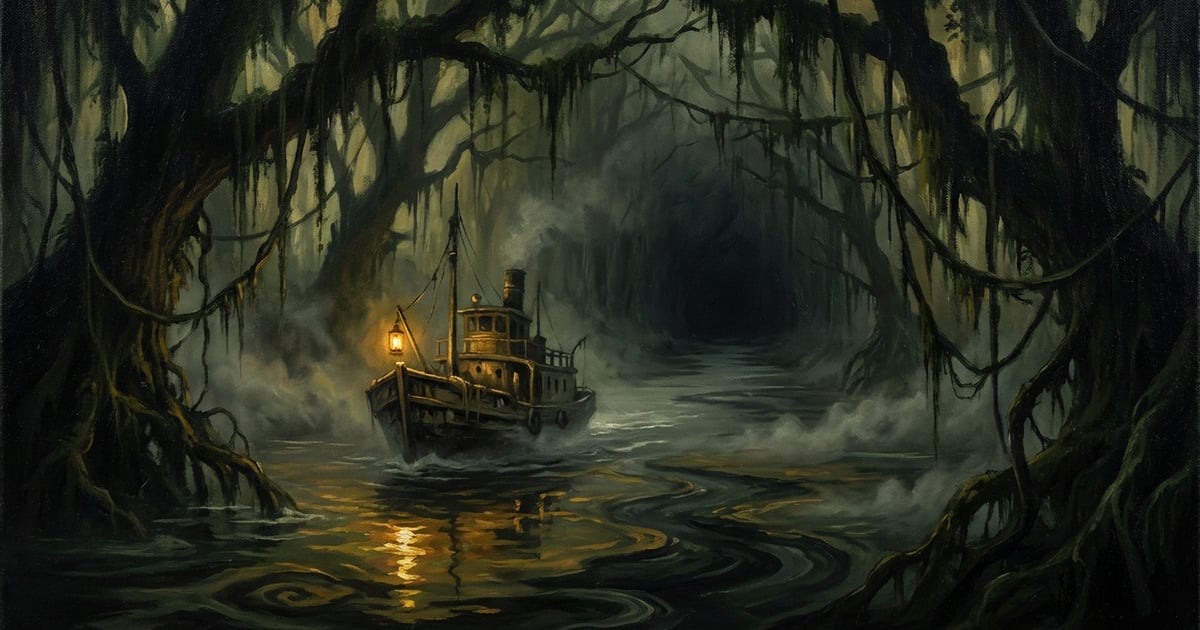
The Russian stands on the bank in motley, as if he had left a troupe of mimes, and Marlow cannot see how such a person stayed alive this far up the river. The young man says he went a little farther, then a little farther again, until he no longer knows how he will get back. He is glad he managed it. Near the house, heads are turned on posts to face the dwelling. The Russian calls them the heads of rebels. The word lets him keep Kurtz as a man worth following. He also says Kurtz once wanted to shoot him over a small lot of ivory a village chief had given him. He handed the ivory over and left, and he does not judge Kurtz for the threat. When Marlow gets close enough, through the glass, to speak to Kurtz, he finds a man hollow at the core. The head seems to jump back out of reach. The Russian, who admires him, is crestfallen at the distance. A woman in brass fittings walks to the water and looks at the steamer without the face of someone waiting to be rescued. The station is not asking to be saved. It has a ceremony, a household, and a name for the dead that keeps the living man clean.
Kurtz is carried out too ill to stand. The manager's complaint is not the heads and not the waste. It is that the method was unsound, that the district will be closed, and that the trade will suffer. Marlow answers that there was no method at all. The manager takes the murmur as agreement and is pleased to have been proved right. The ivory is loaded anyway. That night Kurtz leaves the cabin and crawls towards the camp fires on all fours. Marlow goes after him in the grass. Kurtz talks of immense plans and of a return he still means to make. Marlow does not win him with a speech about duty. He talks him back because the alternative is to lose the voice he came up the river to hear. He has already made what he calls a choice of nightmares. He had turned towards the wilderness, not towards a man he thought was as good as buried. Faced with the manager's version of work, he finds he would rather stay with Kurtz's nightmare, because at least that one can still speak. On the way down Kurtz cries out that he will wring the heart of the wilderness yet. A breakdown on the river is what first shakes that confidence. On board, the same voice keeps producing elevated sentences about his Intended, his career, his ideas, while the man saying them is already hollow. His last words are not a conversion and not a programme. He says, The horror, twice. Marlow is left with a sentence that judges something and will not say what. He will not turn it into a line the Company can file.
Kurtz is buried in a muddy hole. Marlow nearly dies on the way down, and he carries what is left of Kurtz as a loyalty he does not fully understand. In the sepulchral city a cousin cannot say what Kurtz was, except that he was a universal genius, a painter who wrote for the papers or a journalist who could paint. A man from the Company wants papers and talks of justice. Marlow gives the report to a journalist and tears off the forgotten line about extermination, so the altruistic pages can travel without the note. What none of these visitors can use is the sentence Kurtz actually ended on. One visit remains. The Intended receives him in black, in a room where a grand piano sits like a pale sarcophagus. She says no one knew Kurtz as she did. She knew him best. With every word the room grows darker, and only her forehead stays lit by belief. She asks for his last word. Marlow, who has said he hates a lie because it tastes of mortality, tells her the last word was her name. He could not say the other thing. It would have been too dark altogether. She keeps a grief that fits the world she already lives in. He keeps the grove, the heads, and the note out of that room.
The telling ends where it began. Marlow sits on the Nellie like a Buddha who has finished preaching, and for a moment nobody moves. The Director says they have lost the first of the ebb. The narrator looks up. A black bank of cloud bars the offing, and the river that leads to the uttermost ends of the earth runs sombre under it, into the heart of an immense darkness. The listeners have the story the Intended does not. The tide they were waiting for has already begun to go.
Conrad wrote Heart of Darkness during the height of European colonialism, when entire nations justified brutal exploitation as 'civilising missions.' The same psychological mechanism operates today in corporate environments, healthcare systems, and government agencies where good people find themselves implementing harmful policies. The African crew members in this chapter face an impossible choice: follow company orders that starve them, or revolt and lose everything. They choose restraint, maintaining their dignity while serving a system that dehumanizes them. This mirrors modern workers who know their company's practices hurt customers or communities but need the paycheck. The Russian trader represents another response—complete identification with power, even when that power is destructive. He's like the middle manager who adopts corporate language so completely they forget their original values. The locals attacking the boat aren't savage—they're protecting someone they believe represents their interests against a system that doesn't. Today's version might be a community fighting a plant closure or patients defending a doctor against hospital administration. Conrad shows us that the problem isn't individual moral failure—it's systems that force impossible choices. The question becomes: how do you maintain your humanity while navigating institutions that don't recognise it?
Explore this chapter with AI to uncover deeper meaning and practical takeaways.
AI Discussion