
Marlow is lying on the deck of his steamer when the manager and his uncle walk the bank and talk as if no one else were there. They are not arranging a rescue. Kurtz sends in as much ivory as the other agents together, he will not take orders, and they would rather the climate or a fever removed him. The uncle has arrived with the Eldorado expedition. They agree the wilderness can remove Kurtz for them, so they never have to give the order. Marlow, half asleep, hears how little either man needs to do if he waits. The station can keep its routine. The river can do the rest. He is still the captain of a boat that is not yet afloat, listening to the men who will ride in it decide that the most useful outcome is a death they will not have to order.
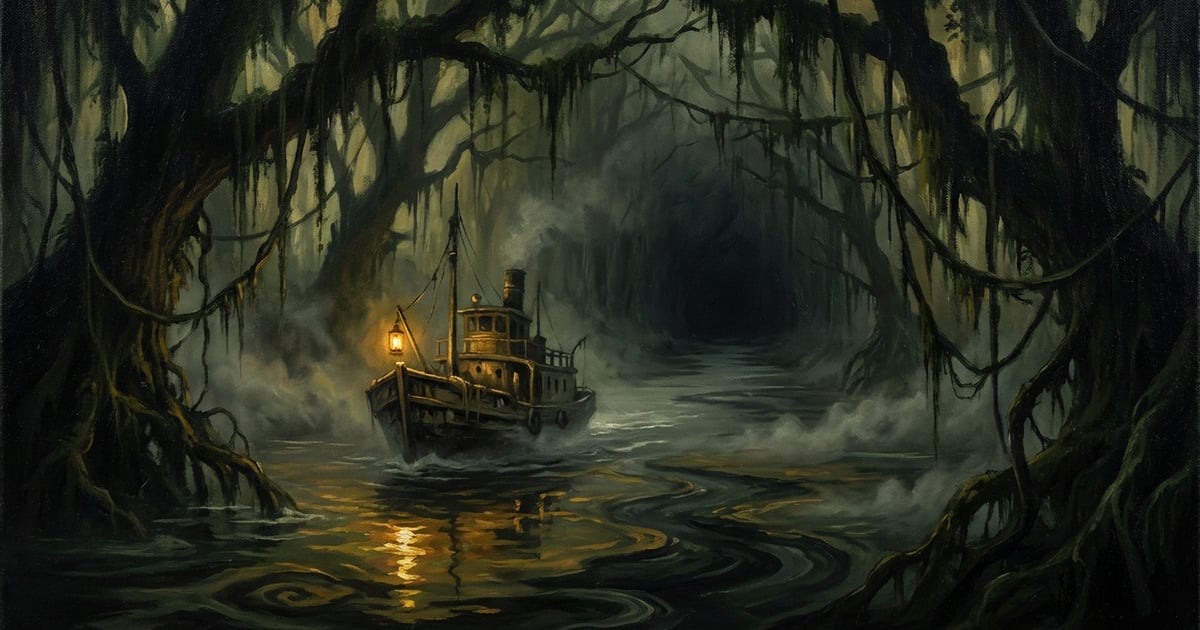
When the repair is done, the steamer goes up a channel so narrow that the boat feels like a beetle crawling on the floor of a high portico. Wooded islands turn the water into a maze of shoals. Marlow butts the hull against snags until the past he came from seems to belong to another life. He has taken on a crew along the way, men the pilgrims are happy to call cannibals and then to employ. They brought hippo meat, and it goes rotten, and the smell of it stays with him. For weeks they grow hungrier, and they watch the manager and the pilgrims eat, and they do not turn on the passengers. The hunger is not a secret. Marlow is grateful to them. They are men he can work with, and they do not turn on one another in front of him. The fact that hunger produces no attack is the part he cannot file under the Company's language. Marlow finds he cannot name what is holding them. He runs through superstition, disgust, patience, fear, and some kind of honour, and none of those words survive an empty stomach. The manager's kind of restraint was a hope that fever would remove a rival. The crew's restraint is a fact Marlow can see and cannot explain. A white fog then settles and stands like a wall. When it lifts, a cry and a flight of arrows come out of the bank. The pilgrims empty their rifles into the bush. Marlow's helmsman is killed at the wheel. Marlow throws one shoe, wet with that man's blood, over the side, and the disgust shows him what he has been travelling towards. He had never pictured Kurtz doing a job. He had pictured him talking. A conversation is what the ruined boat, the wait, and the fog have been for.
Before the station there is a ruined hut, and in it a book sixty years old on the breaking strain of ships' chains, with notes in the margin that look like cipher. Marlow handles the manual as if it might fall apart. On a river that feels like the earliest beginnings of the world, somebody has still been measuring a job. He does not yet know the notes were written by the young man ahead. The papers that travel with Kurtz's name are a different kind of measurement. There is a report for the International Society for the Suppression of Savage Customs, page after page appealing to every altruistic sentiment, and a last line Kurtz later forgets he wrote: Exterminate all the brutes. He will ask Marlow to take good care of the pamphlet and will not mention the note. All Europe, Marlow says, contributed to the making of him. The phrases that stick are possessives. My Intended, my ivory, my station, my river. The report can be shown to a society. The note is what he does when the sentence runs out.
The Inner Station, when the steamer reaches it, does not look like a rescue. A young Russian in patched brown clothes, bright scraps sewn on like a harlequin, comes down to the bank. He has gone farther up than the Company sent anyone, and he is proud of the distance rather than eager to be taken home. He had trouble keeping people off the steamer. Marlow asks if they meant to kill him. No, the Russian says. They do not want Kurtz to go. Then he opens his arms and tells Marlow that this man has enlarged his mind. The manager's plan was to let the climate finish a rival. The man waiting at the station has a follower who wants the rival to stay. Kurtz is no longer a name in another agent's mouth. He is a person other people have already arranged their lives around, and the steamer is alongside. Marlow has not yet stepped ashore to meet him.
Conrad wrote Heart of Darkness during the height of European colonialism, when entire nations justified brutal exploitation as 'civilising missions.' The same psychological mechanism operates today in corporate environments, healthcare systems, and government agencies where good people find themselves implementing harmful policies. The African crew members in this chapter face an impossible choice: follow company orders that starve them, or revolt and lose everything. They choose restraint, maintaining their dignity while serving a system that dehumanizes them. This mirrors modern workers who know their company's practices hurt customers or communities but need the paycheck. The Russian trader represents another response—complete identification with power, even when that power is destructive. He's like the middle manager who adopts corporate language so completely they forget their original values. The locals attacking the boat aren't savage—they're protecting someone they believe represents their interests against a system that doesn't. Today's version might be a community fighting a plant closure or patients defending a doctor against hospital administration. Conrad shows us that the problem isn't individual moral failure—it's systems that force impossible choices. The question becomes: how do you maintain your humanity while navigating institutions that don't recognise it?
Explore this chapter with AI to uncover deeper meaning and practical takeaways.
AI Discussion