
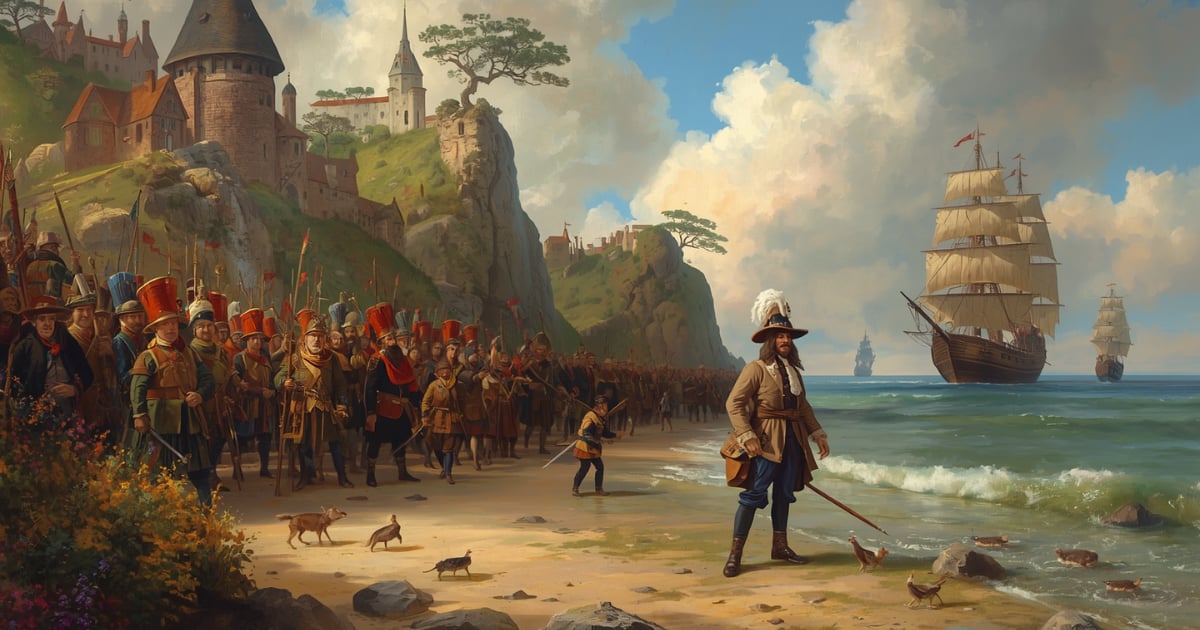
Gulliver closes his Struldbrug digression and turns homeward. The king of Luggnagg, unable to keep him at court, grants licence to depart with a letter to the Emperor of Japan, four hundred and forty, four gold pieces, and a red diamond he will sell in England for eleven hundred pounds. On 6 May 1709 he sails for Japan. At Xamoschi and Yedo he presents the seal: a king lifting a lame beggar.
Posing as a Dutch merchant shipwrecked into Luggnagg, he asks safe conduct to Nangasac and begs exemption from trampling the crucifix imposed on Hollanders, for the sake of his patron. The Emperor, surprised but willing to gratify Luggnagg, grants passage by forgetfulness and warns that Dutch countrymen would cut his throat if they learned the secret. At Nangasac he joins the Amboyna of Amsterdam, invents Gelderland parents, passes as a surgeon for half fare, and evades crew questions until a malicious skipper is bambooed by an officer instructed to let him pass.
The voyage reaches Amsterdam on 10 April 1710, then England. On 16 April he lands at the Downs, goes straight to Redriff at two in the afternoon, and finds his wife and family in good health after five years and six months away. Part IV waits beyond the threshold.
Gulliver's crisis in Japan forces a question every working person faces: How do you maintain your values when the system demands compromise? Swift wasn't just telling a travel story, he was exploring how ordinary people survive in environments designed to break them. The crucifix scene reveals something crucial about power: it often tests loyalty through humiliation, demanding you betray something sacred to prove your submission. But Gulliver's solution shows there's usually a third option between martyrdom and sellout. He doesn't lie about his faith, but he reframes his situation. He doesn't challenge the system directly, but he finds an angle that works within it. This pattern appears everywhere in modern workplaces. The boss who demands you throw a coworker under the bus to prove your loyalty. The company that requires you to smile while implementing policies you know will hurt people. The system that punishes honesty while rewarding strategic silence. Swift understood that survival often requires not just courage, but intelligence, the ability to read power, find leverage, and navigate without losing your soul. Sometimes the most radical act isn't direct resistance, but finding ways to preserve your humanity while working within broken systems.
Explore this chapter with AI to uncover deeper meaning and practical takeaways.
AI Discussion