
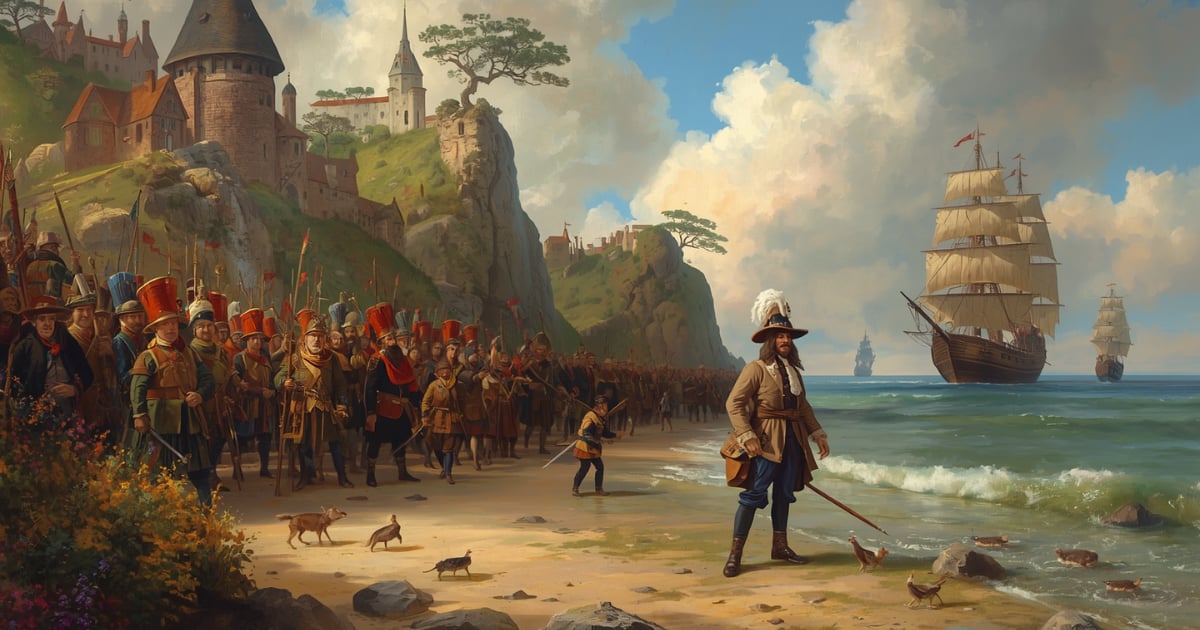
Gulliver wakes chained to the temple, his first clear look at Lilliput revealing a country that resembles a continuous garden, fields forty feet square, trees no taller than seven feet. His first crisis is bodily: two days without relief, he creeps inside his house to manage it, and is careful never to repeat the indignity. When he comes back out, the Emperor is already there on horseback. The horse nearly bolts at the sight of him; the Emperor dismounts and surveys Gulliver from a careful distance. The court tries communicating in every European language Gulliver knows. Nothing works. After two hours the court withdraws. Six arrow, shooters from the crowd are handed over as punishment. Gulliver pretends to eat one, then cuts his ropes and sets him free; releases the other five the same way.
The act is reported to court and lands in his favour. The news of a living giant empties villages across the kingdom. The Emperor holds council on what to do: starve him, shoot him with poison arrows, or absorb the cost. The risk of plague from a rotting giant, corpse settles the debate. His daily ration is fixed at six cattle, forty sheep, bread, wine, and other provisions. Six hundred servants are assigned to him, three hundred tailors begin making clothes, and six scholars start teaching him the language. Three weeks of daily lessons and the Emperor's personal visits get them to basic conversation. The first thing Gulliver learns to say is that he wants his liberty. The Emperor answers that this must wait, that Gulliver must first swear a peace with the kingdom and prove himself through patient, discreet behaviour.
The Emperor then asks to have Gulliver searched. Two officers climb into his pockets and produce a written inventory in the Lilliputian style: a coarse cloth large enough to carpet the throne room, a silver chest whose contents cause sneezing fits, a bundle of writings with letters half the size of a man's palm, an engine with twenty poles that combs his head, two hollow iron pillars with strange protrusions, round pieces of white and red metal too heavy to lift, two black pillars with steel plates inside, a silver chain attached to a globe that makes a noise like a water, mill and which they conclude must be either an unknown animal or his god. When the inventory is read back, the Emperor demands the weapons. Gulliver draws his scimitar; the troops shout in terror and the reflected sun blinds them. He fires a pistol into the air: hundreds fall as if struck dead, and the Emperor, though he holds his ground, takes several minutes to recover. Gulliver surrenders the sword, both pistols, powder, watch, money, knife, razor, comb, snuff, box, and journal. The weapons are carted to the royal stores; everything else is returned. He says nothing about a hidden pocket containing his spectacles, pocket telescope, and a few small items he judges of no consequence to the Emperor and no safe to risk losing.
Swift understood something profound about power: the moment you demonstrate you won't abuse it, you actually gain more of it. Gulliver's gentle release of his would, be punishers isn't just kindness, it's strategic brilliance. He recognises that sustainable influence requires buy, in, not submission. This pattern appears constantly in working, class life, though we rarely name it. The experienced mechanic who teaches instead of showing off. The veteran server who covers for the new hire's mistakes rather than letting them crash. The seasoned factory worker who shares shortcuts instead of hoarding knowledge. Each choice between dominance and consideration shapes not just the immediate situation, but the entire workplace culture. Swift was writing about political power, but his insight applies anywhere people interact across difference, whether that difference is experience, authority, or simply having a better day. The most effective leaders, from union organizers to shift supervisors, understand this instinctively. They know that people follow willingly when they feel respected, but resist when they feel diminished. The question isn't whether you have power over others, it's whether you'll use that power to build bridges or walls. In a world that often rewards aggression, choosing strategic restraint becomes a radical act.
Explore this chapter with AI to uncover deeper meaning and practical takeaways.
AI Discussion