LIVE
OCD← Home
Gulliver's Travels cover
1726
Gulliver's Travels
Jonathan Swift · Shipwrecked Among Giants and Lilliputians
Chapter 1
Reading
Ch. 1
Ch. 2
Loading audio...
0:000:00

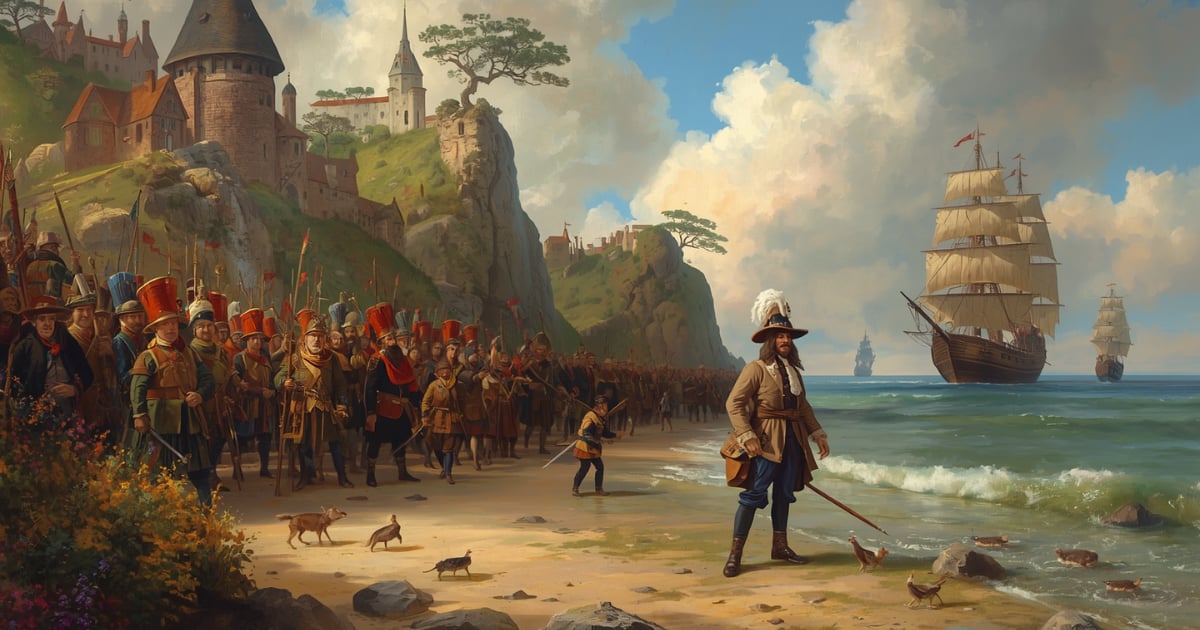
Lemuel Gulliver is a Nottinghamshire surgeon who treats travel as his fortune. After an apprenticeship to Mr Bates and a London practice that fails when his mentor dies, he boards the Antelope in May 1699 for the South Sea. A November storm wrecks the ship. Six men take a boat; the boat capsizes; he swims alone, walks half a mile without seeing a house, drinks the last of his brandy, and sleeps nine hours on short, soft grass, more soundly than he can remember.

He tries to rise and cannot. Arms, legs, and hair are pinned. A human six inches high stands on his chest with a drawn bow. Forty more follow. He roars; they flee and return with arrows in his hand and face. He could break the strings and dash the first of them, and he chooses to lie still. A hurgo speaks from a platform in a language he does not have. He puts a finger to his mouth.

A hundred climb his sides with meat and wine sent by the king's order from the first report of a body on the beach. He eats shoulders smaller than a lark's wing and drains two hogsheads that hold less than a pint. The wine was drugged. The emperor had already decided, in council, to bind him in the night, feed him, and build a machine rather than wake him with spears. Gulliver later calls that plan prudent: a wounded giant would have shown no mercy.

Nine hundred of the strongest men raise him on pulleys onto a wooden frame. Fifteen hundred horses haul him to the capital while he sleeps. An officer wakes him with a half-pike in the nostril. They lodge him in a temple declared profane after a murder and lock ninety-one chains to his left leg with thirty-six padlocks, long enough to walk a semicircle and crawl inside. A hundred thousand come to look; ten thousand climb him with ladders until a proclamation forbids it. When the workmen finally cut the beach ropes, he rises with as melancholy a disposition as ever he had in his life.

Amplified Discussion
When Your Strengths Become Weaknesses

Swift understood something modern workers face daily: the skills that got you promoted might sabotage you in your new role. Gulliver's size, his greatest advantage, becomes his biggest liability because it makes him threatening and conspicuous. He can't hide, can't blend in, can't learn the culture quietly. Similarly, Richard's deep technical knowledge marks him as an outsider to workers who see expertise as management's weapon against them. This isn't about competence; it's about context. A nurse who excels on the medical floor might struggle in the ER not because she lacks skills, but because the informal networks, communication styles, and unwritten priorities are completely different. The same pattern appears when longtime employees get promoted to supervisor, when skilled tradesmen join union shops with different cultures, or when experienced workers transfer between departments. Your proven abilities can actually work against you if they signal that you don't belong to the new group. The solution isn't to hide your competence, but to recognise that every new environment has its own language, alliances, and survival rules. Success requires learning these invisible systems before trying to change them. What strengths in your life might actually be creating distance between you and the people you need to work with?

Explore this chapter with AI to uncover deeper meaning and practical takeaways.

AI Discussion
Why it matters

Reading Power Dynamics

Your biggest advantages mean nothing if you do not understand the system you have walked into. Gulliver could crush the Lilliputians with one hand, but while he slept on the beach they tied him down, drugged his wine, moved him with nine hundred men and fifteen hundred horses, and chained him to a temple before he even knew he was in a negotiation. Read power the way Gulliver eventually does: map who controls the environment, learn the unwritten rules, and choose restraint until you understand what you are actually facing.

Lessons

PracticeThis week, notice when someone with obvious authority (boss, teacher, parent) gets quietly undermined by coordinated group behaviour - watch how information flows and alliances form.

Psych reading

Advantage Without Understanding

Having superior capabilities means nothing if you don't understand the system you're operating within.

In the mind

This chapter reveals a fundamental pattern: your advantages do not guarantee your control. Gulliver possesses overwhelming physical superiority, he could crush his captors without effort. Yet he finds himself completely powerless, bound by tiny ropes and subject to their will. This is not about physical strength; it is about understanding the rules of engagement in unfamiliar territory. The mechanism operates through information asymmetry and collective coordination. The Lilliputians know their terrain, their resources, and their systems. They act as a unified group with shared purpose. Gulliver, despite his size, lacks context, allies, and understanding of local customs.

His individual strength becomes irrelevant when facing organised opposition that controls the environment. Power without knowledge equals vulnerability. The closing third of the chapter makes this point with precision. Nine hundred men on pulleys lift him. Fifteen hundred horses move him. The emperor had organised all of this from the moment a scout reported Gulliver asleep on the beach, while Gulliver had no idea any of it was happening. By the time he wakes with a pike in his nostril, the decision about where he will live, how he will be restrained, and how many people will be permitted to climb his body has already been made at the highest level of government.

He never had a chance to negotiate because he never understood he was already inside their system. This pattern appears everywhere in modern life. A skilled tradesperson starting at a new company finds himself sidelined by office politics he does not understand. An experienced nurse transferring to a different hospital struggles because each facility has unwritten rules and established hierarchies. A capable worker faces a hostile committee that uses procedural rules to neutralise opposition. In each case, competence and capability matter less than understanding the system. When you recognise this pattern, resist the urge to rely solely on your existing strengths.

Observe first. Map the power structures. Identify the key players and unwritten rules. Build small alliances before making big moves. Gulliver's restraint, not crushing the Lilliputians despite his frustration, models the right first response: respect the local system while you learn it, even when it seems absurd. Your goal is not to dominate but to navigate. When you can name the pattern, predict the next move, and choose restraint before you assert strength, you have a practical map for the next decision.

Find the right chapter

Each mood maps to a life skill. Each skill connects to the patterns in classic literature.

😔How do you feel😊

Personalize your match

Optional—life stage, what you need today, and what you're navigating help us pick chapters that fit—not generic lists. You may also freeform using the feeling search below.

Sign in to save your profile

Choices stay on this device until you sign in.

Browse the Full Library
4,582Chapters
118+Books
86Authors