
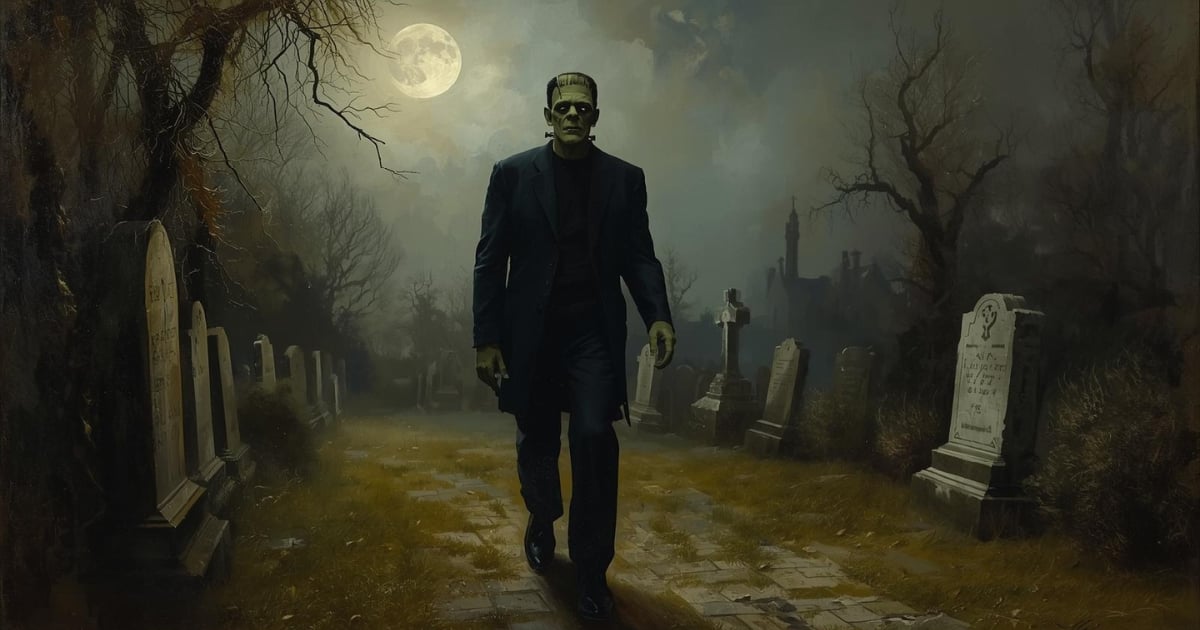
Night. He howls in the wood and declares everlasting war against the species, and more than all against the man who formed him. Morning almost unsays it. He thinks he was too hasty: he should have won the father first. He goes back. The cottage is dark. Felix tells a landlord they can never inhabit it again. The creature never sees the family more. He wrecks the garden, waits for the moon to sink, and fires the straw.
He walks toward Geneva, the only town named in Victor's papers, by night, through frozen rivers. A spring morning almost makes him happy. A girl slips into a deep river. He saves her. A rustic tears her from his arms and shoots him in the shoulder. Weeks later, in the fields outside Geneva, a child runs into his hiding-place. He thinks a young mind might still be taught. William screams monster, then names his father: M. Frankenstein, the syndic.
The creature grasps his throat. A portrait of Caroline glitters on the body. In a barn a young woman sleeps on straw. He puts the portrait in her dress and flees. He has ranged to these mountains, he tells Victor, and they will not part until Victor creates a companion of the same species, with the same defects.
The creature's story reveals something disturbing about intelligence without responsibility. He's not just smart - he's eloquent, observant, capable of deep feeling and complex reasoning. But Victor gave him consciousness without community, intelligence without love, power without purpose. The result isn't random destruction - it's calculated revenge that targets exactly what will hurt most. This pattern shows up constantly in modern workplaces and relationships. The brilliant employee who gets promoted too fast without proper support, then uses their position to settle scores. The gifted student who gets academic attention but no emotional guidance, becoming manipulative instead of wise. The tech creator who builds something powerful then walks away when it gets complicated, leaving others to deal with the consequences. Intelligence amplifies everything - including revenge. When someone has the capacity to understand exactly how systems work and what people value most, abandoning them doesn't make the problem go away. It teaches them to weaponize their gifts. The creature's eloquent rage is more terrifying than mindless violence because it's precise, patient, and personal. This forces us to ask uncomfortable questions about our own abandoned creations - the relationships we've ghosted, the projects we've walked away from, the people we've given up on when they became inconvenient. What monsters might our abandonment have created?
Explore this chapter with AI to uncover deeper meaning and practical takeaways.
AI Discussion