
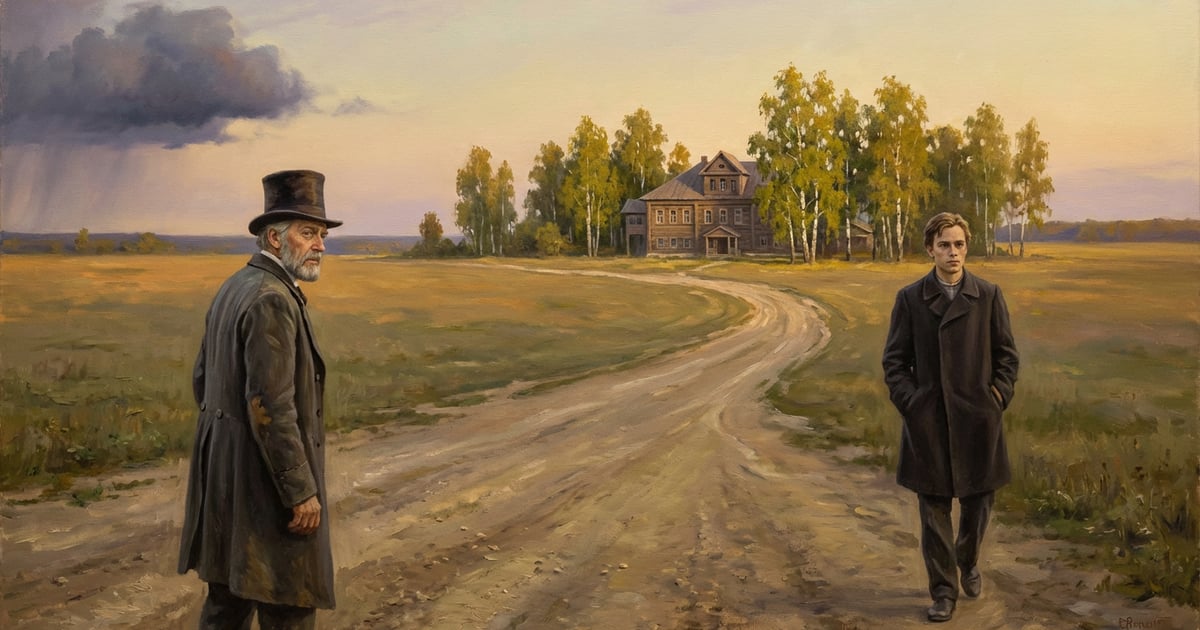
The same day Bazarov meets Thenichka, though he has come into the garden to talk about trees. The oaks have failed. He wants silver poplars, Norwegian firs, and limes if loam is added first. The lilacs and acacias have done well because they do not need much room. Then he sees the arbour. Thenichka is there with Duniasha and Mitia. Arkady nods as to an old acquaintance, and the two walk on until Bazarov asks who she was. He thinks her good-looking. Arkady explains, a little embarrassed. Bazarov commends Nikolai's taste, calls him a young dog, and turns back to be introduced. Arkady begs him to be careful. Bazarov says he is no rustic.
He takes off his cap, bows, and calls himself a friend of Arkady's and a perfectly harmless individual. Thenichka rises and says nothing. He asks about the red cheeks, learns the baby has cut four teeth, and takes Mitia into his arms. The child does not fight or fear him. Everything is going right, Bazarov says. If the boy ails, send for him. He asks if the mother is well, and tells Duniasha she looks all right, and she giggles. When Arkady tries to hold the baby, Mitia throws his head back and cries. Another time, Arkady says, when the child is used to him. The friends leave. Bazarov wants the patronymic. Nikolaievna. What he likes is the total absence of shyness. She is a mother, and therefore justified. Arkady agrees, then starts to speak of his father. Bazarov finishes the sentence: the father is justified too. Arkady will not go that far. From one point of view his father is not justified. He ought to marry her. Bazarov is quiet, then surprised that the marriage rite still matters. For some paces they say nothing.
He has been inspecting the place. The cattle look poor, the horses broken-down, the buildings tipsy, the workmen inclined to loaf, and he cannot yet tell whether the new steward is a fool or a rogue. These peasants are cheating Nikolai. The Russian muzhik, he says, will break even the back of God. Arkady warns that this is close to Paul's charge, that Bazarov thinks poorly of Russia. Rubbish, Bazarov says. The Russian's best point is that he thinks poorly of himself. Two and two make four. Nothing else matters. Arkady asks whether nature is also rubbish, looking at the fields in the morning sun. Nature is rubbish in Arkady's sense, Bazarov answers. She is not a church, but a workshop, and man is the labourer. A cello reaches them, sensitive and unpractised, Schubert's Erwartung, the melody like honey. Bazarov is astonished that the player is Nikolai, forty-four, a father, a man of note in the county. He laughs. Arkady, for all his reverence, cannot manage even a smile.
Turgenev shows us something counterintuitive: sometimes the person who breaks social rules creates more harmony than the one who follows them perfectly. Bazarov ignores the awkwardness of meeting his friend's father's unmarried partner and treats her like any other person. His directness works. Arkady, who knows all the proper protocols, creates tension by overthinking the situation. This pattern appears constantly in working-class environments where unwritten rules about 'knowing your place' can create artificial barriers. The security guard who treats everyone with the same respect, regardless of their job title, often gets more cooperation than the one who strictly enforces hierarchy. The CNA who talks to confused patients like real people, not like children, calms them better than the one following scripted communication techniques. The mechanic who explains problems honestly, without talking down to customers, builds more trust than the one using technical jargon to seem authoritative. The key insight is that authentic concern for others' comfort often matters more than perfect adherence to social expectations. When you're genuinely interested in someone's wellbeing rather than managing your own image, people sense it. They relax. Real authority comes from this kind of authentic engagement, not from following rules about how authority should look.
Explore this chapter with AI to uncover deeper meaning and practical takeaways.
AI Discussion