
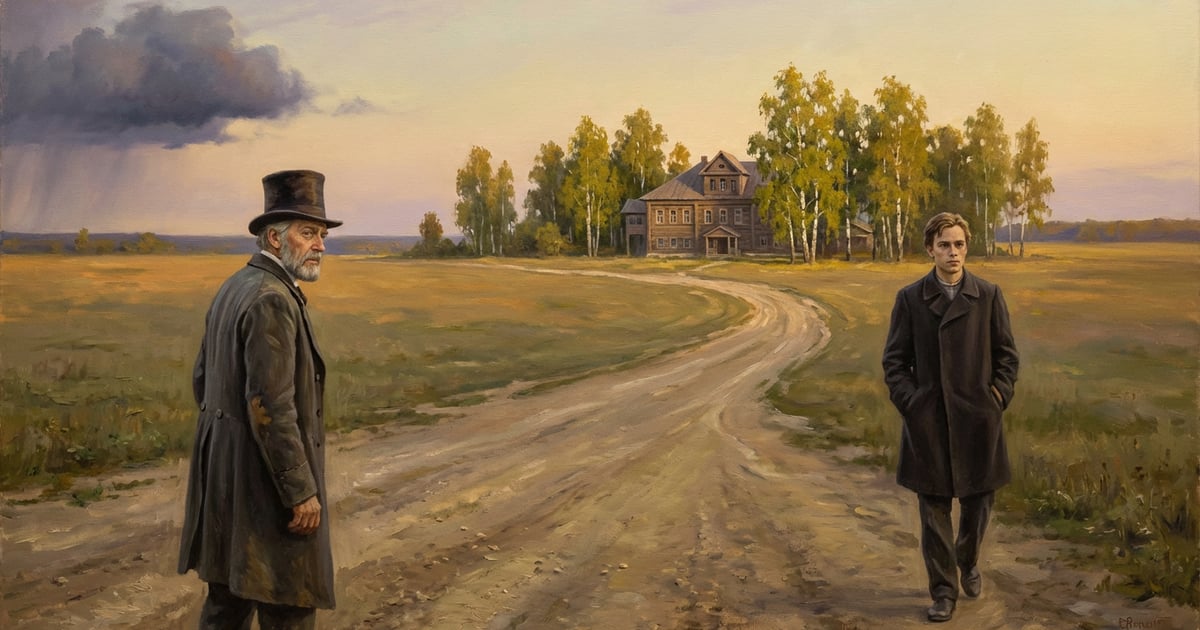
The new estate system creaks like an ungreased wheel. The steward answers every remark in a smooth voice: very well, if so it please you. Nikolai sighs because the place will not prosper without money, and most of the money is gone. Paul has helped before, walking to the window and muttering that he can give some, then giving it. Today he has none to spare, and the details weary him. He is sure his brother's way is wrong, though he knows no better one. Nikolai thinks the opposite. He calls himself weak and retired, and says Paul has the eye of an eagle. Paul turns away and does not correct him.
He walks to the back of the house, tugs his moustache, and knocks. Thenichka is in a chair with the baby. She hands Mitia to the nurse and rearranges her bodice. Paul will not look at her. He has come, he says, to ask for half a pound of green tea. Then he remarks on the curtains, asks if the room is better than the wing, and learns that the laundry women are lodged there now. He does not leave. She stands locking and unlocking her fingers. He loves children, he says. Why was the little one taken away? She brings Mitia back in a red robe and a beaded collar, face washed, breathing hard, delighted. Paul tickles the chin. The baby stares at a siskin in a cage and smiles. This is Uncle, she tells him. Thenichka says he is six months and will be seven on the eleventh. Duniasha timidly suggests eight, and is told no. Mitia grabs his mother's nose. Paul says the boy is very like his brother, and looks at the young mother almost mournfully. Nikolai appears in the doorway, so glad at the picture that Paul can only smile, glance at his watch, and announce that he came to arrange about tea.
Thenichka asks to return to the wing. Nikolai says the reason for that no longer exists. He kisses the baby's cheek, then her hand, white against the red robe. She asks why. The chapter then tells how she came: an inn where the linen was so clean he thought the landlady German, a widow named Arina Savishna, a daughter of sixteen kept almost unseen, a spark from the stove in the girl's eye, his own hands on her hair, a kiss where the hair was parted, a rye field where she hid and he called that he would not hurt her, her mother's death of cholera, and then the sentence that the rest need not be related. Paul, back in his study of weapons and red wild roses, stares at the ceiling with his hands behind his head. He gets up, unhooks the heavy curtains, and lies down again.
Turgenev shows us something timeless: sometimes the most meaningful relationships happen in spaces society doesn't officially recognize. Nikolai and Thenichka's arrangement worked for both of them, providing companionship, security, and genuine affection. But because it didn't fit the approved categories of their time, everyone involved lived with constant vulnerability. Today, we see this pattern everywhere in working-class life. The single parent whose neighbour helps with childcare, creating a family-like bond that benefits everyone but makes others uncomfortable. The workplace mentorship that crosses generational or gender lines, providing real value but generating gossip. The caregiving arrangements where friends step in when official systems fail, effective but precarious because they lack legal protection. These relationships often solve problems that formal structures can't address, but they require extra emotional labor precisely because they exist in undefined territory. The people in them must constantly negotiate boundaries, manage others' judgments, and protect something valuable that has no social scaffolding. Understanding this pattern helps us recognize that some of life's most important connections happen outside the approved frameworks, and that these relationships deserve respect, not judgment, even as we acknowledge their inherent risks.
Explore this chapter with AI to uncover deeper meaning and practical takeaways.
AI Discussion