
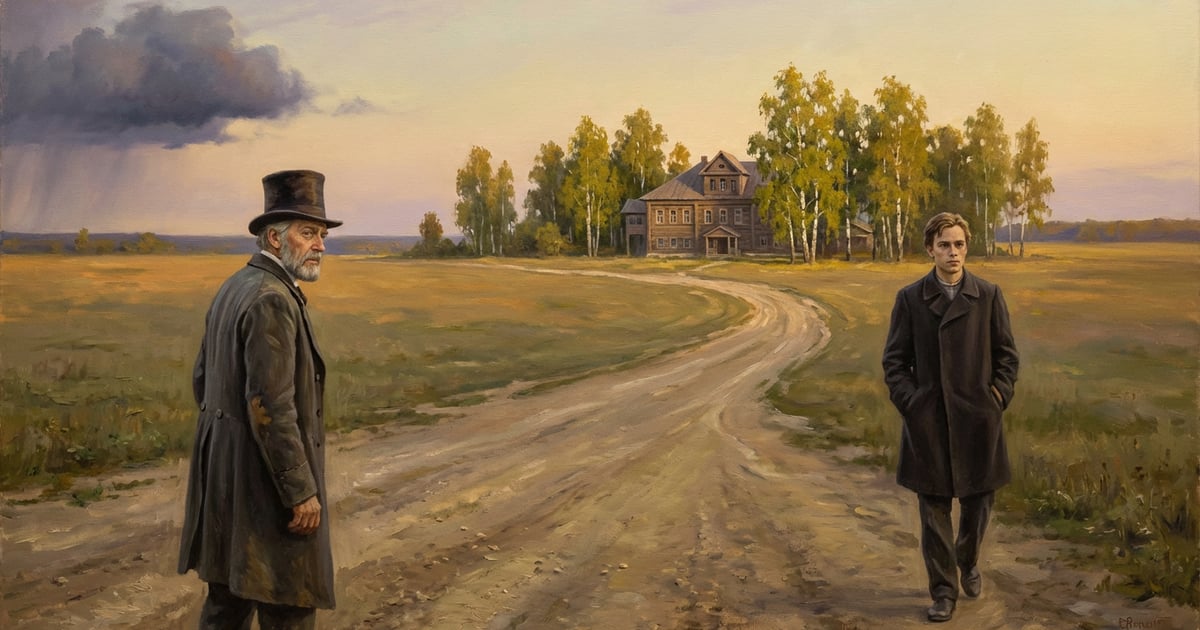
Six months have passed, and the country is in a white winter, the close of a January day, the sun going down into a red sea. At Marino the windows are lit, and Prokofitch, in a tail-coat and white gloves, lays seven covers. A week ago, in the tiny parish church, quietly and almost without a witness, two weddings were held: Arkady and Katia, Nikolai and Thenichka. Today Nikolai gives his brother a farewell dinner. Paul is leaving for Moscow. Anna has already gone there, after giving the younger couple a handsome dowry.
Mitia is at the table with his nurse. Paul sits between Katia and Thenichka, thinner than he was, and looking the more refined for it. Thenichka, in a new silk gown and a necklace, smiles as if to say she is not responsible for this, and the others smile as if they would like to be excused as well. Nikolai rises with a glass, begins to say how much he, how much they, and stops. He is not good at a speech. Arkady is not ready either. So the father embraces his brother and begs him to come back soon. Paul kisses Thenichka's hand, which she has not learnt to offer in the right way, drinks twice to the company, and says may they all be happy, and farewell. The English word passes unnoticed. Katia clinks glasses with her husband and whispers that she drinks to the memory of Bazarov. Arkady squeezes her hand, and does not propose the toast aloud.
Anna has married, not for love and not from duty, a rising statesman as cold as ice. They live amicably, and may in time reach happiness, even love. The Princess is dead, and her memory went with her. At Marino, Arkady has become a capable manager. Nikolai rides about making the same speeches to the peasants over and over, and both the neighbours who favour emancipation and the ones who curse it find him too mild. Katia has a son, Kolia. Thenichka, Theodosia Nikolaievna, if Katia sits down at the piano, cannot leave her. In Dresden, on the afternoon promenade, you may meet Paul, grey-haired and gouty and still handsome. He never reads a Russian book. In the Russian church he sits against the wall until he remembers where he is, and almost without a sign he crosses himself. Sitnikov, in Petersburg, says he is carrying on the work of the late Bazarov. Rumour says someone has thrashed him again. He calls the rumour ironical.
In a remote corner of Russia there is a small country cemetery, weedy, its wooden crosses mouldy, sheep wandering over the tombs. One grave no man molests and no animal tramples. Birds perch there and sing at evening. An iron railing stands around it, and a young fir at the head and another at the foot. It is the grave of Evgenii Vasilitch Bazarov. Now and then two aged people come from the neighbouring house, supporting one another. They kneel, weep, dust the dumb stone, lay a sprig of fir on it, and can hardly bear to leave. The heart in that tomb was passionate and wild and erring. The flowers that grow there look out with nothing but peace, and speak only of a calm that does not notice us, and of a life that has no end.
Turgenev understood something we often miss: the most important changes happen after the cameras stop rolling. When Bazarov dies, when the confrontations end, when the speeches are over, that's when real life begins. People quietly adapt, find new equilibriums, and make the small daily choices that actually reshape their world. This pattern appears everywhere in working-class life. After a plant closure, the real story isn't the dramatic final day, it's the six months afterward when families figure out new routines, when some people retrain while others relocate, when communities slowly reorganize around different economic realities. After a workplace injury, the headlines focus on the accident, but the real change happens in the gradual shift toward better safety practices, in how workers start speaking up differently, in the small policy adjustments that prevent future incidents. Even in families, the most significant transformations follow major disruptions, divorce, illness, job loss, not through dramatic interventions but through thousands of small adaptations. The danger lies in expecting immediate results and judging success by dramatic visible change. When we understand this pattern, we can invest our energy more wisely, supporting people through the adjustment period, making consistent choices aligned with our values, and recognizing that sustainable change requires patience and persistence rather than revolutionary fervor.
Explore this chapter with AI to uncover deeper meaning and practical takeaways.
AI Discussion