
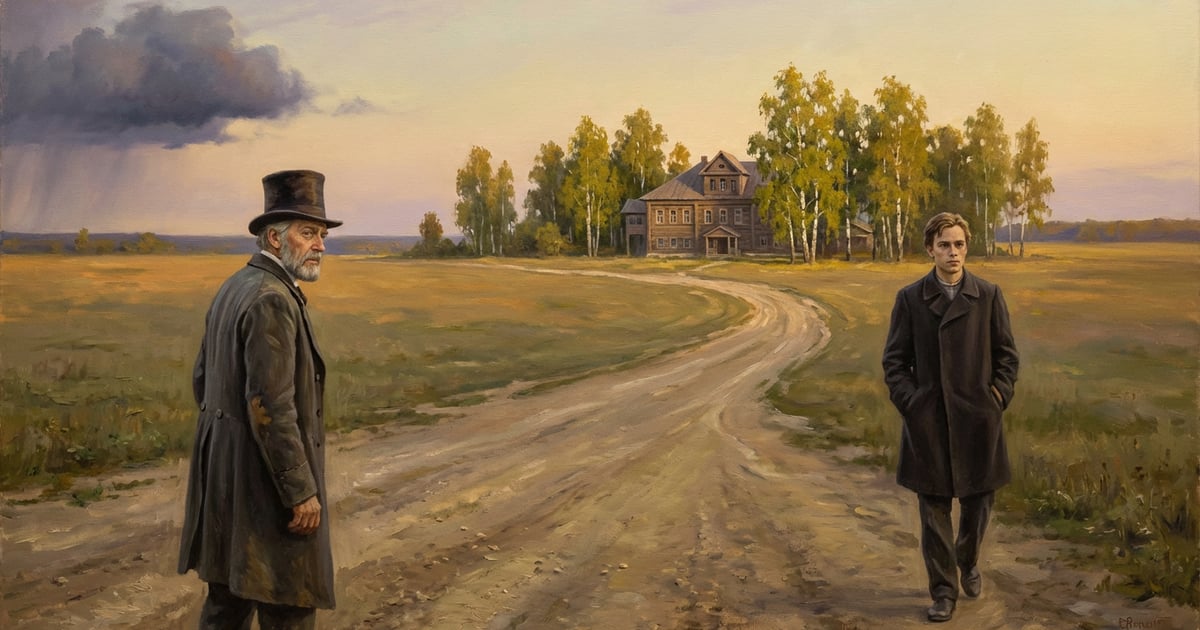
For a fortnight the day at Nikolskoe runs on rails. Breakfast at eight, then Anna with the steward and the housekeeper, then talk or a walk, cards or music, and at half-past ten she withdraws and gives the orders for tomorrow. Bazarov says it reminds him of running on a pair of rails. The liveried lacqueys offend him. She hears him out. In the country, she says, one cannot live anyhow, or slovenliness follows. She keeps the round as it was. He has grown captious since they arrived. He glares, speaks with reluctance, and cannot sit still.
Arkady decides that his friend is in love with Madame Odintsov. The decision makes him melancholy, which does not stop him making a friend of Katia. Madame cares nothing for him. This good-hearted creature does not give him the cold shoulder, and the thought brings back the old joy of magnanimity. On walks the couples divide. Katia and Arkady love the natural world and will not quite say so. Anna and Bazarov are more or less indifferent to it. Bazarov stops talking about Anna, praises Katia only by habit, and lectures his pupil less. Arkady notices, and keeps it to himself.
The feeling itself is one he would have laughed at. If a woman pleases you, attain your goal. If you cannot, turn away. The world does not rest upon a single keystone. She pleases him, the goal is not to be attained, and he cannot turn away. In the woods he snaps boughs underfoot. In a hayloft he invents kisses that have not happened, then grinds his teeth at himself. One morning his father's steward, Timotheitch, appears and denies that he was sent to fetch him. He is only on his way to the town, he says, and turned aside. Do not lie, Bazarov answers. The parents' hearts are aching for a sight of him. Tell them I will come presently. The old man remounts the shabby drozhki and trots off, not in the direction of the town.
That evening she asks why he must go, and whether he has forgotten the chemistry. He tells her to read Pelouse and Frémy. She wants not a book but the man, and the father for whose sake he is about to abandon her. He thinks: why abandon? Aloud he calls his people obscure, and calls her an aristocrat who loves comfort and is indifferent to the rest. She says she is unhappy, with no wish to live, and that a strong attachment might save her. He answers that she is incapable of falling in love, and that he knows it by hearsay. To himself he calls her a coquette whom idleness is using to weary him. She wants everything or nothing. A life for a life. Idle words, he says, and not meant to be taken personally. Then he says good-night and squeezes her hand until she could have shrieked. She blows a kiss after him and runs towards the door. The maid comes in with a decanter. Anna stops, sends her away, and sits while her hair comes loose. Two hours later Bazarov returns with his boots soaked with dew. Arkady is still dressed, a book in his hands. You were with her, he says. I was, Bazarov answers, while you and Katia played. I was not playing, Arkady says, and stops. The tears are very near, and he will not let them fall in front of his mentor.
Turgenev understood something that modern psychology has confirmed: the more we invest in being right about something, the harder it becomes to change our minds, even when change would benefit us. Bazarov's tragedy isn't that he's wrong about aristocracy or science, it's that he's made his identity so rigid that admitting any complexity threatens his entire sense of self. This pattern dominates modern workplaces and relationships. The nurse who's built their reputation on 'not being dramatic' can't advocate for better staffing. The parent who prides themselves on being 'practical' dismisses their teenager's creative ambitions. The mechanic who's known for 'telling it like it is' can't admit when they don't know something. We see this in politics, where changing your position is seen as weakness rather than growth. We see it in relationships, where apologising feels like losing rather than connecting. The cost is enormous, we choose being right over being happy, being consistent over being effective. Turgenev shows us that intellectual humility isn't about being wishy-washy; it's about being secure enough in yourself to let your opinions evolve. The question isn't whether you'll be wrong about something important, you will. The question is whether you'll be flexible enough to course-correct when you discover it.
Explore this chapter with AI to uncover deeper meaning and practical takeaways.
AI Discussion