
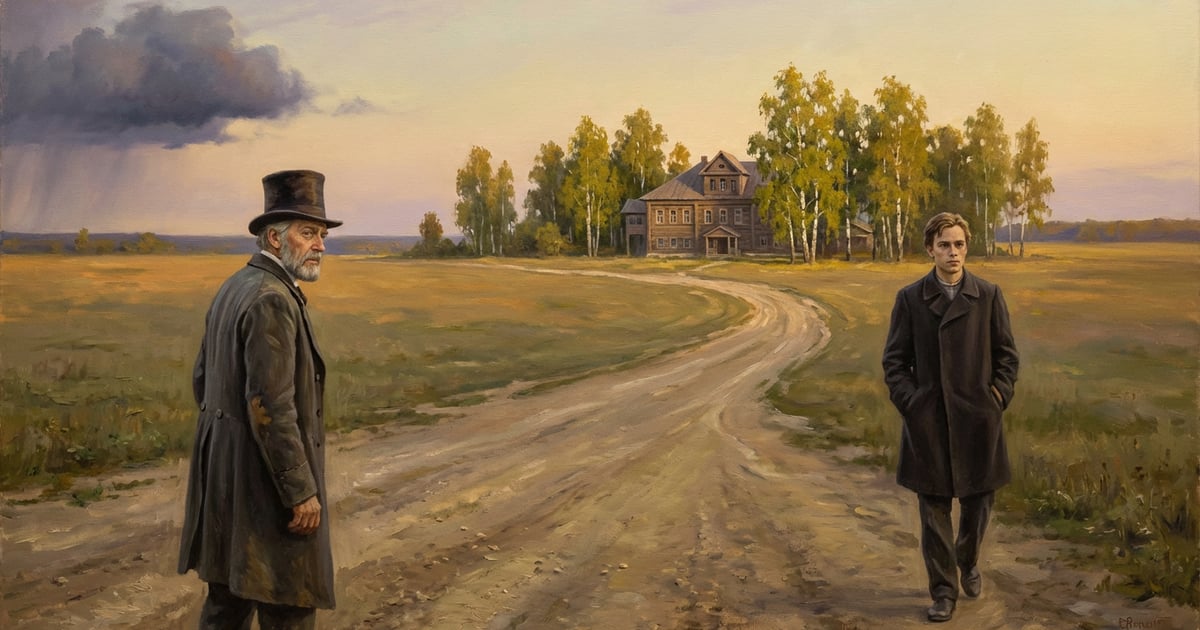
The yellow house on the hill matches the church beside it: a green roof, white columns, a coat of arms, an avenue of clipped firs. A butler in a black tail-coat shows them a spotless room and says Anna Sergievna will see them in half an hour. Bazarov asks for a small glass of vodka. What grandeur, he says. He is a future doctor, the son of a doctor, the grandson of a sexton, even as Speransky's grandfather was, and they have not so much as a tail-coat. Arkady shrugs, and is a little awed himself. In the drawing-room a portrait of a sandy-haired man hangs over the divan. He, Bazarov whispers.
She comes in with her hair dressed behind the ears and sets out the household as if from a lesson: a sister at the piano, an elderly aunt, a neighbour for cards. On finding that her mother had known his, and that his mother had made Anna's mother her confidant during the love affair with Nikolai, Arkady talks of his dead parent with enthusiasm. Bazarov turns the albums and thinks what a domesticated individual he has become. A greyhound named Fifi puts a cold nose into each hand. Behind the dog is Katia, eighteen, a basket of flowers, her breath fluttering. Anna calls Bazarov off the photographs. He says her temperament looks cold, and argument needs impulse. She says she is impatient and exacting. They move from pictures to geology, then to whether one person differs from another. People are like trees in a forest, he says. A botanist does not study each trunk. Rectify the social body, and moral sickness will cease. In each of us there is an identical spleen. Katia, arranging the flowers, blushes to her ears. The aunt is coming. Spare her.
The Princess is small, with a mallet-shaped face, a grey false front, and a velvet chair no one else may use. She wants the dog out, takes honey rather than sugar in her tea, and asks what Prince Ivan says in his letter. No one answers. Bazarov decides she is kept for show, because she comes of a princely house. Rain cancels the walk. Porphyri Platonitch arrives for cards, stout and affable, and Bazarov plays so as to prepare for a district physician's post. Anna sends Katia to the piano, since Arkady loves music and they will be glad to hear him. He feels himself being got rid of. Something like the start of love is already simmering, and it is not for the girl at the keys. Katia plays Mozart's Sonata-Fantasia in C minor coldly and upright, until the close breaks into lament and a curl falls over her forehead. He thinks only that she plays well, and is not bad-looking.
That night he calls Anna wonderful. Bazarov says she has brains, and has seen life, and manages her property. The marvellous one is the sister, who still has freshness and timidity. Of Anna you could make what you desired. The other is yesterday's loaf. Anna reads two foolish French novels and sleeps a cold, spotless figure in white. Next morning she goes botanising with Bazarov and comes back just before luncheon, cheeks rosy, a field flower between her fingers, the mantilla slipped to her shoulders. Bazarov's face is cheerful, even good-humoured, and Arkady does not like it. Bazarov mutters good-morning and goes to his room. She gives Arkady a negligent handshake and walks on. One would think, he tells himself, that she and I had made one another's acquaintance only today.
Bazarov's declaration that all people are like trees in a forest reveals something crucial about how intelligence can become a defence mechanism. He's not really making a philosophical point - he's protecting himself from feeling vulnerable in an unfamiliar social situation. This pattern shows up everywhere in working-class life. The nurse who shuts down patient questions with medical jargon instead of explaining clearly. The mechanic who uses technical terms to make customers feel stupid rather than educated about their car problems. The coworker who always has to be the smartest person in the room during safety meetings. When we feel out of our depth socially or professionally, it's tempting to retreat into whatever makes us feel superior - our technical knowledge, our street smarts, our political awareness. But notice what Bazarov misses: Anna's genuine curiosity and Katia's quiet competence. When we use our intelligence as armor, we often miss opportunities for real connection and learning. The most dangerous part isn't that we do this to others - it's that we do it to ourselves, cutting ourselves off from growth because we're too busy proving we're already smart enough. Real intelligence creates bridges, not walls. It asks questions instead of delivering verdicts. It admits uncertainty instead of performing certainty. The question becomes: are we using our minds to understand the world better, or just to feel better about our place in it?
Explore this chapter with AI to uncover deeper meaning and practical takeaways.
AI Discussion