
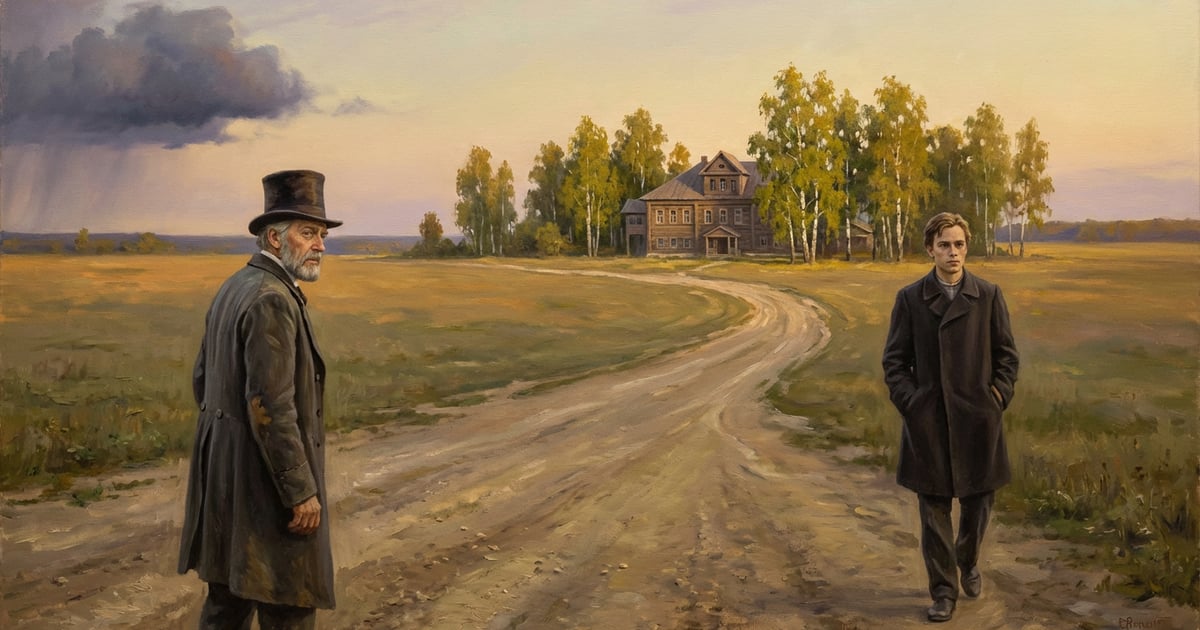
Half an hour after the quarrel, Nikolai Petrovitch goes to his favourite arbour. The rift with Arkady is plain, and he knows it will widen. The winters in St Petersburg, the modern books, the delight when he could put one word into the young men's debates: all of it was for nothing. Paul says the elders are more in the right. Nikolai can say the same without vanity. He also believes the young men have something the elders lack, and that it is not youth alone. Perhaps less of the barin hangs about them. He bends his head. To reject poetry. To fail with art and nature.
Evening is closing. A peasant on a white pony trots along the dark track by the aspen copse, a patch on his shoulder as clear as the horse's twinkling legs. The sun makes the trunks one bright mass. Bats whirl. Late bees move slowly in the lilac. "O God, how fair!" A favourite couplet starts, and then he remembers Arkady and Stoff und Kraft. He sits on, and quotes no more. He sees his dead wife, not as the thrifty mistress of later years, but as the girl on the staircase of his student rooms, the day he brushed against her and could only mutter "Pardon, monsieur." She fled, looked back at the bend, blushed, and grew demure. He would give worlds for something stronger than memory. He wants the scent of her breath.
Thenichka calls his name from somewhere near. The feeling is neither vexation nor shame, yet he starts, because her voice brings back his grey hairs and the present. The enchanted world quivers and goes. He asks her to go away. He will come presently. Another reminder, he thinks, that he is a barin. Night has come while he sat. Her face hangs in the dark as a pale blur. He paces the garden until he is nearly worn out, and will not go in to the lighted windows. Slow tears come. This is a hundred times worse than the cello. At a turn in the path Paul asks why he is as white as a ghost. Nikolai explains in a few words and goes towards the house. Paul walks on, looking at the stars. Nothing is in his eyes but the reflection of that light. He was not born a Romanticist.
The same night Bazarov proposes that he and Arkady accept the relation's invitation, since Arkady was included too. The weather is fine. They can look at the town and talk without interruption. Bazarov will not come back to Marino afterwards. His father lives only thirty versts off, and it is a long time since he saw the old people. They have been good to him, especially his father, and he is their only son. Staying there is dull. He will pay a second visit on the way back if he can. Arkady answers with a show of indifference. Under it he is delighted, and only the need to keep up his Nihilism stops him from showing it. The next day they set out. The young people of Marino lament their going. Duniasha weeps. Only the elders breathe more freely.
Turgenev wrote during Russia's Great Reforms, when serfs gained freedom but traditional structures crumbled. Nikolai represents landowners watching their world transform beyond recognition. Today, we see this everywhere: experienced workers displaced by automation, parents confused by their children's career choices, longtime residents watching neighborhoods gentrify. The pain isn't just about change - it's about feeling your knowledge and values suddenly seem worthless. Nikolai doesn't hate progress; he mourns the beauty and poetry being discarded in the rush toward efficiency. Roberto doesn't hate technology; he grieves for when work relationships mattered more than metrics. This creates a double bind: resist change and become irrelevant, or embrace it and lose your identity. The chapter suggests a third path - staying curious about what the other generation values while honouring what you've learned. Nikolai's mistake isn't loving the past; it's assuming his son's new values are inherently shallow. Roberto's challenge isn't learning new systems; it's recognizing that efficiency and meaning aren't mutually exclusive. The question becomes: how do you honour your experience while remaining open to evolution?
Explore this chapter with AI to uncover deeper meaning and practical takeaways.
AI Discussion