
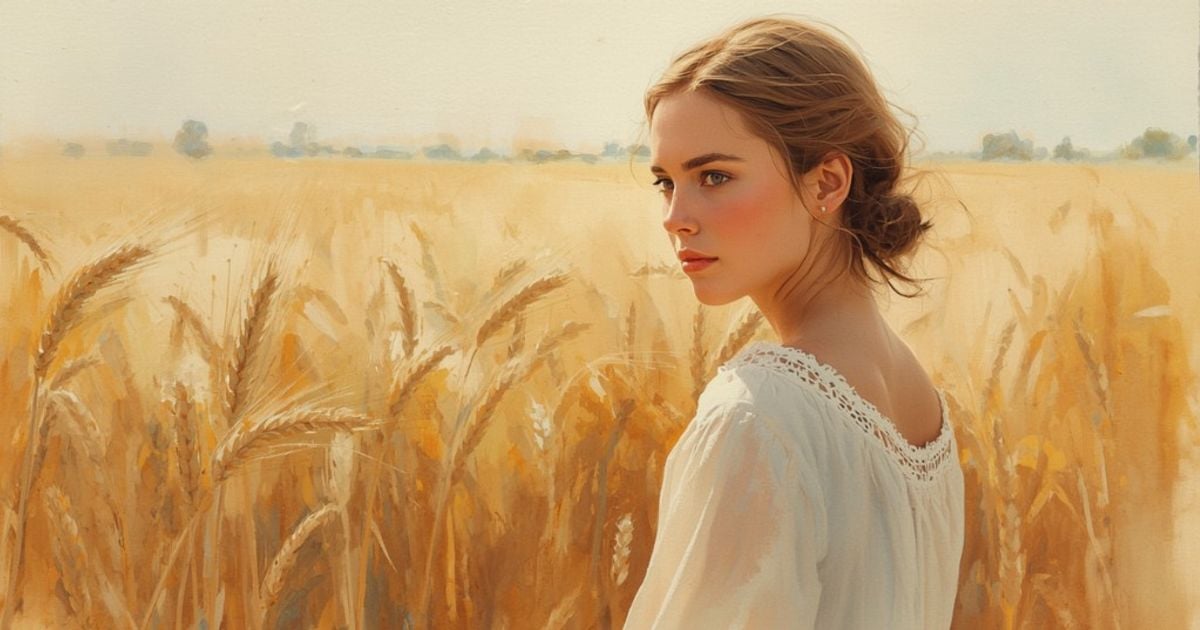
Bathsheba’s first public step as a farmer in her own right is the Casterbridge corn market. The low hall is full of hot men who talk in twos and threes with ground-ash saplings in their hands, poking pigs, sheep and neighbours alike, while a few town-bred fowls wait for any corn that is thrown down. Among them moves the one woman in the room, prettily dressed, like a chaise among carts. At her first step in, the talk stops and every face turns to her. It takes more nerve than she had expected, but she makes her way to the few farmers she knows, then speaks boldly to strangers, and pours grain into her narrow palm in perfect Casterbridge manner. She holds firm on her own prices and cuts theirs, and Hardy says the first was natural in a dealer and the second inevitable in a woman. The farmers whisper, “Who is she?” and answer themselves: headstrong, a pity, but so shapely a maid will soon be picked up. Twice or three times she is tempted to stroll among them like a queen and forget about closing prices altogether.
One man spoils the triumph by not looking. Without looking within a right angle of him, she knows there is a black sheep in the flock. If nobody had stared, or everybody, she would not have minded, but the smallness of the exception makes the mystery. He is gentlemanly, upright, quiet, with Roman features and great dignity, and she decides from his unmoved face that he cannot be married.
On the road home in the yellow gig she tells Liddy the day was “as bad as being married, eyes everywhere”, and mentions that one man had more sense than to waste his time on her. She puts it so that Liddy will not think she is piqued. A low carriage behind a fine horse overtakes them, and Liddy names the driver: Farmer Boldwood, who never turns his head. They agree he is interesting, and that a woman must have jilted him. Bathsheba says it is more likely to be his nature, then that it is perhaps a little of both. Liddy is sure of it, and Bathsheba, who asked, is glad to be told. Neither of them knows a thing about him.
Hardy understood something about human psychology that modern dating apps have weaponized: we want most what seems hardest to get. Bathsheba commands respect from dozens of farmers, yet she fixates on the one man who doesn't even glance her way. This isn't shallow vanity—it's how our brains are wired. When everyone notices us, their attention loses value. But when someone we perceive as important remains indifferent, we interpret this as a puzzle to solve, assuming they must see something we don't. This pattern dominates modern relationships. We obsess over the colleague who never responds to our emails while ignoring supportive teammates. We chase romantic interests who seem uninterested while overlooking genuine admirers. We refresh social media hoping for validation from specific people who rarely engage. The mechanism works through scarcity and status—we assume that if someone doesn't need our attention, they must be superior. But indifference often signals incompatibility, not superiority. Sometimes the person who doesn't notice you is simply focused elsewhere, or genuinely not interested, or dealing with their own issues. Hardy shows us that recognizing this pattern gives us power. When you can name what's happening—'I'm chasing validation, not connection'—you can redirect your energy toward people who reciprocate interest. The question becomes: are you drawn to someone's qualities, or just frustrated by their indifference?
Explore this chapter with AI to uncover deeper meaning and practical takeaways.
AI Discussion