
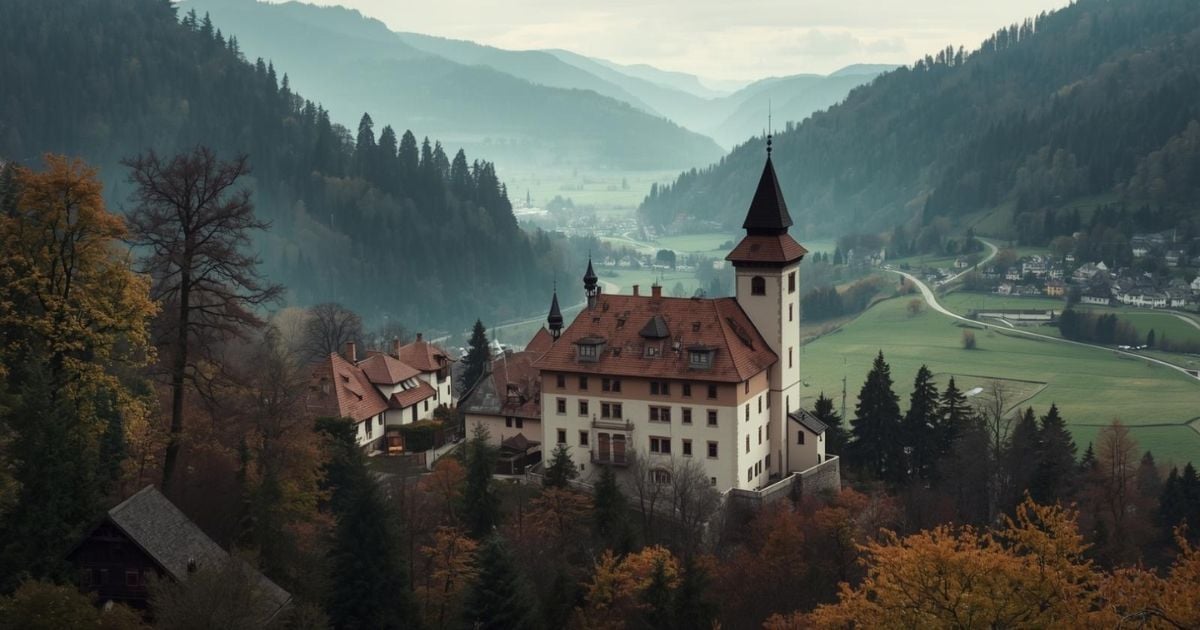
Jonathan Harker opens his journal as a confident English solicitor, timing trains, noting food, and treating Transylvania as a professional errand. He has done his homework at the British Museum, yet he cannot find Castle Dracula on any map as precise as an Ordnance Survey sheet. The gap does not slow him. He reads local history as colour, collects recipes for Mina, and writes that every superstition in the world seems gathered in the Carpathian horseshoe. The further east he travels, the more the landscape feels like a border crossing in mood as well as in geography.
At Bistritz the Golden Krone is ready for him, and Count Dracula's letter is warm, practical, and controlling at once: a seat on the diligence, a carriage at the Borgo Pass. The landlord and his wife cross themselves at the Count's name and will say no more. On the eve of St. George's Day the landlady kneels, mixes languages in her terror, and begs Jonathan not to travel when evil will have full sway at midnight. He calls it ridiculous, cites duty, and still accepts the crucifix she puts round his neck for his mother's sake. The charm sits against his English churchman's doubt, and his mind is not as easy as usual when the coach finally leaves.
The passengers treat him like a man already marked. They murmur words his dictionary translates as devil, hell, witch, vampire. They sign the cross and guard against the evil eye while pitying him with a kindness that frightens him more than open hostility. The driver hurries as if time itself were an enemy, refuses to let Jonathan walk because the dogs are too fierce, and jokes grimly that he may have enough of such matters before sleep. Gifts of garlic and crucifixes pile into his lap as the pass narrows and thunder hangs in the air.
At the pass the promised carriage seems to fail, then a black calèche arrives with a driver whose smile shows teeth too sharp and eyes too red in the lamplight. Jonathan's luggage is seized with inhuman strength, the wolves answer to a command in the snow, and blue flames move at the roadside while the driver works in silence. The journal that was meant to record a property transaction ends at a vast ruined castle whose black windows give no light. Jonathan is still writing, still rational on the page, and already inside the predator's threshold.
Jonathan Harker represents a dangerous type of intelligence - the kind that's so confident in its own rationality that it dismisses wisdom it can't categorise. He's educated, logical, and professional. He's also walking straight into a trap that everyone around him can see coming. This isn't stupidity - it's cognitive arrogance. Stoker was writing during the height of British imperial confidence, when 'civilised' people routinely dismissed local knowledge as primitive superstition. Sound familiar? We do this constantly today. The college-educated manager who ignores warnings from longtime employees about a new hire because 'they just don't like change.' The professional who dismisses their working-class family's concerns about their romantic partner because 'they don't understand our relationship.' The expert who bulldozes through community objections to a project because locals 'lack the big picture.' Here's what Harker missed: the innkeeper's wife wasn't being superstitious - she was reading patterns. Those 'backward' villagers had survival knowledge passed down through generations. They recognised predatory behavior that Harker's formal education never taught him to see. The most dangerous moment isn't when we lack information - it's when we think we know better than the people who've been living with the consequences. Real intelligence means staying humble enough to learn from sources that don't match our credentials.
Explore this chapter with AI to uncover deeper meaning and practical takeaways.
AI Discussion