
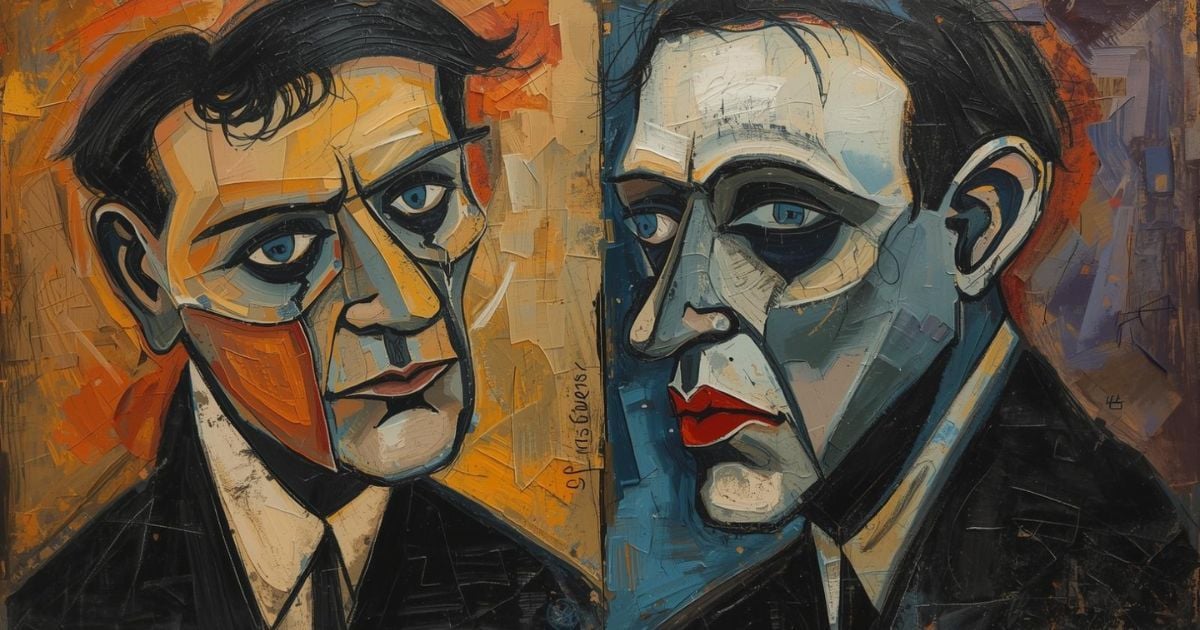
This, too, was myself. That is what Jekyll felt when he first looked in the glass at Edward Hyde, smaller, younger, stamped with deformity, and felt a leap of welcome, not disgust. He had already been two men before any drug. He wanted a grave face for the public and hid the rest with a morbid shame. He told himself man is not truly one, but truly two, and he daydreamed of housing each in a separate body, so the just could walk clean and the unjust could go without remorse. Late one night he drank. The pangs were like birth or death. Then he was younger, lighter, tenfold more wicked, and glad of it. He had lost in stature. He stole through his own house a stranger, then drank again and came back as Henry Jekyll. The drug, he says, was neither devil nor angel. It only shook the door. What ran out that night was the worse thing, because that was what was awake.
He furnished the rooms in Soho. He told the servants Hyde had power in the square. He wrote the will. He thought the safety complete. Let Hyde pass like breath on a glass, and the man trimming the midnight lamp would be Jekyll, able to laugh. The pleasures turned monstrous. Jekyll stood aghast, then told himself Hyde alone was guilty. He even tried to undo some of the harm. Thus his conscience slept. Hyde walked over the child Enfield caught. They paid with a cheque in Jekyll's name. Then Hyde got his own account, and Jekyll sloped his own hand backward for the new signature, and thought he sat beyond fate.
One morning he woke in his own bed and saw, on the sheet, a lean hairy hand. He had gone to sleep Jekyll. He had woken Hyde. The servants were up. The drugs were two flights down. Then he remembered they were already used to Hyde in the house. He got back. He chose the doctor, he says, and the friends, and the honest hopes. He did not give up the Soho house. He did not destroy the clothes. For two months he was severe. Then in an hour of weakness he drank again. The caged thing came out roaring. Carew's civilities felt like a child's toy. Hyde beat him to death with glee, fled, burned papers, and sang as he mixed the draught. Jekyll fell on his knees. He locked the door and ground the key under his heel. He was glad the scaffold now guarded him. Then, as an ordinary secret sinner, he slipped. On a bright January bench in the park he compared himself with other men, and found himself better. He looked down. The hand on his knee was corded and hairy. He was Hyde, hunted, with no way home but Lanyon.
After that night the change came on its own. If he slept, he woke as Hyde. Only a great effort and the drug could hold Jekyll's face. The powers of Hyde grew as Jekyll sickened. Hyde scrawled blasphemies in Jekyll's books and burned the portrait of his father. Jekyll came to pity the thing he also loathed, because it loved life and feared the knife. Then the old salt ran out. New powder gave the first change of colour, not the second. It did nothing. London was ransacked. Nothing served. He writes this under the last of the old powders. This is the last time, short of a miracle, that Henry Jekyll can think his own thoughts or see his own face in the glass. If the change takes him at the pen, Hyde will tear the pages. Half an hour from now he will put that hated self on again, for good. Will Hyde die on the scaffold, or find courage to end it? God knows. I am careless. This is my true hour of death, and what follows concerns another than myself. Here then, as I lay down the pen and seal the confession, I bring the life of that unhappy Henry Jekyll to an end.
Jekyll's story exposes a dangerous myth: that we can neatly separate different aspects of ourselves. He believed he could be respectable Dr. Jekyll by day and indulgent Mr. Hyde by night, with no spillover between the two. This fantasy appeals to modern workers who face similar pressures. We're told to 'leave work at work' and maintain 'work-life balance' as if personality operates like a light switch. But Jekyll's fate reveals the truth, there's only one you, and feeding your worst impulses anywhere feeds them everywhere. The warehouse supervisor who's harsh with workers but tries to be gentle at home discovers that cruelty becomes a habit. The nurse who's patient with difficult patients but explosive with family finds the explosions happening at work too. The retail worker who puts on fake smiles for customers while harboring resentment learns that the resentment poisons everything. Stevenson wrote this story during the Industrial Revolution, when people first began separating 'work identity' from 'personal identity' on a massive scale. His warning remains urgent: integration, not compartmentalization, is the path to wholeness. The goal isn't to eliminate contradictions within yourself, everyone contains multitudes. The goal is to acknowledge those contradictions honestly and set boundaries on behavior, not identity. When you try to split yourself, the split always wins.
Explore this chapter with AI to uncover deeper meaning and practical takeaways.
AI Discussion