
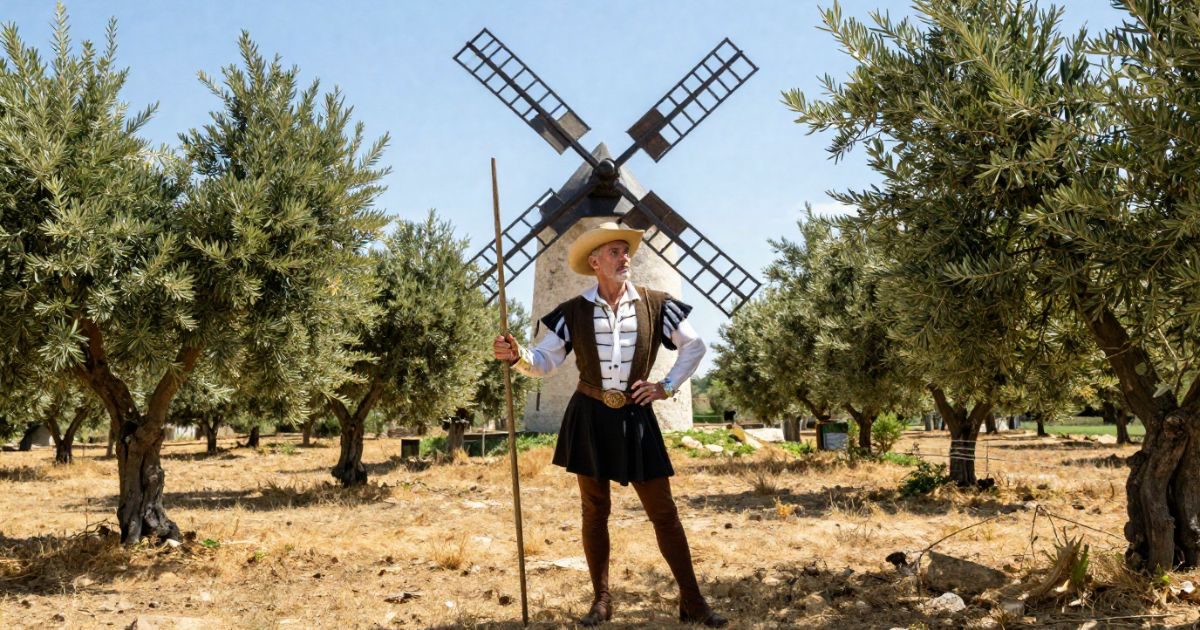
Night brings the appointed horse, and Don Quixote is already uneasy that Malambruno delays. Four ivy-clad wild-men set Clavileño on its feet and tell the knight to mount, the squire to take the croup, and both to cover their eyes until the horse neighs. Sancho will not. Islanders, he says, should not hear that their governor strolled about on the winds, and a three-thousand-league ride might last years. The duke answers that the promised island is rooted in the earth, and that finishing this adventure is the bribe for office. Sancho yields, asking only whether a Christian may commend himself to God on the way. Don Quixote draws him aside and tries to collect five hundred lashes toward Dulcinea's three thousand three hundred before they leave. Sancho will not score himself on the eve of a plank ride.
They mount. Don Quixote inspects the belly like Troy's wooden horse, then sits stirrup-less, looking like a figure in a Flemish tapestry of a Roman triumph. Sancho sits sideways on marble haunches, uncovers his eyes to beg Paternosters, and is scolded for sounding like a man on the gallows. Blindfolded, they hear voices cry that they cleave the air. Servants puff bellows; tow on canes warms their faces. Don Quixote names the second region of the air, where hail is generated, and warns Sancho with the licentiate Torralva, carried to Rome on a stick. Sancho longs to peek. The knight forbids it, lest they fall like the rash youth who steered the Sun's chariot.
A light to the tail ends the flight. Clavileño, stuffed with squibs, blows up and drops them half singed in the same garden. Trifaldi and the bearded band have vanished. A gold parchment on a lance declares the adventure finished, Malambruno satisfied, Clavijo and Antonomasia restored, and Dulcinea still waiting on Sancho's flagellation. The duke embraces Don Quixote as the best of knights.
Sancho claims he peeked. The earth looked like a mustard seed, the men like hazel nuts, and he left Clavileño to sport with seven goats, green, red, blue, and mixed, for three-quarters of an hour. The duchess catches the arithmetic. Don Quixote says Sancho lies or dreams, yet enchantment may allow anything. The hosts stop questioning his heaven. Then the knight whispers that if Sancho wants belief for what he saw aloft, he must give it for Montesinos too.
Night brings four ivy-clad wild-men bearing Clavileño into the garden; Sancho refuses to mount until the duke says his promised island is rooted in place and the price of office is finishing this adventure, and Don Quixote privately asks him for five hundred lashes before the road. Blindfolded on the wooden horse, Sancho hears voices cry they are cleaving the air while servants puff bellows at him; Don Quixote, feeling heat and wind, decides they have reached the second region of the air and warns Sancho with the story of licentiate Torralva carried to Rome on a stick. Cervantes makes the cost visible: not only what the characters suffer, but what bystanders must decide once the story can no longer stay private. The chapter asks whether comfort, silence, or intervention is the truer form of care when someone is living inside a plot of their own.
Explore this chapter with AI to uncover deeper meaning and practical takeaways.
AI Discussion