
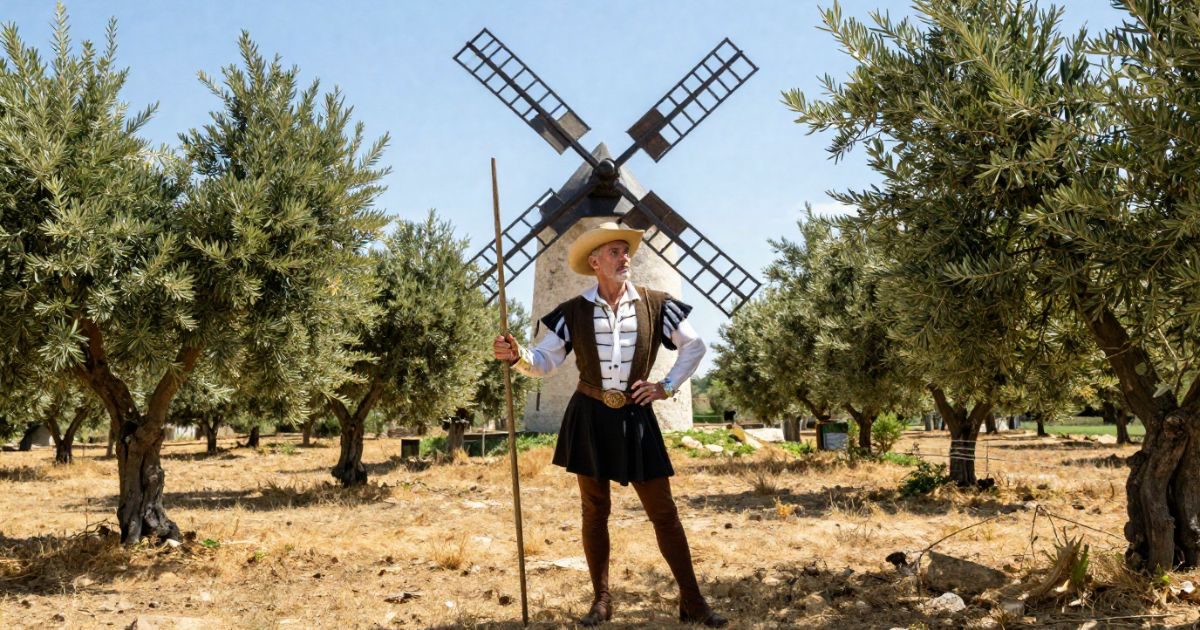
On the plain Don Quixote sees thirty or forty windmills and announces monstrous giants with arms nearly two leagues long. Sancho names them plainly: mills, sails, millstones. Quixote is so sure they are giants that he neither hears the warning nor sees the sails, commends himself to Dulcinea, and charges Rocinante at the first mill. A breeze turns the sail, the lance shivers, and horse and rider roll on the ground. Sancho says only a man with the same thing in his head could have mistaken them. Quixote blames the sage Friston for turning giants into mills to steal his glory.
They limp toward Puerto Lapice. Quixote rips a dry oak branch to replace the lance, recalls Diego Perez de Vargas pounding Moors with a bough, and will not complain of pain because knights-errant may not, even if their bowels come out. Sancho eats from the alforjas and drinks from the bota; Quixote stays awake all night for Dulcinea, as the books require. At the thoroughfare he forbids Sancho to draw sword against knights, only against rabble.
Then two Benedictine friars on tall mules appear, followed by a coach carrying a Biscay lady bound for Seville. Quixote posts himself in the road and orders the black bodies to release the stolen princess. Sancho warns that this will be worse than the windmills. The first friar flings himself off his mule to save his life; the second flees. Sancho tries to strip the fallen gown as lawful spoil, and the muleteers knock him breathless. Quixote tells the lady to present herself to Dulcinea at El Toboso. A Biscayan squire seizes the lance and will not let the coach pass. Swords come out, a cushion becomes a shield, and the lady's people make a thousand vows. At the crisis the first author leaves the battle impending, and the second author promises that heaven favouring him he found the rest in a way the Second Part will relate.
On the plain Don Quixote sees windmills and announces thirty monstrous giants. Sancho names them plainly. Quixote is so sure they are giants that he cannot hear or see otherwise, charges Rocinante, shatters his lance on a sail, and falls hard. Sancho's diagnosis is perfect: only a man with windmills in his head could mistake them. Quixote blames Friston for turning giants into mills to steal his glory. They mend the lance from an oak branch, debate whether knights may complain of wounds, and let Sancho eat and sleep while Quixote stays awake for Dulcinea. At Puerto Lapice he forbids Sancho to draw sword against knights. Then he halts two Benedictine friars and a coach, declares the friars magicians stealing a princess, and charges despite Sancho's warning that this will go worse than the windmills. Cervantes makes the cost visible: not only what the characters suffer, but what bystanders must decide once the story can no longer stay private. The chapter asks whether comfort, silence, or intervention is the truer form of care when someone is living inside a plot of their own.
Explore this chapter with AI to uncover deeper meaning and practical takeaways.
AI Discussion