
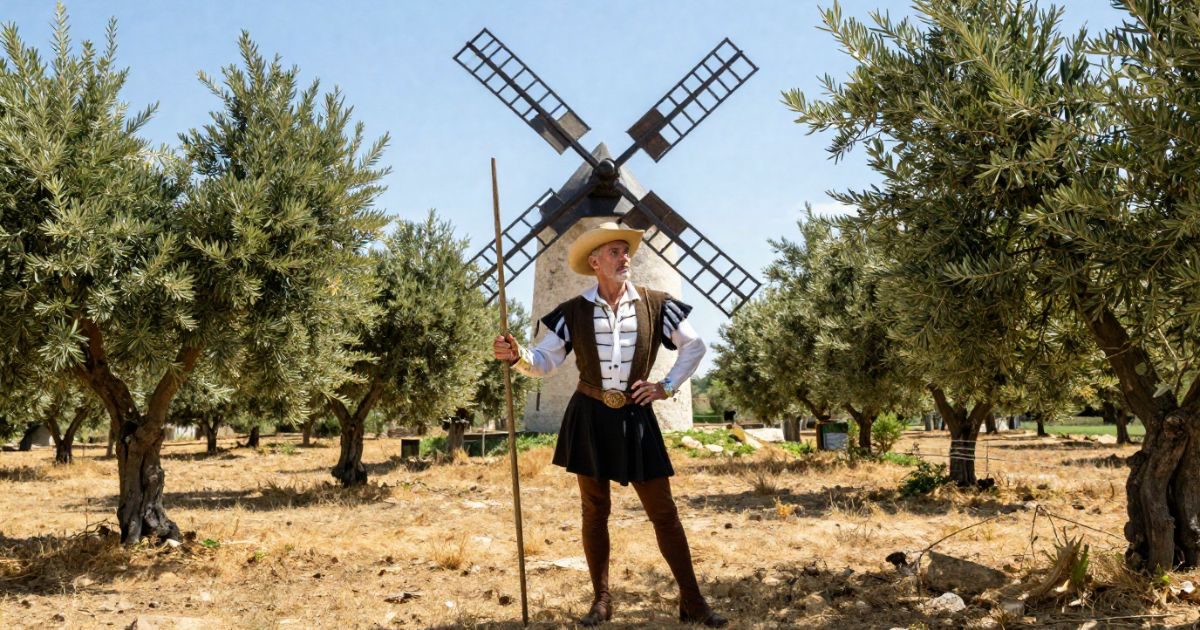
Leaving Don Diego's village, Don Quixote joins two students and two peasants on asses, introduces himself as the Knight of the Lions, and accepts an invitation to the wedding of Camacho the rich and Quiteria the fair. The licentiate tells how Basilio loved Quiteria from childhood like a village Pyramus and Thisbe, until her father blocked the match and chose the wealthy Camacho instead.
Quixote says Basilio's swordplay alone should win him Queen Guinevere; Sancho, citing "each ewe to her like," wishes the poor lover luck anyway. Quixote answers with a long sermon on parental choice, love's blindness, and marriage as a lifelong companion no more returnable than a Gordian knot. Basilio, learning of tomorrow's wedding, has stopped eating, sleeping, or speaking rationally, and the company expects Quiteria's yes to be his death sentence.
Sancho's proverb speech provokes a comic quarrel over gravelling versus cavilling and Sayago dialect versus Toledo polish. Then bachelor Corchuelo challenges the licentiate's fencing science; Don Quixote judges the duel, and skill buttons Corchuelo into defeat while a notary swears the thrown sword flew three-quarters of a league, proving strength is overcome by skill.
At night they reach the wedding meadow blazing with lights, music, and raised benches for plays and dances dedicated to the marriage of Camacho the rich and the obsequies of Basilio. The licentiate then lectures Corchuelo cured of dogmatism on the mathematical excellences of swordplay until dark. Quixote refuses to enter the village, citing knightly custom to sleep in fields and woods, and turns aside with Sancho, who misses Don Diego's good table.
Leaving Don Diego's village, Don Quixote joins two students and two peasants on asses, introduces himself as the Knight of the Lions, and accepts an invitation to the wedding of Camacho the rich and Quiteria the fair. The licentiate tells how Basilio loved Quiteria from childhood like a village Pyramus and Thisbe, until her father blocked the match and chose the wealthy Camacho instead. Quixote says Basilio's swordplay alone should win him Queen Guinevere; Sancho, citing "each ewe to her like," wishes the poor lover luck anyway. Quixote answers with a long sermon on parental choice, love's blindness, and marriage as a lifelong companion no more returnable than a Gordian knot. Basilio, learning of tomorrow's wedding, has stopped eating, sleeping, or speaking rationally, and the company expects Quiteria's yes to be his death sentence. Cervantes makes the cost visible: not only what the characters suffer, but what bystanders must decide once the story can no longer stay private. The chapter asks whether comfort, silence, or intervention is the truer form of care when someone is living inside a plot of their own.
Explore this chapter with AI to uncover deeper meaning and practical takeaways.
AI Discussion