
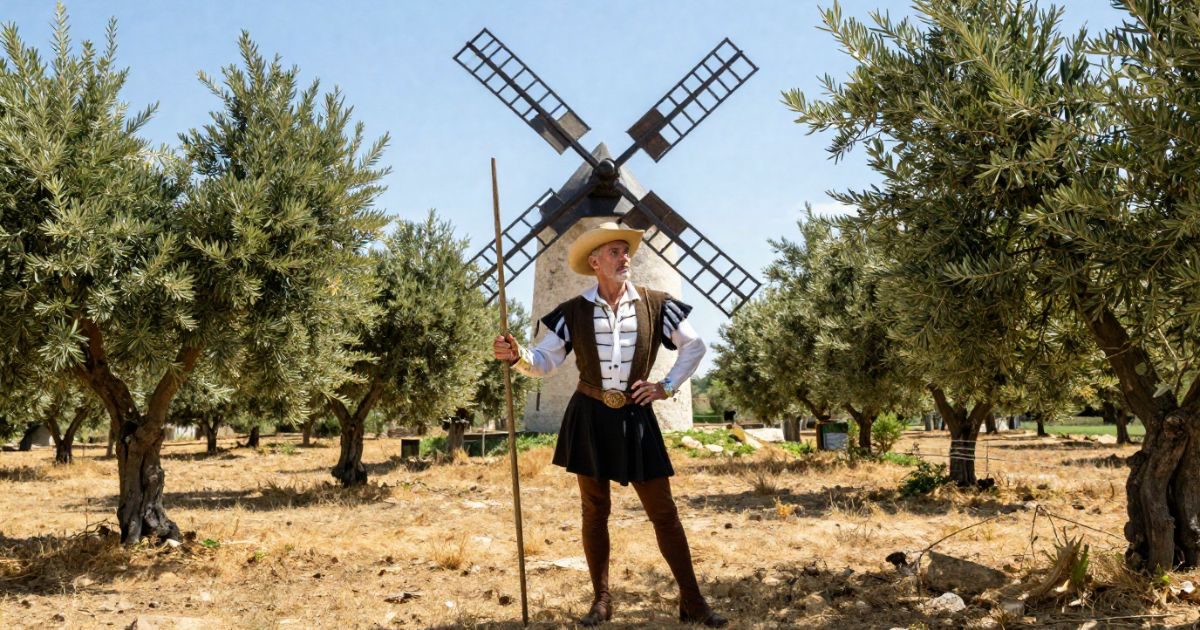
Don Quixote arrives at Don Diego de Miranda's village house, where Toboso wine jars move him to sigh over Dulcinea before he even knows he is speaking aloud. Doña Christina receives the muddy, curd-stained knight with courtesy, Sancho helps him wash until the water stays whey-coloured, and Don Lorenzo, Diego's poet son, listens to a guest who looks absurd yet speaks with polished grace.
Diego tells Lorenzo he has seen Quixote perform the acts of the greatest madman and make observations sensible enough to undo them all. In conversation Lorenzo tests him: Quixote declares knight-errantry a science above poetry, listing the law, theology, medicine, astronomy, and virtues a true knight must master. Lorenzo nearly catches him tripping, but Quixote slips away like an eel and later pronounces him the best poet on earth after hearing his gloss and Pyramus and Thisbe sonnet.
Diego's table pleases Quixote most for its Carthusian silence. Diego's table pleases Quixote most for its Carthusian silence. After grace he presses Lorenzo to recite his tournament gloss, listens with expert opinions on second prizes and gloss rules, then shouts that Lorenzo deserves laurel from Paris, Bologna, and Salamanca. Lorenzo enjoys the praise even while counting him a glorious madman, and recites a Pyramus and Thisbe sonnet to satisfy the knight's appetite for verse. Lorenzo sums him up to his father as a madman full of streaks and lucid intervals. Sancho, well fed for four days, dreads returning to the woods and restocks his saddlebags from Diego's stores. When departure comes, Quixote refuses idleness, thanks his hosts, and sets out toward the cave of Montesinos and the lakes of Ruidera on his way to Saragossa. His parting advice mixes sensible counsel about poetry with an offer to take Lorenzo knight-erranting, leaving father and son amazed at the strange medley of sense and nonsense in one man.
Don Quixote arrives at Don Diego de Miranda's village house, where Toboso wine jars move him to sigh over Dulcinea before he even knows he is speaking aloud. Doña Christina receives the muddy, curd-stained knight with courtesy, Sancho helps him wash until the water stays whey-coloured, and Don Lorenzo, Diego's poet son, listens to a guest who looks absurd yet speaks with polished grace. Diego tells Lorenzo he has seen Quixote perform the acts of the greatest madman and make observations sensible enough to undo them all. In conversation Lorenzo tests him: Quixote declares knight-errantry a science above poetry, listing the law, theology, medicine, astronomy, and virtues a true knight must master. Lorenzo nearly catches him tripping, but Quixote slips away like an eel and later pronounces him the best poet on earth after hearing his gloss and Pyramus and Thisbe sonnet. Cervantes makes the cost visible: not only what the characters suffer, but what bystanders must decide once the story can no longer stay private. The chapter asks whether comfort, silence, or intervention is the truer form of care when someone is living inside a plot of their own.
Explore this chapter with AI to uncover deeper meaning and practical takeaways.
AI Discussion