
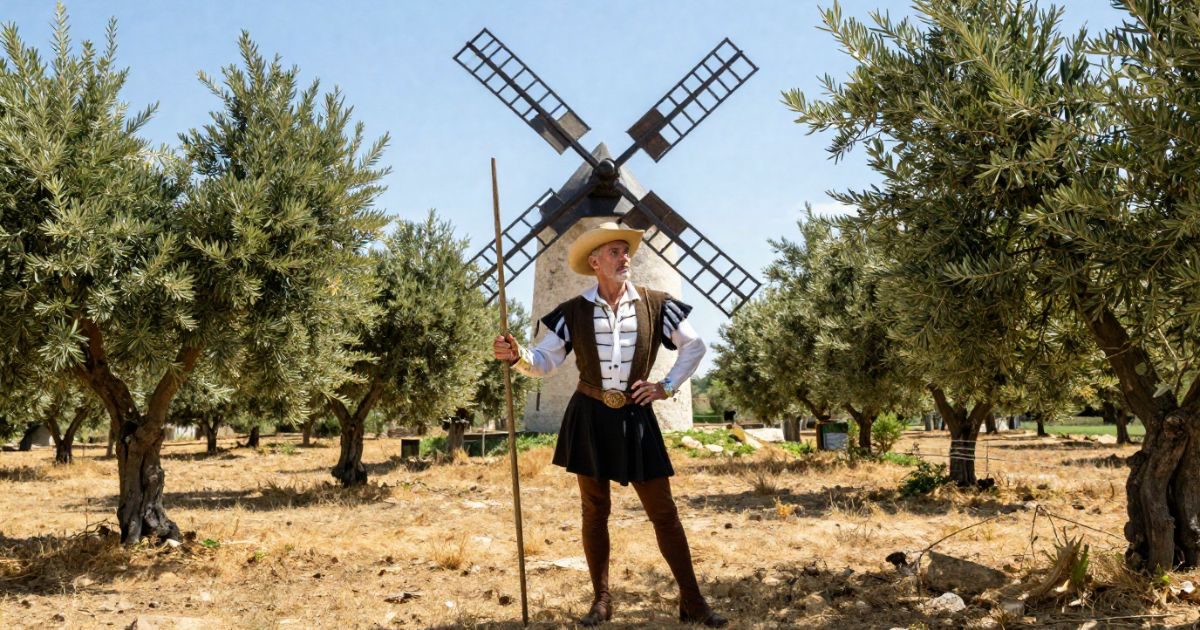
The Knight of the Grove resumes his Casildea de Vandalia saga: Giralda stilled, bulls of Guisando lifted, cavern of Cabra searched, and knights across Spain forced to confess her beauty. His labours never end because each finished peril only opens another, and his crown jewel is a claimed victory over Don Quixote of La Mancha, whose fame he says now belongs to him because the vanquished knight's renown gilds the victor's crown. He names Quixote's aquiline nose, Sancho, Rocinante, and Dulcinea, once Aldonza Lorenzo, with such precision that Quixote admits the portrait matches, yet still denies the defeat could have been real.
Quixote nearly calls the lie direct, but holds back to force a confession and answers with enchanter theory: enemies may have sent an impostor in his shape to steal his fame, and Dulcinea too has been transformed within the last ten hours. They agree to duel at dawn on knightly terms, the vanquished to obey the victor within the limits of chivalry. Their squires wake snoring. The Grove squire invokes Andalusian custom and proposes bag blows with pebbles, then three or four buffets to start the anger. Sancho refuses every provocation, citing wax penalties, missing swords, peace, and a cudgel if anyone handles his face.
At sunrise the Grove knight appears as the Knight of the Mirrors in cloth of gold studded with little moons, while his squire's enormous pasteboard nose terrifies Sancho into a cork tree. Quixote asks to see his face; the Mirror knight refuses for Casildea's sake. The other horse will not budge. Quixote charges with unparalleled fury, and one blow drops the Mirror knight senseless. Unlacing the helmet, Quixote finds the bachelor Samson Carrasco. Sancho, still half believing in enchanters, advises a sword-thrust into the mouth. The squire removes his nose, pulls the pasteboard from his pocket, and reveals himself as Tom Cecial, Sancho's neighbour. Quixote makes the fallen knight confess Dulcinea's shoe above Casildea's beard and swear to carry a message to El Toboso, while insisting Samson must be an enchanter's double, not the friend he seems. Both master and man leave under that delusion and ride on toward Saragossa.
The Knight of the Grove resumes his Casildea de Vandalia saga: Giralda stilled, bulls of Guisando lifted, cavern of Cabra searched, and knights across Spain forced to confess her beauty. His labours never end because each finished peril only opens another, and his crown jewel is a claimed victory over Don Quixote of La Mancha, whose fame he says now belongs to him because the vanquished knight's renown gilds the victor's crown. Quixote nearly calls the lie direct, but holds back to force a confession and answers with enchanter theory: enemies may have sent an impostor in his shape to steal his fame, and Dulcinea too has been transformed within the last ten hours. They agree to duel at dawn on knightly terms, the vanquished to obey the victor within the limits of chivalry. Their squires wake snoring; the Grove squire invokes Andalusian custom and proposes bag blows with pebbles, but Sancho refuses every provocation, citing wax penalties, missing swords, peace, and a cudgel if provoked. Cervantes makes the cost visible: not only what the characters suffer, but what bystanders must decide once the story can no longer stay private. The chapter asks whether comfort, silence, or intervention is the truer form of care when someone is living inside a plot of their own.
Explore this chapter with AI to uncover deeper meaning and practical takeaways.
AI Discussion