
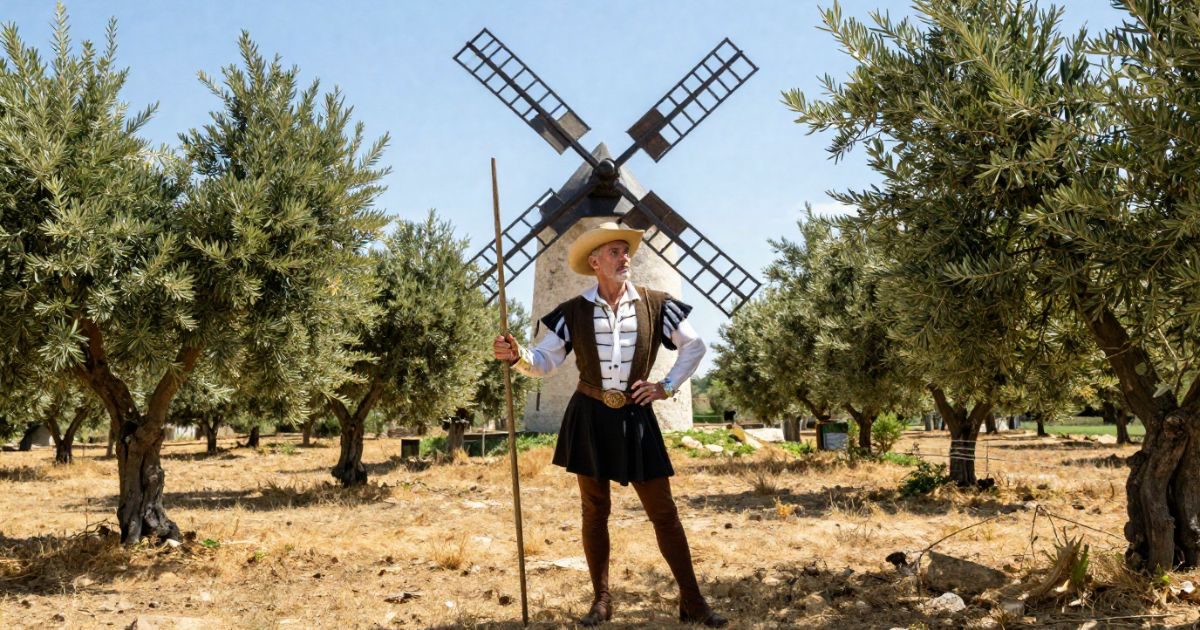
Part Two opens a month after the ox-cart homecoming. The curate and barber stay away from Don Quixote lest they reawaken his madness, but they visit his niece and housekeeper, hear that he sometimes sounds sane, and come to test him in bed, green waistcoat and red cap, looking as withered as a mummy. They talk of government reform with such good sense that the two almost believe the enchanted ride cured him, and the niece and housekeeper thank God for a mind so clear. Then the curate, changing plan, mentions the Turkish fleet threatening Naples, Sicily, and Malta.
Don Quixote advises the king to proclaim a day when every knight-errant in Spain must assemble. Even half a dozen might suffice, for one alone could destroy the Turk as if an army had but one throat. He refuses to detail the plan lest some courtier steal the credit. The niece groans that he wants to ride out again. To undercut the fantasy, the barber tells of a Seville madhouse where a licentiate in canon law writes sensible letters to the archbishop, persuades a chaplain he is cured, and blames his relations for wanting his property. He bids farewell to the inmates with talk of empty stomachs and full brains, and is undone when another madman calling himself Jupiter vows three years without rain on the city. The freed man answers as Neptune. The governor laughs, and the chaplain strips him and leaves him behind.
Quixote catches the comparison, says he is not Neptune, and delivers a long defence of knight-errantry against a slothful age of brocade instead of mail, open-field sleeping, and bark voyages that deserve to be written on brass. The curate pretends he cannot believe Amadis, Roland, Reinaldos, and the Twelve Peers ever lived. Quixote replies with detailed portraits from the books, debates giants through Goliath and Sicilian bones, and argues Angelica was flighty while scorned poets write satires. Everyone enjoys the nonsense until an outcry in the courtyard from the niece and housekeeper interrupts them. Sancho is forcing his way in while they call him the vagabond who led their master astray.
Part Two opens a month after the ox-cart homecoming. The curate and barber avoid Don Quixote lest they reawaken his madness, but visit his niece and housekeeper and hear that he sometimes sounds sane. They test him in bed, green waistcoat and red cap, and find him discussing government reform with such good sense that they almost believe the enchanted ride cured him; then they deliberately mention the Turkish fleet threatening Naples, Sicily, and Malta. Don Quixote advises the king to proclaim a day when every knight-errant in Spain must assemble; even half a dozen might suffice, for one alone could destroy the Turk as if an army had but one throat. He refuses to detail the plan lest some courtier steal the credit. The niece groans that he wants to ride out again and vows he will die a knight-errant. To undercut the fantasy, the barber tells of a Seville madhouse where a licentiate in canon law persuades an archbishop's chaplain he is cured, bids farewell to the inmates with talk of empty stomachs and full brains, and is undone when another madman calling himself Jupiter vows three years without rain on the city; the freed man answers as Neptune, the governor laughs, and the chaplain strips him and leaves him behind. Cervantes makes the cost visible: not only what the characters suffer, but what bystanders must decide once the story can no longer stay private. The chapter asks whether comfort, silence, or intervention is the truer form of care when someone is living inside a plot of their own.
Explore this chapter with AI to uncover deeper meaning and practical takeaways.
AI Discussion