
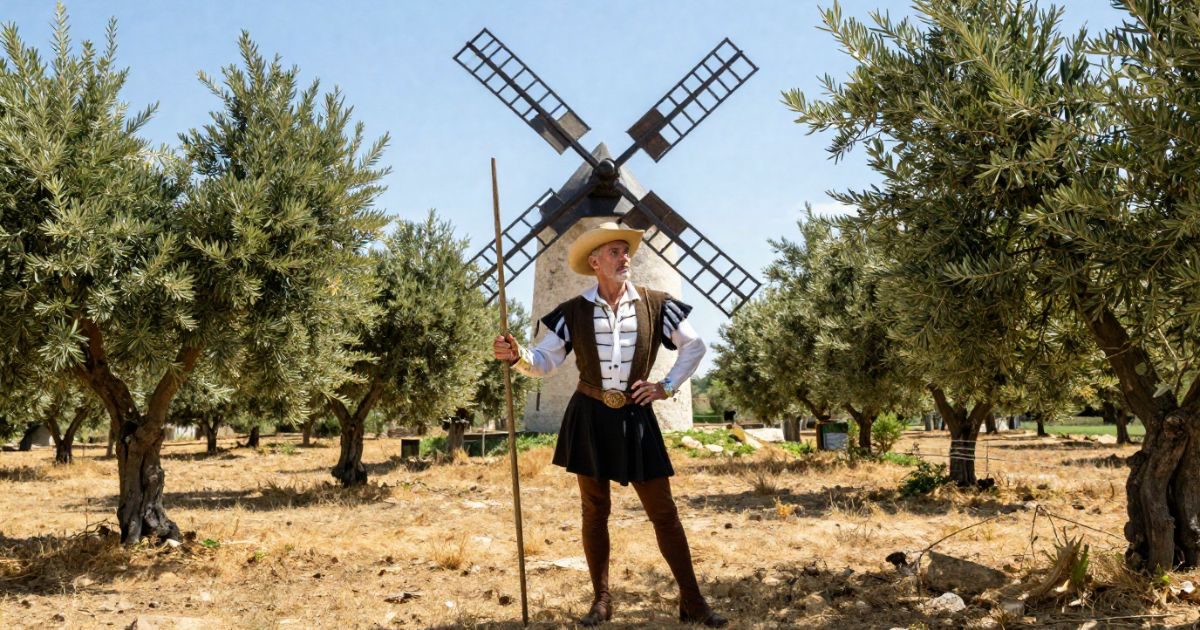
The basin dispute resumes, and the inn's own barber, licence in the craft for twenty years and a soldier in his youth, backs the delusion for amusement. The piece in Quixote's hands is no basin, he says, but it is not a complete helmet either, the beaver being wanting. The robbed barber can scarcely believe an honourable company will say so. If the basin is a helmet, then the pack-saddle is a horse's caparison. Quixote will not rule on the saddle. Too many strange things have happened in this castle, including two hours hanging by one arm, for him to assert anything positively; enchantment rules here, and those not dubbed knights may still see things as they are. Don Fernando takes secret votes from those in on the humour and declares the pack-saddle a thoroughbred's caparison. Don Luis's servants and three officers of the Holy Brotherhood, who know nothing of the game, stare in disbelief.
A Brotherhood officer will not have it. It is a pack-saddle as sure as his father is his father. Quixote calls him a liar and brings the pike down; the shaft shivers on the ground, and the inn becomes one brawl of barbers, servants, officers, and guests. Sancho and the robbed barber seize the saddle between them; Don Luis cuffs a servant; Doña Clara faints. Quixote thunders that they are in Agramante's camp, fighting at cross purposes for sword, horse, eagle, and helmet, and bids the Judge and curate play Agramante and Sobrino. The pack-saddle remains a caparison, the basin a helmet, the inn a castle. Peace is patched: three of Don Luis's men will go to his father, one will stay.
Peace lasts only until the officer who was thrashed remembers a warrant for the man who freed the galley slaves. He reads the parchment slowly, matches the face, and seizes Quixote by the collar so tightly the knight cannot breathe, shouting for the Holy Brotherhood. Quixote throttles him back. Fernando parts them. The officers still demand their highwayman bound for the king. Quixote smiles and asks whether it is robbery to free those in bondage. Knights-errant are independent of all jurisdictions; their law is their sword. No knight-errant ever paid poll-tax, toll, or ferry, and he will give four hundred cudgellings to four hundred officers if they come in his way.
The basin dispute resumes, and the inn's own barber joins the joke, swearing the piece is no barber's basin but an incomplete helmet missing its beaver. Don Fernando collects secret votes from those in on Quixote's humour and declares the pack-saddle a thoroughbred's caparison; the robbed barber and Don Luis's servants, who know nothing of the game, stare in disbelief while Quixote says enchantment rules the castle. A Brotherhood officer insists it is plainly a pack-saddle; Quixote strikes at him, the pike shatters, and the inn becomes one brawl of barbers, servants, officers, and guests. Quixote roars that they are in Agramante's camp and bids the Judge and curate play peacemakers; the fight subsides, Don Luis's future is arranged with Don Fernando, and for Quixote the basin stays a helmet forever. Cervantes makes the cost visible: not only what the characters suffer, but what bystanders must decide once the story can no longer stay private. The chapter asks whether comfort, silence, or intervention is the truer form of care when someone is living inside a plot of their own.
Explore this chapter with AI to uncover deeper meaning and practical takeaways.
AI Discussion