
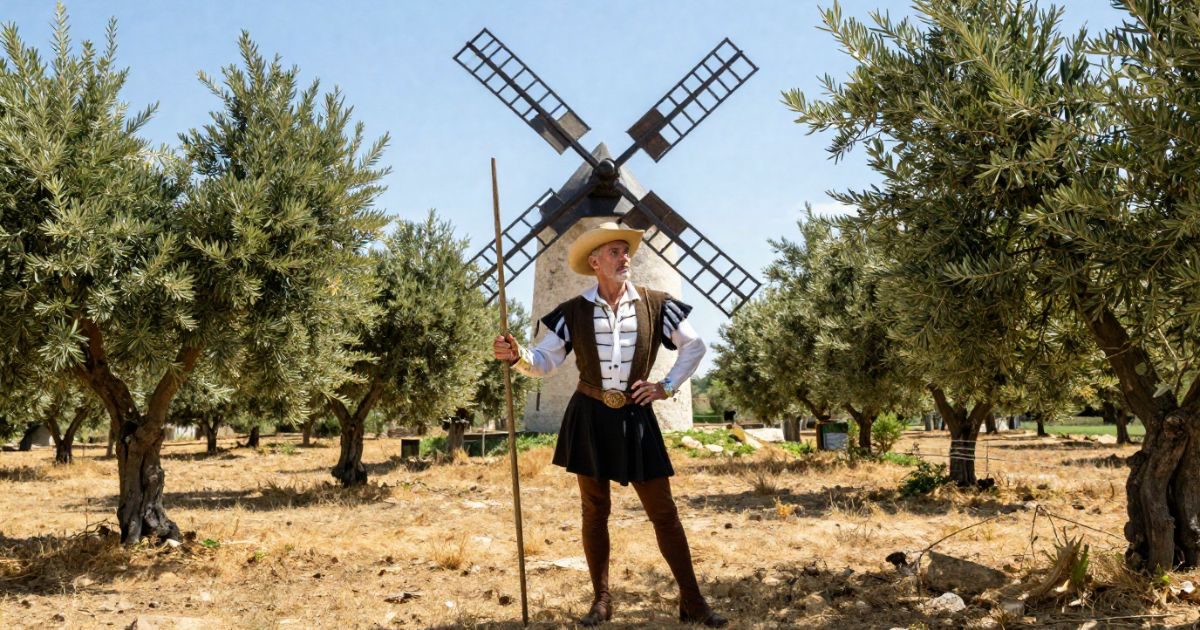
The curate's probe about the galley slaves makes Sancho confess at once, and Quixote defends the deed as knightly duty. Knights-errant do not ask whether the chained go that way for faults or misfortunes; they aid need, not rascality. Whoever objects, saving the licentiate's dignity, knows little of chivalry and lies like a whoreson villain. He settles in his stirrups. Dorothea, who by now understands the craze and that all except Sancho are making game of him, reminds him of the boon already granted: no other adventure, however pressing, until hers is done. The curate swears he would have plucked a moustache rather than speak had he known whose arm freed the chain.
Asked for her trouble, she forgets the name the curate gave her. He supplies Princess Micomicona, lawful heiress of Micomicon, and she spins the tale of King Tinacrio the Sapient, Queen Jaramilla, and the giant Pandafilando of the Scowl, who looks askew out of malignity. The sage king told her not to fight but to seek in Spain a lank knight called Don Azote or Don Gigote, with a grey mole under the shoulder. Sancho corrects the name. Quixote wants to strip to find the mole; Sancho says it is on the backbone, mark of a strong man. When she says she landed at Osuna, which is not a seaport, the curate saves her: Malaga first, Osuna after. She adds that after the giant's throat is cut she is to offer herself as wife. Quixote will restore her realm, but he will not marry a phoenix. His will is enslaved by another.
Sancho, furious at the lost county, says Dulcinea does not come up to this queen's shoe and tells his master to marry and make him a marquis. Quixote gives him two thwacks that bring him to the ground and would have taken his life if Dorothea had not cried out. Might comes from Dulcinea; she fights in him and conquers in him. Sancho hides behind the palfrey and bargains: marry this one, then go back to the other; kings have kept mistresses. Quixote forgives him, first impulses not being in our control, and they ride ahead to talk of the mission. On the road Sancho spots Gines de Pasamonte disguised as a gipsy on Dapple. One shout is enough. Gines jumps down and runs. Quixote will not cancel the three ass-colts even so. Then, asked for Dulcinea's looks and the letter's fate, Sancho admits the notebook never left the Sierra. He had a sacristan copy what he remembered, put in more than three hundred "my souls" and "my life's," and kept of the original only "Scrubbing Lady" and "Yours till death."
The curate's probe about the galley slaves makes Sancho confess and Quixote defend freeing criminals as knightly mercy. Dorothea then plays Princess Micomicona to the life, forgets her cue mid-speech, and the curate quietly supplies the name before she spins the tale of giant Pandafilando of the Scowl. Quixote accepts the quest; Sancho already counts himself governor and husband. Quixote credits Dulcinea's might for the victory not yet fought, while Sancho and he quarrel over whether the squire really saw Dulcinea's beauty. Cervantes makes the cost visible: not only what the characters suffer, but what bystanders must decide once the story can no longer stay private. The chapter asks whether comfort, silence, or intervention is the truer form of care when someone is living inside a plot of their own.
Explore this chapter with AI to uncover deeper meaning and practical takeaways.
AI Discussion