
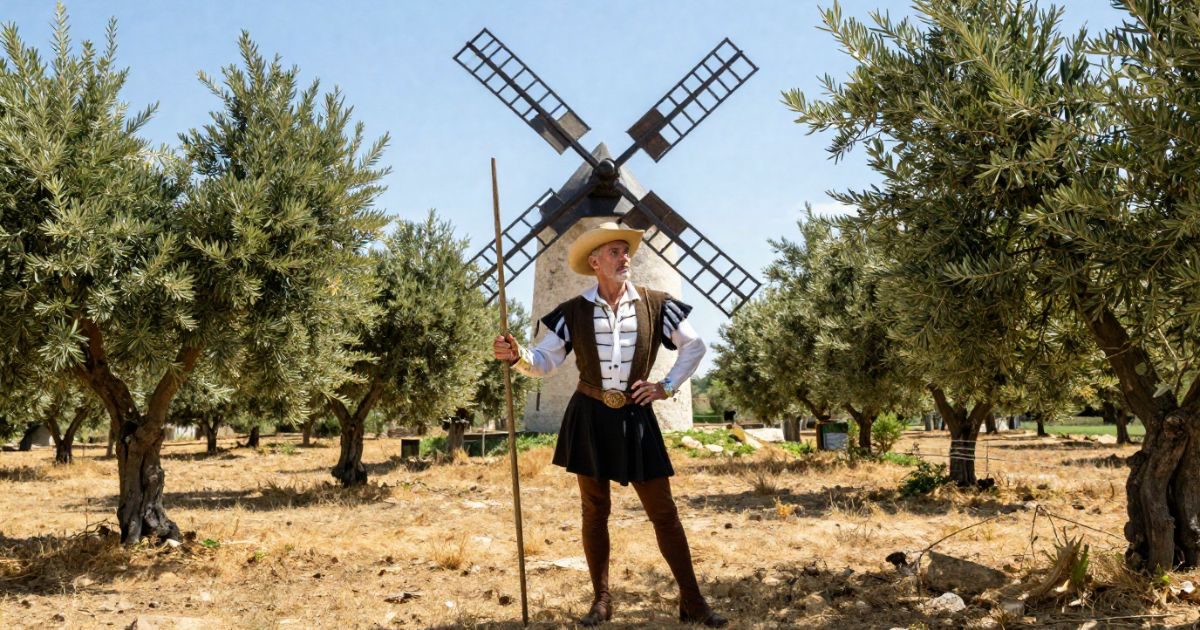
Dorothea ends her tale and asks only for a place to hide, not empty comfort. Shame at facing her parents without the purity they expected outweighs even their love. Cardenio forestalls the curate: she is the fair Dorothea, only daughter of the rich Clenardo, and he is the man Luscinda named as her husband. He heard the "Yes," had not the fortitude to wait for the paper, and now sees a door still open. Luscinda cannot be Fernando's, being his; Fernando cannot be Luscinda's, being hers. He swears as a gentleman and a Christian not to desert Dorothea until Fernando owns the obligation, and if words fail he will challenge him for her injury, leaving his own wrongs to Heaven. She tries to kiss his feet. The curate offers his village; the barber offers his services; Cardenio remembers the quarrel with Quixote as one remembers a dream, without the cause.
Sancho shouts from the broom trail. He has found his master stripped, yellow, half dead with hunger, still sighing for Dulcinea, and still refusing to appear before her until he has done deeds worthy of her, even though told she waits in El Toboso. Dorothea says she can play the distressed princess better than the barber. She has the dress in her pillow-case and has read enough books of chivalry to know how afflicted damsels beg boons. In a green mantle and necklace she looks like a great lady. Sancho, who has never seen such a creature, is told she is heiress of Micomicon, come from Guinea to have a giant killed. He at once begs the curate to marry his master to her so the knight cannot take archbishop's orders, for a married squire is no good for the Church.
Princess Micomicona kneels and will not rise until the boon is granted. Quixote grants it provided it does not prejudice his king, his country, or the lady who holds the key of his heart. Sancho whispers that it is only to kill a big giant. She asks him to accompany her and engage in no other adventure until a traitor is avenged. He arms at once. Sancho, left on foot for want of Dapple, already sees himself king of an island and worries only that the vassals will be black, then comforts himself that cargo can be turned into money and a title. The curate shears Cardenio's beard, meets them as if by chance, and the hired mule kicks the ox-tail off the barber. Quixote calls it a miracle. The curate mutters a charm, sticks the beard back, and promises to teach the spell. Then he tests whether the knight will own his crimes, spinning a tale of beard-stripping footpads who were galley slaves set free by some scoundrel without heart or conscience. Quixote changes colour at every word and never confesses. Pulling him home means feeding a bigger story, not breaking the old one.
Dorothea ends her tale and asks only for a place to hide, not empty comfort. The curate offers his village; Cardenio and Dorothea recognise Fernando's trail in each other's wounds, and the party decides Dorothea can play the distressed princess better than the barber. Sancho leads the disguised group to Quixote, still sighing for Dulcinea though told she waits in El Toboso. Dorothea as Princess Micomicona kneels, names a wicked giant, and asks him to abandon all other adventures until her wrong is righted. Quixote grants the boon at once. Cervantes makes the cost visible: not only what the characters suffer, but what bystanders must decide once the story can no longer stay private. The chapter asks whether comfort, silence, or intervention is the truer form of care when someone is living inside a plot of their own.
Explore this chapter with AI to uncover deeper meaning and practical takeaways.
AI Discussion