
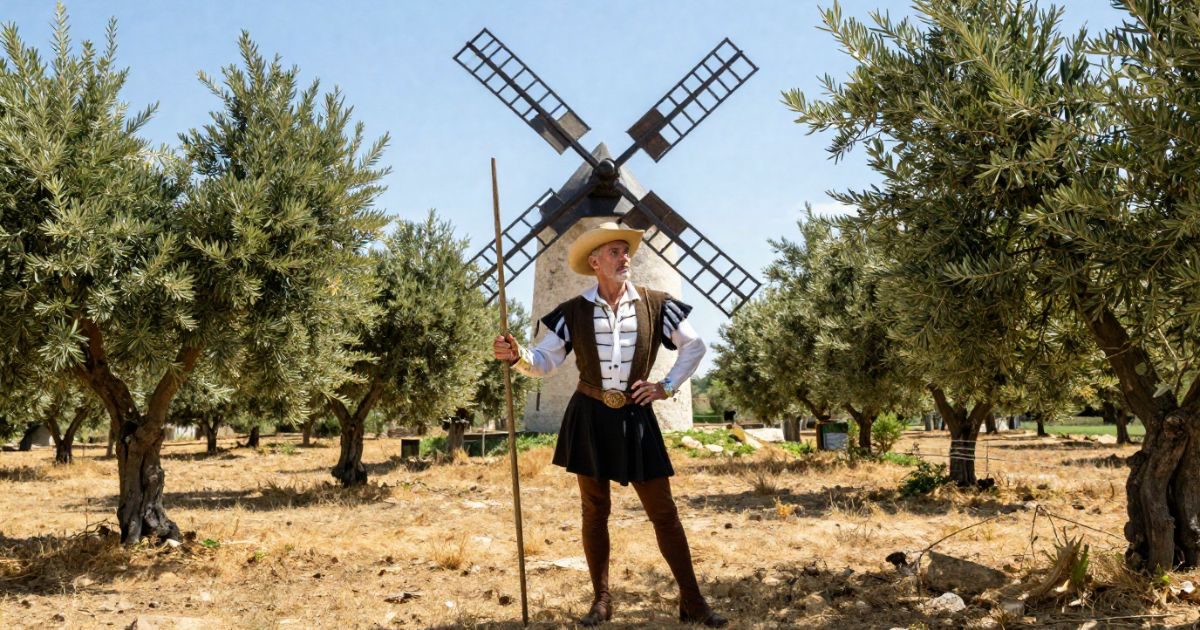
It begins to rain, and Sancho would go into the fulling mills. Don Quixote has taken such an abhorrence to them on account of the joke that he will not enter on any account, so they turn aside onto another road. Shortly afterward he sees a man on horseback wearing something that shines like gold, and says that where one door shuts, another opens: last night fortune cheated them with mills, and now, if he mistakes not, here comes the helmet of Mambrino, concerning which he took the oath Sancho remembers. Sancho does not want any more fulling mills knocking their senses out. What he sees is a man on a grey ass like his own, with something that shines on his head. The fact is that a barber, riding between two villages to bleed one man and shave another, has put his brass basin on to save a new hat from the rain, and the basin glitters at half a league. Without parley Quixote bears down with the pike pointed low. The barber lets himself fall, springs up like a deer, and speeds across the plain, leaving the basin. Quixote says the pagan has imitated the beaver, which bites off what the hunters pursue.
Sancho picks it up and says the basin is worth a real of eight. Quixote puts it on, turns it this way and that, and finds half of it wanting: the pagan who first wore this head-piece must have had a very large head. Sancho, remembering the pike, checks his laughter and says it looks exactly like a regular barber's basin. Quixote suspects someone melted half the pure gold and made of the rest this thing like a basin; he will have a blacksmith set it to rights until it rivals the helmet the god of smithies forged for the god of battles, and in the meantime it will do to protect him from a chance blow of a stone. Sancho reminds him of the slings at the battle of the two armies. As for the dapple-grey steed that looks like a grey ass, the laws of chivalry will not stretch to changing one ass for another, but the matter of trappings being doubtful, Sancho, fortified by this licence, effects the mutatio capparum and rigs his beast to the ninety-nines. They break their fast on the remaining clerical spoils, drink from the mill brook without looking that way, and let Rocinante choose the road.
Sancho asks leave to speak, because the hard injunction of silence has left things rotting in his stomach. Little is got by adventures in wilds where, even if the most perilous are won, no one sees them and they remain untold. Better to serve some emperor who has a war on hand, so that the worth of the knight's person may be written down. Quixote says the thought is not amiss, but first a knight must roam on probation until boys at the city gate cry that this is he who vanquished Brocabruno and delivered the Mameluke of Persia. Then comes the king at the windows, the queen's chamber, the princess more divine than human, a hideous dwarf with a fair dame between two giants, a war, a grating in a garden, tears, a marriage, and at last a throne and a duke's daughter for the squire. Sancho says that is what he is waiting for, word for word, under the title of the Knight of the Rueful Countenance.
All they want now, Quixote adds, is a king at war with a beautiful daughter, and a pedigree that will satisfy a father-in-law, for he cannot make out that he is even second cousin to an emperor. There are two kinds of lineages, a pyramid upside down and a rising from the common herd; a sage historian may yet clear him as fifth or sixth from a king, and if not, the princess will take him though he were a water-carrier's son, or they will carry her off. Sancho, an old Christian, holds that enough to fit him for a count. Once a king, Quixote can give nobility without purchase. Sancho will support the tittle, then the title, having been beadle of a brotherhood whose gown sat so well on him that all said he looked as if he were steward. He must shave his thick beard every second day, so he will keep a barber at wages and even make him go behind like a nobleman's equerry, as he saw in the capital. Quixote says he may be the first count to have a barber follow him, for shaving a beard is a greater trust than saddling a horse. Let the barber be Sancho's look-out, and the king's crown the knight's. Raising his eyes, he saw what will be told in the following chapter.
Rename the evidence sharply enough and you can wear your delusion on your head. Avoiding the fulling mills after rain, Quixote sees a barber's brass basin as Mambrino's golden helmet, charges, and keeps the prize when the barber flees. Sancho says it is a grey ass and a basin; Quixote says an enchanter melted half the gold and reshaped the rest. Sancho swaps trappings onto his beast, then asks leave to speak: serve an emperor, he says, so deeds get written down. Quixote answers with a long fantasy of court, princess, dwarf, war, and marriage until fame precedes the throne. Cervantes makes the cost visible: not only what the characters suffer, but what bystanders must decide once the story can no longer stay private. The chapter asks whether comfort, silence, or intervention is the truer form of care when someone is living inside a plot of their own.
Explore this chapter with AI to uncover deeper meaning and practical takeaways.
AI Discussion