
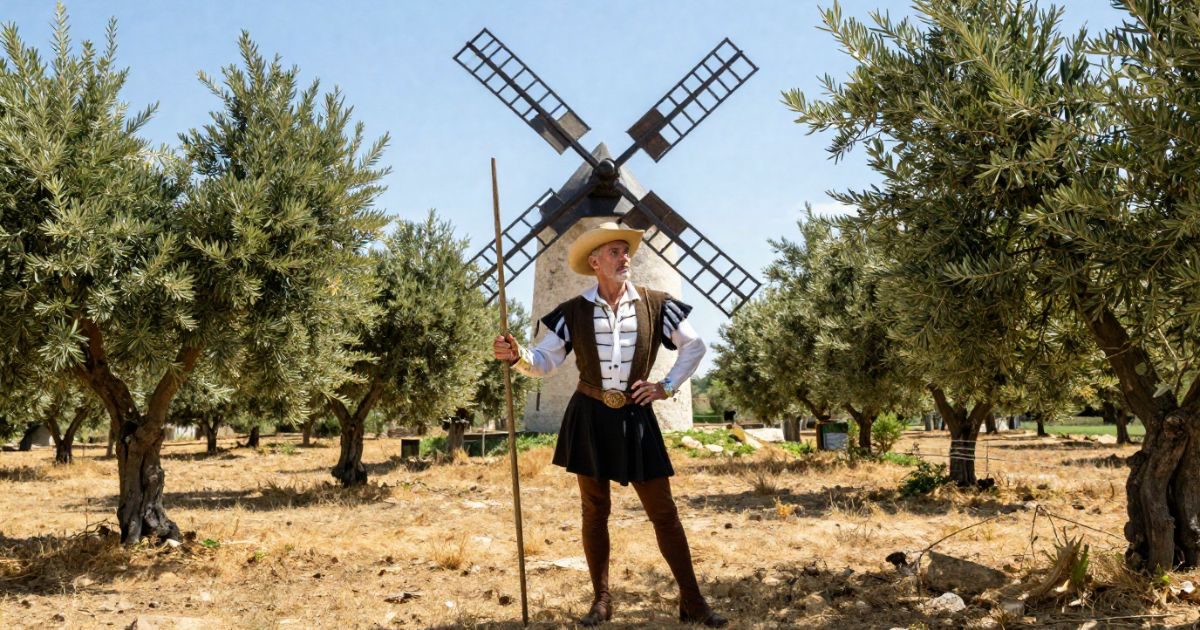
Thirst after the clerics' dry meat drives them across the dark meadow toward the sound of water falling from great rocks. Another noise spoils the cheer: measured strokes, a rattling of iron and chains, tall trees whose leaves make a low ominous sound. Don Quixote leaps on Rocinante, braces his buckler, and declares that Heaven has born him in this iron age to revive the golden one, outdoing the Twelve of France and the Nine Worthies. He tells Sancho to wait three days and no more, then go to El Toboso and say that her captive knight died attempting things that might make him worthy of being called hers. Sancho weeps, quotes the village curate that he who seeks danger perishes in it, and begs him at least to wait until the Horn marks dawn. Tears will not turn a knight aside. So while tightening the girths Sancho quietly ties Rocinante's legs with the ass's halter. The horse can only jump. Quixote, unsuspecting, takes it for Heaven's order and consents to wait.
Sancho holds the left thigh in his embrace, too afraid of the strokes to move a finger's width, and starts the tale of Lope Ruiz and Torralva, repeating every clause twice in the Estremadura fashion until Quixote bids him go straight on. The shepherd's love turns to hate; Torralva follows barefoot with comb and paint; they reach the swollen Guadiana, where a boat holds one person and one goat. Sancho makes his master keep count of three hundred crossings, and when Quixote cannot say how many have gone, the story ends there, for there is no going farther. Toward morning Sancho, still glued to the saddle, silently drops his breeches rather than step away. Quixote, fingers to his nose, says he smells stronger than ever, and not of ambergris, and that great familiarity has bred this contempt.
At daybreak Sancho unties the horse. Quixote takes the pawing for a signal, repeats the three-day watch and the will that will pay wages if he dies, and moves toward the water. Sancho follows on foot, leading the ass, and stretches his neck between Rocinante's legs. A hundred paces on, around a corner, the true cause appears: six fulling hammers making all the din by their alternate strokes. Quixote is struck dumb and rigid. Sancho's cheeks puff with laughter. The knight cannot help laughing at the sight of him, and Sancho lets go so heartily that he has to hold his sides, four times stopping and breaking out afresh, mocking the iron-age speech. Mortified, Quixote lifts his pike and smites him two such blows that, catching the head, there would have been no wages to pay except to his heirs.
Sancho says he is only joking. Quixote is not. If the hammers had been giants, had he not shown the courage the attempt required? Is a gentleman bound to distinguish fulling mills he has never seen? Turn the six hammers into six giants and bring them on, one by one or all together. Sancho owns he went too far, then asks how much a squire got in those days, by the month or by the day like bricklayers. Quixote never met a squire who talked so much: Gandalin kept his cap in his hand, Gasabal is named only once in a whole history. From this day they must observe more respect, for favours will come in due time, and if they do not, the wages in the sealed will will not be lost. Squires of old were dependent on favour, not wages, and no condition is more hazardous than that of adventurers. Sancho answers that the mere noise of fulling hammers can disquiet so valiant a heart, and promises not to open his lips henceforward except to honour his master as natural lord.
Fear turns a fulling mill into an epic before dawn proves otherwise. Thirsty after eating the dead man's meat without wine, Sancho reads the grass as proof of water, then hears falls, iron, and measured strokes in the dark chestnut grove. Quixote declares the golden age reborn and rides toward peril. Sancho secretly ties Rocinante's legs, calls it heaven's sign, and tells the endless Lope Ruiz and Torralva goat story one crossing at a time until Quixote begs him to stop repeating every line. At daybreak Quixote charges the noise anyway; Sancho weeps and follows. Cervantes makes the cost visible: not only what the characters suffer, but what bystanders must decide once the story can no longer stay private. The chapter asks whether comfort, silence, or intervention is the truer form of care when someone is living inside a plot of their own.
Explore this chapter with AI to uncover deeper meaning and practical takeaways.
AI Discussion