
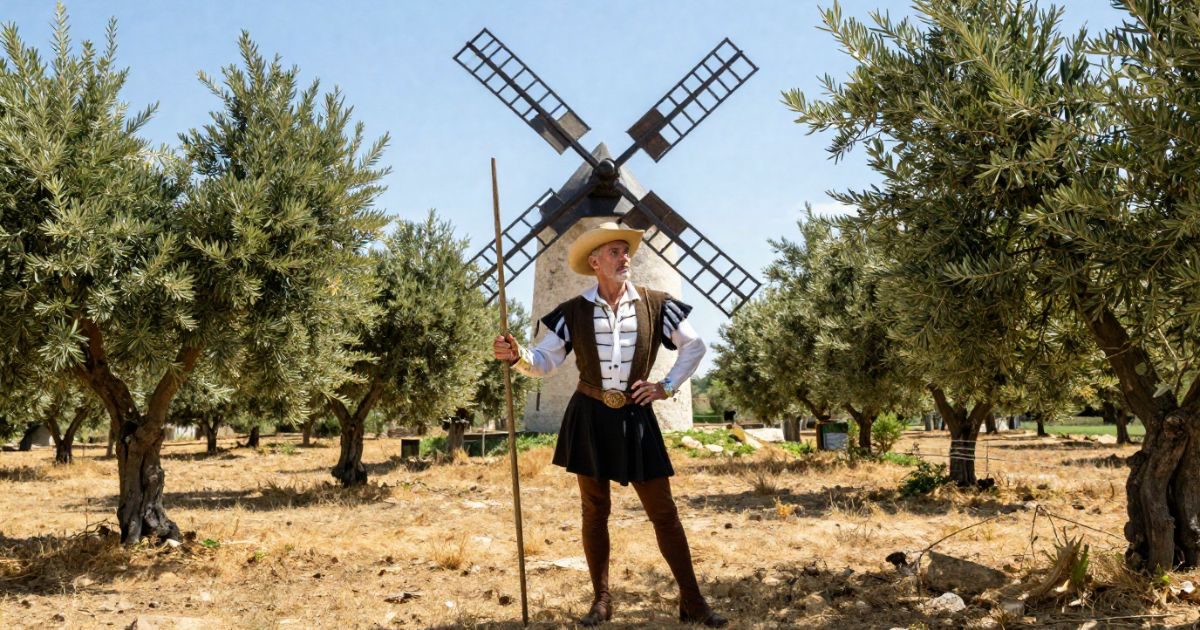
Quixote quits the inn for Barcelona by the direct road avoiding Saragossa to expose the lying historian; after six quiet days he broods in a thicket that Dulcinea is perishing, thou art living on regardless, while Sancho sleeps, and reasoning like Alexander the Great cutting the Gordian knot that lashes need not be voluntary he tries to whip Sancho with Rocinante's reins until Sancho overpowers him, singing traitor and Doña Sancha's foe, and Quixote swears not to touch a hair.
Sancho then feels men's feet and legs in the trees; Quixote identifies hanged freebooters and guesses they near Barcelona; at dawn Roque Guinart's band surrounds them, strips Dapple though the duke's crowns in Sancho's girdle escape, and the captain greets them with merciful words, marveling when Quixote names himself and laments being caught unbridged.
Claudia Jeronima rides up in green damask, tells Roque she shot Don Vicente for betraying their pledge to marry another; they find him dying, he denies the marriage and offers her his hand in death, she wrings his hands and faints on his bleeding breast as the insuperable and cruel might of jealousy ends both lives, and she vows a monastery while Roque offers protection and applauds her piety.
Roque restores Sancho's goods though three kerchiefs worth three cities are missing, divides loot with scrupulous exactness, and Sancho says justice is such a good thing even among thieves; Quixote urges the band toward knight-errantry, Roque robs two captains, pilgrims, and the regent's lady Doña Guiomar but lends crowns with safe-conducts, saying it is by his singing the abbot gets his dinner, spares pilgrims' hoard, gives Sancho ten crowns, and slays a saucy Gascon who grumbled about generosity.
Roque writes Barcelona to deposit Quixote in full armour mounted on Rocinante with Sancho on an ass in the middle of the strand on Saint John the Baptist's Day for the Niarros' sport, assuring his friend the knight is the drollest and wisest man in the world, and the letter goes by a squire disguised as a peasant while Quixote and Sancho wait among outlaws who live by spies, sentinels, and divided spoils.
Quixote quits the inn for Barcelona by the direct road avoiding Saragossa to expose the lying historian; after six quiet days he broods in a thicket that Dulcinea is perishing, thou art living on regardless, while Sancho sleeps, and reasoning like Alexander the Great cutting the Gordian knot that lashes need not be voluntary he tries to whip Sancho with Rocinante's reins until Sancho overpowers him, singing traitor and Doña Sancha's foe, and Quixote swears not to touch a hair. Sancho then feels men's feet and legs in the trees; Quixote identifies hanged freebooters and guesses they near Barcelona; at dawn Roque Guinart's band surrounds them, strips Dapple though the duke's crowns in Sancho's girdle escape, and the captain greets them with merciful words, marveling when Quixote names himself and laments being caught unbridged. Cervantes makes the cost visible: not only what the characters suffer, but what bystanders must decide once the story can no longer stay private. The chapter asks whether comfort, silence, or intervention is the truer form of care when someone is living inside a plot of their own.
Explore this chapter with AI to uncover deeper meaning and practical takeaways.
AI Discussion