
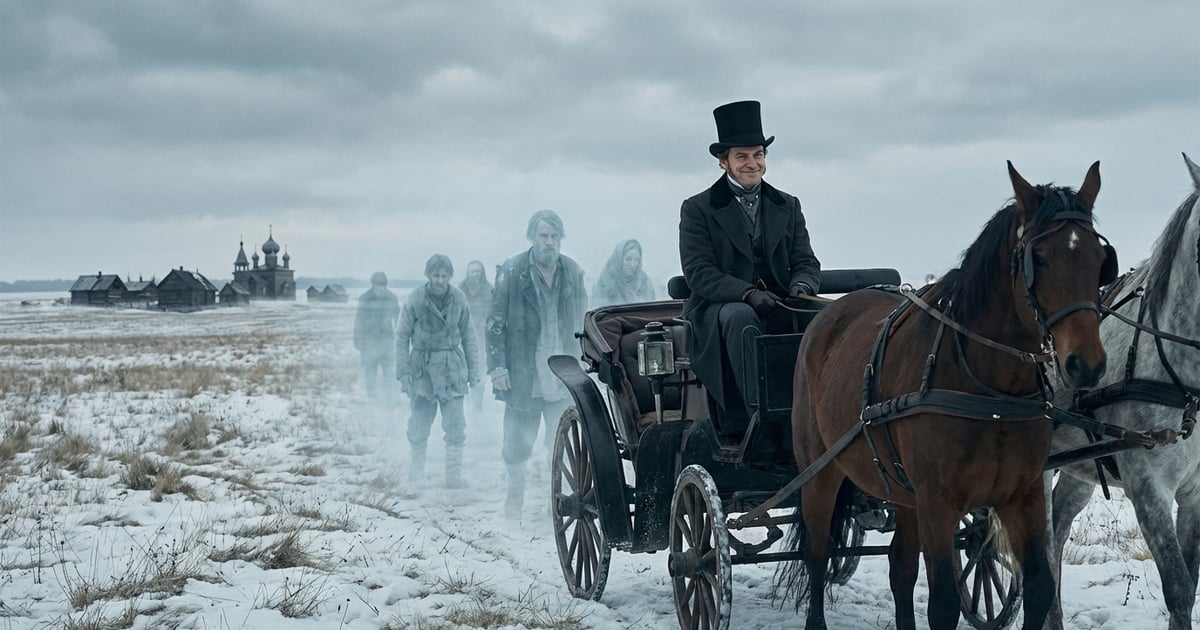
Chichikov wakes owning nearly four hundred souls, skips his mirror, cuts capers in Moroccan slippers like a Scottish highlander, and drafts indentures himself to save lawyer fees and lawyer delays. At the municipal offices he is bounced from desk to desk until Ivan Antonovitch, a pitcher-mug face buried in papers, admits this is the serf desk. In the President's sanctum Sobakevitch already sits; Plushkin's letter is read with wonder that the miser still lives; witnesses are summoned; fees shrink because the President likes the total near a hundred thousand roubles. At the Chief of Police's feast Chichikov is toasted as a Kherson landowner, urged to marry, and carried home drunk while Selifan and Petrushka slip to a basement tavern. The President forbids gratuities yet hosts a feast where the Chief of Police procures sturgeon like a father to the town.
Reading the lists, he sighs over names: Korobotchka's nicknames, Plushkin's terse dots, Sobakevitch's biographies listing fathers, mothers, and trades. He invents lives for Probka Stepan the carpenter and drunk shoemakers, then imagines runaways arguing with gendarmes in a comic monologue that turns the census into fiction. Manilov arrives with a list bordered by his wife and supports Chichikov through every stair with embarrassing zeal. Chichikov lectures on liberal youth while hiding that he is talking rubbish; Sobakevitch boasts of selling Michiev though the President thought the craftsman dead. Ivan Antonovitch whispers that the serfs are worthless; Sobakevitch whispers why Plushkin was visited. Witnesses multiply: the blinking Public Prosecutor, the Medical Inspector, Father Cyril and his clerk-son, each signing with ornate flourishes while Ivan Antonovitch dockets the deed for half fees. Toasts follow: health to the Kherson landowner, prosperity to transferred peasants, beauty to a future wife Chichikov has never met.
Sobakevitch devours a quarter of the sturgeon before anyone else reaches it, then sits frowning in an armchair. Champagne yields to Hungarian wine; officials dispute politics without sense; Chichikov recites verses and imagines agricultural reform on land he does not own. The Public Prosecutor's drozhki carry him home while the driver holds him upright; Petrushka and Selifan abandon duty for a basement drink and sleep in a tangle of snores. The chapter turns acquisition into bureaucracy and celebration: paper souls pass through Themis in a dirty dressing-gown, then through sturgeon and champagne. Chichikov babbles poetry to a blinking Sobakevitch, orders Selifan to inventory peasants who exist only on lists, and sleeps the sleep of a man who believes paperwork can become property. Fraud has graduated from village haggling to official registry; the town now treats the scheme as respectability. Volume One's economic joke is complete: the dead are registered, toasted, and imagined marching to Kherson while the living sleep off the champagne.
Gogol understood something crucial about human nature: sometimes entire systems conspire to validate deception because everyone benefits from the lie. In Chichikov's world, the bureaucrats get their bribes, the officials get their fees, and society gets an exciting new landowner to celebrate. Nobody asks hard questions because the answers might spoil the party. This isn't just about one man's con game, it's about how communities can become complicit in their own deception. We see this pattern everywhere today. The workplace that promotes someone based on charm rather than competence because they make everyone feel good. The family that enables a relative's addiction because confronting it would be harder than pretending everything's fine. The neighbourhood that ignores obvious problems because addressing them would require uncomfortable conversations. The social media ecosystem where everyone performs success and everyone else validates it, creating a feedback loop of mutual deception. What makes this particularly dangerous is how the validation changes the deceiver. Chichikov starts calculating and ends up genuinely moved by his imaginary success. The lie becomes psychologically real through social confirmation. When we understand this pattern, we can ask better questions: Who benefits from believing this story? What am I afraid to verify? When does healthy confidence cross into dangerous delusion?
Explore this chapter with AI to uncover deeper meaning and practical takeaways.
AI Discussion