
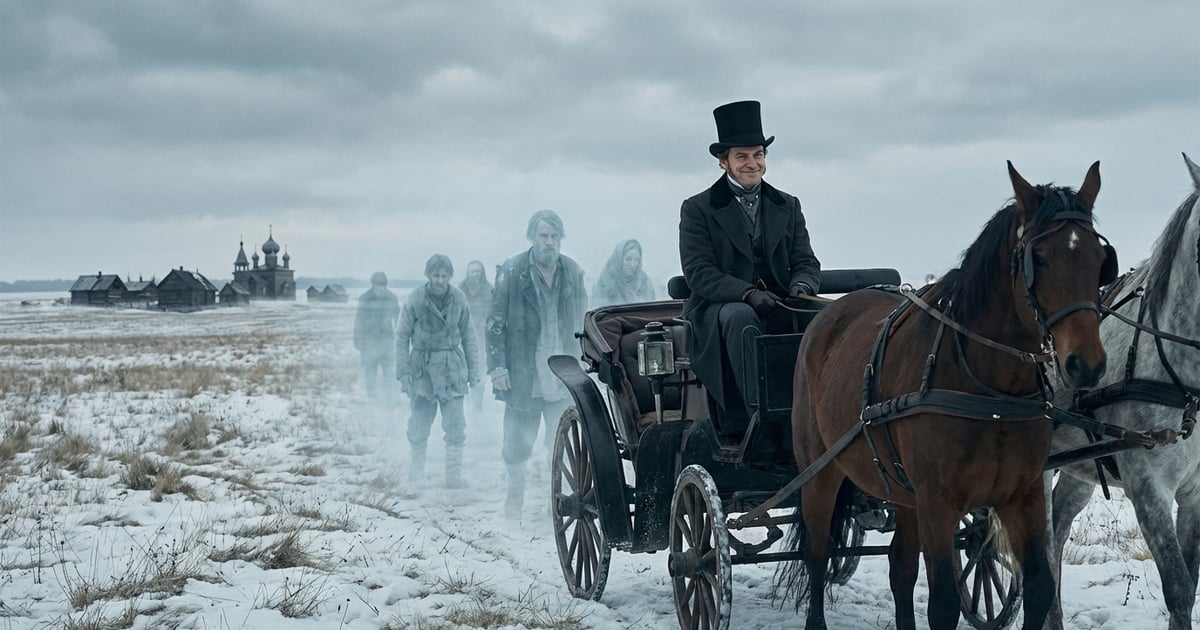
Chichikov wakes in open country worrying that Colonel Koshkarev will prove as mad as the last landowner. He asks Selifan whether they asked the way. Selifan heard only clatter; Petrushka asked the coachman. Chichikov calls him a fool for relying on Petrushka. They take a man with a respectable paunch for the colonel and drive toward roofs that look like a homestead. The voice beside the britchka belongs to someone else. It is Peter Petrovitch Pietukh, hauled from a fishing net in the lake, fat, cheerful, and organised around appetite. Chichikov is dumbfounded: he ordered Koshkarev's house and has been delivered to a feast. Pietukh sends the servants for vodka and treats dinner as the only philosophy worth mastering. Past midnight the dishes still arrive. Chichikov lies down hearing a pasty divided into kingdoms of sturgeon cheeks, buckwheat and mushrooms, calves' brains and sweet milk.
At this table he meets Platon Mikhalitch, handsome, wealthy, and bored beyond measure. He and his brother own ten thousand desiatins and over a thousand souls. The harvest has not failed. The peasants have not died. His brother is an excellent manager. Still Platon wants an enemy, an anxiety, any diversion, because everything remains eternally dull. Chichikov proposes travel. New places may rouse him. On the road he tells himself that once you have seen this view you have seen one of the beauty spots of Europe, then catches himself smoothing his chin like a man of the world. Platon names a better education than scenery: his brother-in-law Constantine Thedorovitch Kostanzhoglo, who now draws two hundred thousand roubles from a property that eight years ago produced a bare twenty thousand.
They leave with Selifan barely keeping the box and Petrushka tied on after falling twice. Kostanzhoglo's estate announces itself in squared fields and workers who look busy because the work is real. The house is bare of bronze and china. Everything serves use. Over dinner he lectures against factories built only for show, against educating peasants before they are fed, against philanthropy that ruins families while posing as progress. Out upon candle-makers fetched from London, he cries, and upon turning a Russian landowner into a huckster. He did not found workshops for fashion. Wool had nowhere to go, so he wove plain cloth for local markets. Fish factories dumped offal on his bank for six years, so he boiled it into glue and cleared forty thousand roubles. He talks of summer as endless reaping, of rye-sheaf heaped on rye-sheaf, of a harvest that feeds millions once the plough has done its work. Stay a few days, he says, and you will see that no great wisdom is required, only contact with the soil. Chichikov stares as if watching a new kind of fist. He asks how a newcomer could grow rich quickly. Stay, says the host, and watch. The lady of the house agrees. Then Chichikov mentions General Betristchev's relative, Colonel Koshkarev. They know him. He is quite mad. Kostanzhoglo has a gig already harnessed. Go now, return for tea.
What could be done with a lunatic like Koshkarev? In the end curiosity, not duty to General Betristchev, moves Chichikov to climb into the gig. A commissioner escorts him through departments named in French and German, each with a seal, a ledger, and an overseer who oversees another overseer. The Committee for the Reception of Reports and Returns has put up its shutters. Peasants wait for rations that paperwork delays. Koshkarev returns radiant with a document carried through in due form and reads a petition that proves, on this estate, the soul is deathless. Nothing edible leaves the basement. Kostanzhoglo later calls the visit useful: the colonel is a caricature of intellectuals who copy European models until the land itself starves. The province, he adds, never speaks his own name without also calling him a miser and a usurer.
Back at the productive table, Chichikov's mind turns to a ruined neighbour. Why does Kostanzhoglo not buy the place himself? Because to everything there must be a limit; already his property is enough. Chichikov already has ten thousand roubles. He will try to borrow fifteen thousand more from the man who has offered to help anyone who really desires to grow rich. The rest he will raise by mortgaging Khlobuev's estate, or by telling Khlobuev to wait and to go to the courts if he prefers. Even at forty thousand, Chichikov thinks, he would still have demanded a reduction. The census trick that brought him into the province suddenly looks smaller than a swampy estate bought cheap and worked. For hours the rest of the household has been asleep. Chichikov lies awake on the plan until slumber takes him too, still tasting Pietukh's feast from the first wrong turning of the day, while the next estate waits unbought.
Gogol understood something that modern management theory often misses: complexity can become a form of procrastination. Colonel Koshkarev's elaborate bureaucracy serves his ego more than his estate, while Kostanzhoglo's direct approach serves his actual goals. This pattern repeats everywhere in working-class life. Healthcare workers spend hours on documentation systems that don't improve patient care. Retail employees navigate inventory software so complex it slows down customer service. Students get lost in study apps instead of actually studying. The appeal of complex systems is psychological, they make us feel sophisticated and in control. But Kostanzhoglo's success comes from understanding fundamentals: good soil, motivated workers, efficient processes. He doesn't need impressive systems because he has impressive results. The question isn't whether a system looks professional, but whether it helps you accomplish your actual goal. Sometimes the most powerful tool is a notebook and pen, not a digital dashboard. Sometimes the best meeting is a five-minute conversation, not a structured brainstorming session. Gogol suggests that when we're building systems, we should ask: does this serve the work, or does the work now serve the system?
Explore this chapter with AI to uncover deeper meaning and practical takeaways.
AI Discussion