
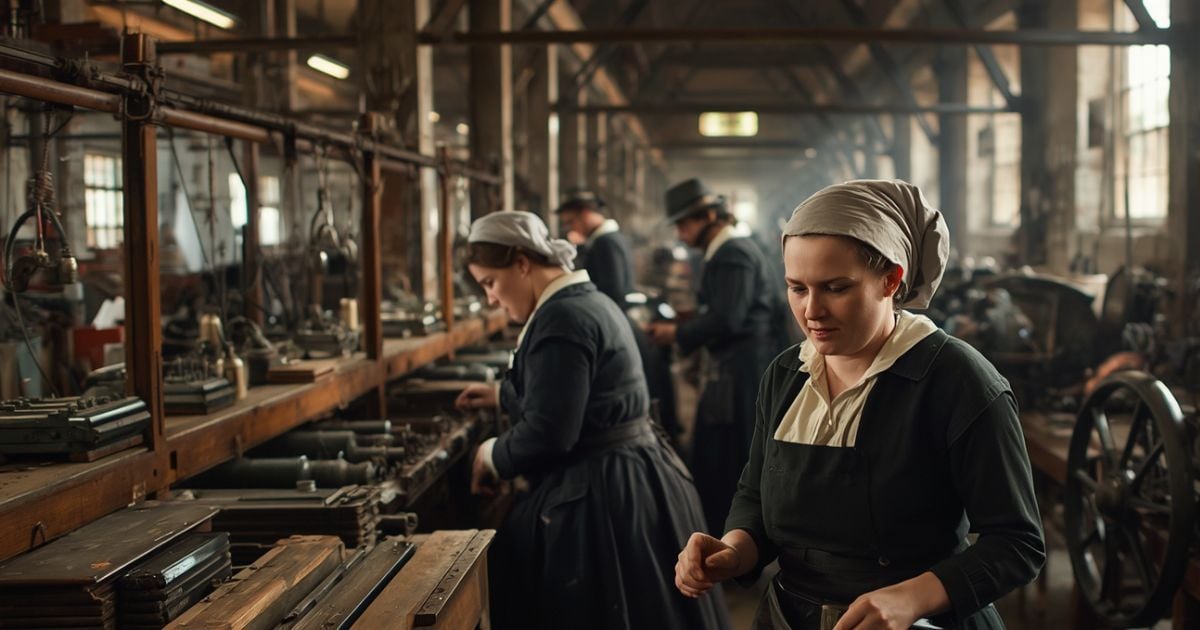
Marx begins with a puzzle about the spinner. In one working day he adds new value to the cotton, and yet the value of the cotton and of his spindle also reappears in the yarn. He does not do two jobs at once. The same act has two sides. As labour in the abstract, a stretch of human effort, it adds new value, and the amount depends only on the time spent. As spinning in particular, a useful trade, it carries the old value of the cotton and spindle into the yarn. A joiner would add the same value in a day, but he could not turn cotton into yarn. Marx tests this with a spinner who, thanks to an invention, spins 36 lbs of cotton in six hours instead of 6 lbs. Each pound now takes a sixth of the new labour, so the value added to it falls to a sixth, while the cotton value carried into six hours of yarn is six times larger. If the price of cotton rises sixfold or falls to a sixth while the spinner works as before, he adds the same value but passes on a very different one.
Means of production hand over value only as they lose their use-value. The coal under the boiler and the tallow on the axles vanish. Dye and raw material change form. Tools and machines keep their shape until they wear out, and Marx compares their life with a man's, whose date of death nobody can read from his face, although life insurance offices draw profitable averages. A machine worth £1,000 that lasts 1,000 days gives up a thousandth of its value each day, though it enters the labour-process whole. Waste counts too. If 15 lbs of every 115 lbs of cotton vanish as devil's dust, that loss is a necessary condition of the yarn, so its value moves across as well. Natural agents such as land, wind and water pass on nothing, since they cost no labour. No means of production can give more than it is worth, however useful it is. A machine that cost £150 can add at most £150.
Value, says Marx, goes through a kind of transmigration. It deserts the consumed body to occupy the new one, behind the labourer's back. He cannot add new labour without preserving old values, and this power to preserve is a gift of Nature that costs him nothing and suits the capitalist very well. The capitalist is too busy making money to notice until a violent interruption of production, in a crisis, makes him sensitively aware of it. The materials only reappear in the product, while the labour truly creates. Stop the work when six hours have added three shillings, and the labourer has replaced his wage. If the day runs on to twelve hours, the action of labour-power not only reproduces its own value but produces value over and above it.
From this Marx takes his names. The part of capital laid out on materials and machinery does not change in value as it moves into the product, so he calls it constant capital. The part laid out on labour-power reproduces its own value and adds an excess, which may be more or less, so he calls it variable capital. Constant capital can still change in price. When a failed harvest lifts cotton from sixpence to a shilling a pound, every pound already bought or spun carries that rise into the yarn, and speculators bet on cotton rather than yarn, because less labour has been worked into it. Machinery loses value when a new invention makes it cheaper to build. Even if one man with one costly machine now works up a hundred times as much material as ten men did, only the proportion of constant to variable capital has changed, not the difference between them. The two parts are named, and the surplus they promise has still to be measured.
Marx identified something that happens in every workplace: the moment you become competent, you start working two jobs for the price of one. The nurse who prevents medical errors while providing care. The cook who maintains food safety standards while creating meals. The driver who preserves vehicle value while completing deliveries. This isn't about exploitation by evil bosses—it's about how work itself functions. The structure rewards efficiency by making efficient workers carry more responsibility without proportional compensation. Modern 'lean' operations depend entirely on workers performing this dual function. When companies eliminate 'redundant' positions, they're really transferring the preservation work to remaining employees while paying only for the visible creation work. This explains why productivity rises while wages stagnate, why 'doing more with less' never seems to benefit the people doing more. The pattern reveals itself in performance reviews that praise your 'initiative' and 'problem-solving' but don't translate praise into proportional pay increases. Understanding this dual nature of work changes how you negotiate, how you document your contributions, and how you recognize your true value in any organization. The question isn't whether this pattern exists—it's whether you can see it operating in your own work life.
Explore this chapter with AI to uncover deeper meaning and practical takeaways.
AI Discussion