
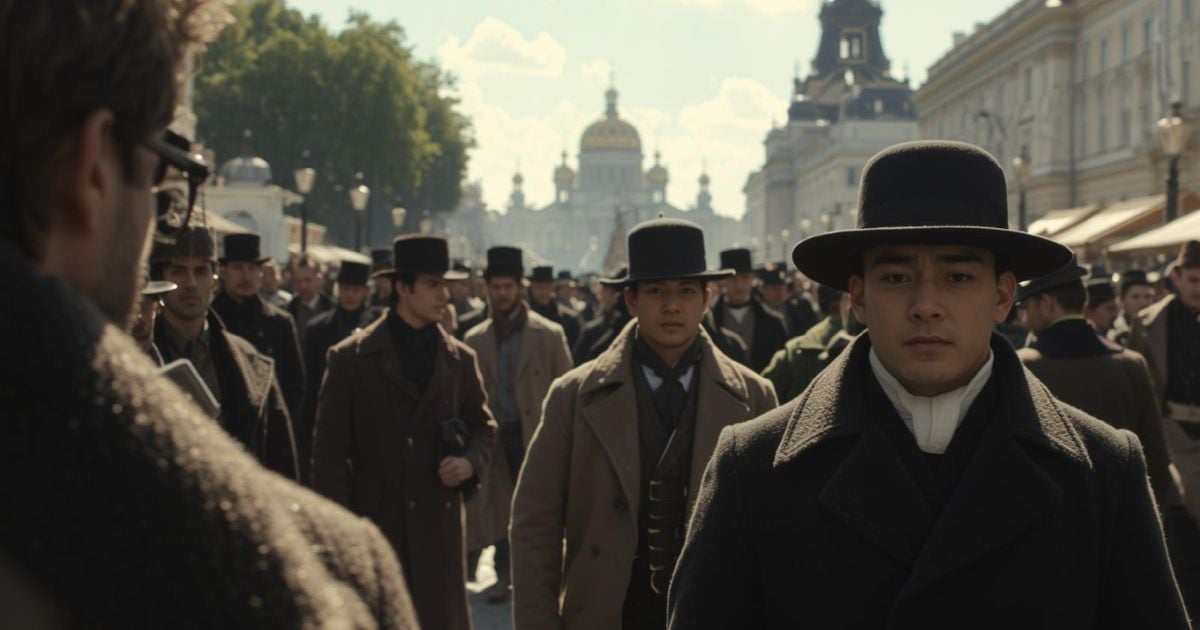
The locked door from Porfiry's interview bursts open. Warders try to hold back the prisoner Nikolay, but a pale young workman forces his way in, kneels, and cries: I am guilty! Mine is the sin! I am the murderer. He names Alyona Ivanovna and her sister Lizaveta Ivanovna, killed with an axe; darkness came over me. Porfiry, thrown off his plan, questions the axe, Mitka, the porters on the stairs. Nikolay answers too neatly; Porfiry mutters it is not his own tale he was telling, then hurries Raskolnikov out, flustered and trembling. On the stairs Raskolnikov mocks the little surprise and calls Porfiry's office comical: torture a man into confessing, then call the confession a lie.
At home Raskolnikov sees the false confession buys time but cannot hold; Porfiry has shown his hand without a final checkmate. Relief mixes with dread until the door opens again: yesterday's visitor from the murder flat, the tannery workman who bowed in the gateway. He says I have sinned by evil thoughts, explains he was vexed when porters let a drunk-seeming man go after asking about blood, tracked Raskolnikov down, and sat in Porfiry's next room during the whole interview. He was the surprise behind the door. He told Porfiry about the flat visit; Porfiry raged that he would have arrested Raskolnikov had he known sooner, locked the witness to hear everything, then released him after Nikolay and Raskolnikov left.
Raskolnikov realizes the near disaster was a trivial circumstance: only psychology and delirium, no hard facts yet, and it all cuts both ways. He forgives the man's slander and goes out more confident, vowing to make a fight for it while despising his own cowardice. Nikolay's tale has bought time. The workman has already told Porfiry about the flat and the blood stains.
Part IV Chapter VI resolves Porfiry's cliffhanger: not Sonia, not Svidrigailov. Nikolay kneels and claims the axe murders; Porfiry knows it is not his own tale yet uses the shock to eject Raskolnikov. On the stairs they trade ironies about surprise and comical offices. Then the gateway workman reveals he was locked in the next room, the ear Porfiry planted. Raskolnikov grasps that only delirium and circumstance threaten him for now. Dostoevsky pairs theatrical guilt with mundane surveillance: reprieve without absolution.
Explore this chapter with AI to uncover deeper meaning and practical takeaways.
AI Discussion