
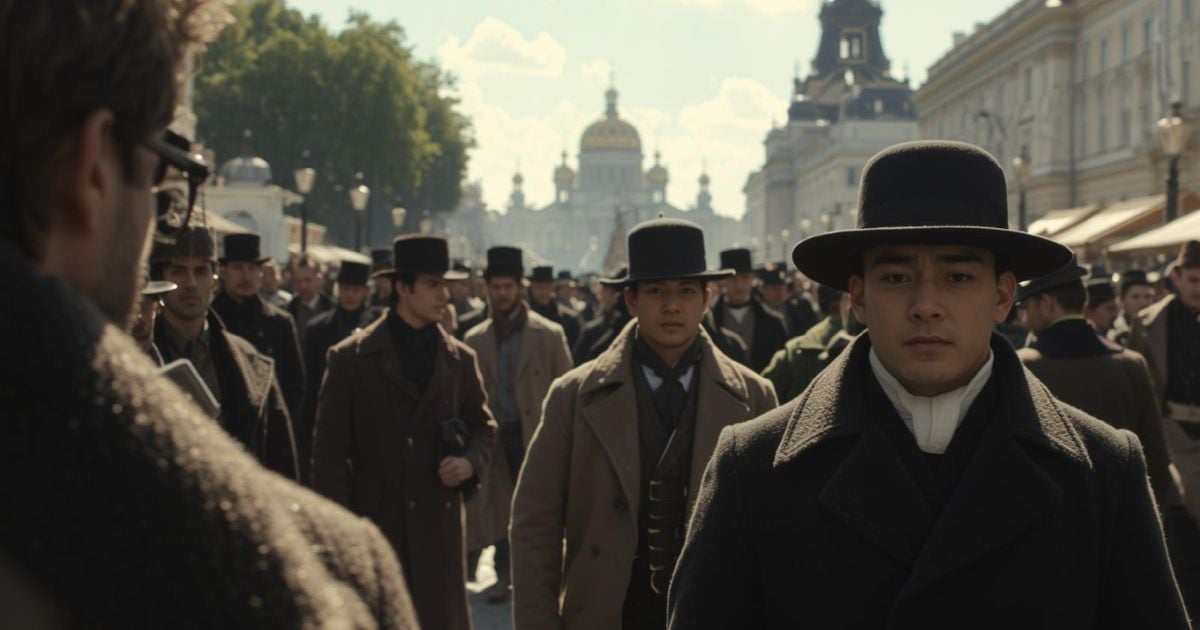
Next morning at eleven Raskolnikov enters the investigation office and waits ten uneasy minutes among indifferent clerks. He looks for a mysterious watch to prevent his escape and finds only faces absorbed in petty details, people passing who have nothing to do with him. He had expected they would pounce upon him. He might go where he liked for them. Porfiry receives him alone, genial and restless, talking of government quarters and cigarettes while Raskolnikov names the lawyer's trick of irrelevant opening questions. Porfiry laughs, admits the tradition, and launches into a lecture on free-form investigation: let the suspect walk the town, circle him with suspicion like a butterfly round a candle, wait until guilt offers proof as plain as twice two are four. He compares the clever suspect to paper generals who beat Napoleon until real surrender arrives. Raskolnikov holds his cap, answers the watch paper, and feels every joke land as weight.
Porfiry sketches the cultivated criminal who overplays wit, turns too pale on purpose, rings bells about blood, and collapses when temperament betrays intellect. He mentions Razumihin dining here, the articles Raskolnikov wrote on crime, and spleen as a regular gold-mine for investigators. He warns that this illness is infectious for Razumihin, who is too good a man for such a position. Raskolnikov breaks: he accuses Porfiry of suspecting him of murdering the pawnbroker and Lizaveta, demands formal procedure or release, and shouts that he will not be jeered at. Porfiry plays alarm, offers water, then reveals he knows the night visit to the flat, the bell, the porters, Razumihin's visit, mother and sister in town. He cites a morbid-psychology case of a man who confessed to a murder he only enabled, mirroring bell-ringing and blood questions. Raskolnikov insists he was not delirious and knew what he was doing.
The duel tightens. Porfiry whispers threats about clerks overhearing, alternates friendship and sternness, and refuses a straight answer when Raskolnikov demands to be told he is perfectly free from suspicion. Fury rises again: I won't allow it, I will not allow myself to be tortured, arrest me in due form. He spits on friendship, takes his cap, and reaches the door. Porfiry stops him with a grin: won't you see my little surprise? He roars that Porfiry is lying, a damned punchinello, and rushes at him. Porfiry retreats to the other door, not alarmed. Raskolnikov shouts that these are only Zametov's wretched suspicions, that Porfiry wanted to drive him to fury then knock him down with priests and deputies. Porfiry takes him by the arm at the door and chuckles. Noise stirs beyond the door. The handle is still in his hand. Someone is pushing in the outer room.
Part IV Chapter V is the second Porfiry interview, not Sonia's confession. Rodya waits, trades ironies about legal openings, hears the butterfly-and-candle theory and twice-two proof, then erupts when the flat and bell-ringing surface. Porfiry will not say he is free from suspicion because uncertainty is the lever. The locked-door surprise ends on a cliffhanger; the revelation belongs to the next chapter. Dostoevsky shows investigation as drama: the suspect's temperament completes the case the dossier lacks.
Explore this chapter with AI to uncover deeper meaning and practical takeaways.
AI Discussion