
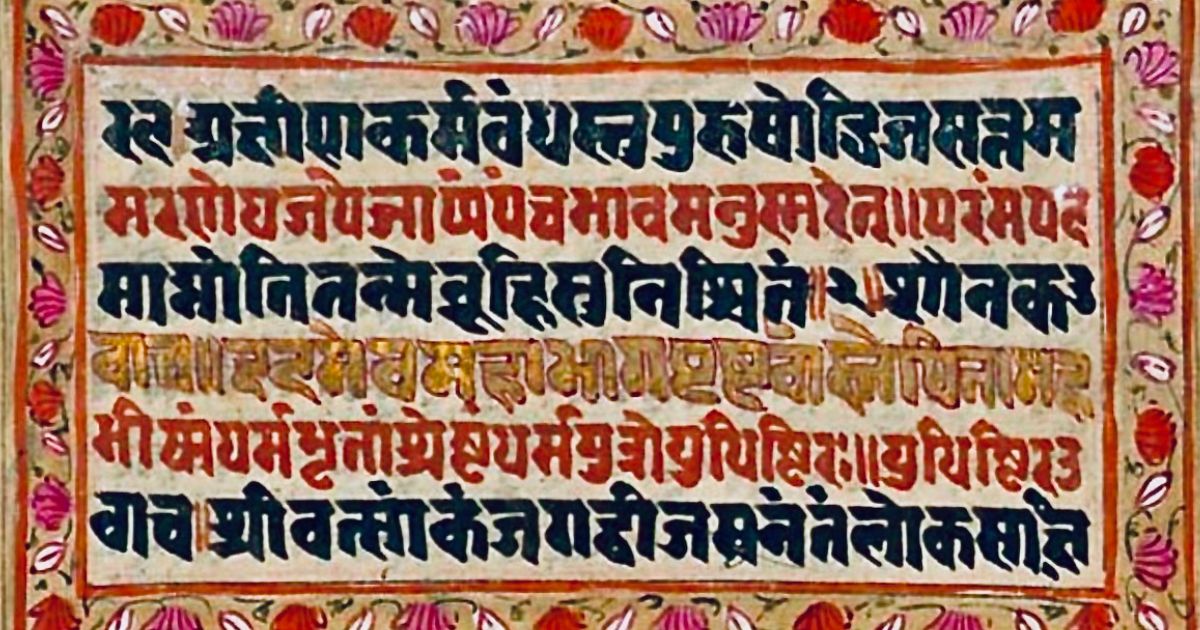
Krishna opens with a claim that startles the prince. He says he taught this same yoga long ago to Vivaswata, the Lord of Light, who passed it down a line of royal sages until, with the years, the truth grew dim and was lost. Now he is giving it again, because Arjuna is his friend and follower.
Arjuna pushes back. Krishna was born in these later days, and Vivaswata came long before, so how can Krishna say he taught him at the beginning? Krishna answers that he has been born many times, and so has Arjuna, though only Krishna remembers. He is unborn and undying, yet when righteousness declines and wickedness grows strong he takes visible shape, age after age, to help the good and push the evil back. His work does not bind him, and anyone who understands that is freed from it too.
Then Krishna takes up a puzzle that wise people have long argued over: what is action, and what is inaction? The wise see rest inside action and action inside rest. They work without craving the reward, calm whether things go well or badly. Krishna lists many kinds of sacrifice, from the fire of self-denial to gifts of wealth, then says the sacrifice of knowledge is better than any gift. Knowledge burns away the dross of works the way fire turns fuel to ash, while those who doubt find no peace. He tells Arjuna to take up the sword of wisdom, cut the doubt that binds his heart, and arise.
Krishna's teaching about working without attachment to results sounds counterintuitive in our achievement-obsessed culture. We're told to 'want it more' and 'stay hungry,' but Krishna suggests the opposite: care deeply about the work itself while releasing attachment to specific outcomes. This isn't about not caring—it's about caring so much that you refuse to let outcome-anxiety sabotage your performance. Consider healthcare workers during the pandemic. Those who maintained their sanity weren't the ones who stopped caring about patients, but those who learned to give everything to patient care while accepting they couldn't save everyone. They focused on what they could control: their preparation, their compassion, their skill. The results—whether patients recovered—remained beyond their direct control. This pattern appears everywhere: the best teachers focus on delivering excellent lessons rather than obsessing over test scores. Skilled mechanics concentrate on quality repairs rather than worrying about customer reviews. Effective parents set consistent boundaries rather than trying to control their children's every choice. The paradox is real: when we stop clinging desperately to specific outcomes, we often achieve better results because we're not sabotaging ourselves with anxiety and second-guessing. How might your own work improve if you could give everything to the process while holding outcomes lightly?
Explore this chapter with AI to uncover deeper meaning and practical takeaways.
AI Discussion