
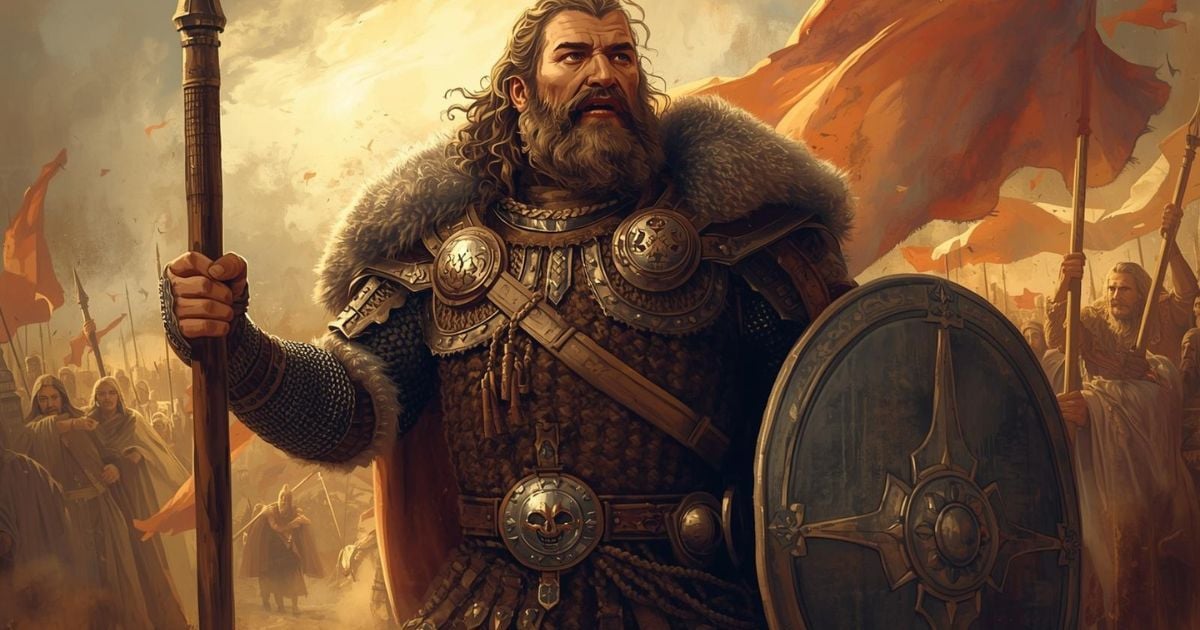
The climactic battle between Beowulf and Grendel reaches its violent conclusion. Despite his warriors' brave attempts to help, their swords prove useless against the monster, Grendel bears some kind of supernatural protection against weapons. This forces Beowulf to rely entirely on his bare hands and raw strength, turning the fight into a test of pure will and determination.
The struggle is brutal and decisive. Grendel suffers a catastrophic injury as Beowulf literally tears the monster's arm from his shoulder, causing mortal damage that sends the creature fleeing back to his marsh lair to die. Beowulf claims victory not through superior weaponry or numbers, but through sheer tenacity and refusing to give up when conventional methods fail.
The chapter emphasizes how sometimes the most direct approach, meeting force with force, succeeds where elaborate strategies fail. Beowulf hangs Grendel's severed arm and claw in the great hall as proof of his victory, a tangible symbol that the nightmare plaguing the Danes for twelve years is finally over.
This moment represents more than just defeating a monster; it's about one person's willingness to face an impossible challenge and see it through to the end, regardless of the cost. The victory restores hope and proves that even the most entrenched problems can be solved with enough courage and determination.
Beowulf's victory over Grendel reveals something profound about how we solve problems. His warriors had the best weapons, the most advanced technology of their time, years of training, yet their swords were useless against the monster. Only when Beowulf stripped away all sophistication and relied on his bare hands did he succeed. This pattern echoes through every era and every workplace. We live in a world obsessed with complex solutions, elaborate software systems, detailed procedures, multi-step processes, expert consultants. Yet often the breakthrough comes when someone abandons the complexity and goes back to basics. The nurse who stops following the protocol and actually listens to what the patient is saying. The mechanic who ignores the computer diagnostic and trusts what his hands tell him about the engine. The parent who puts down the parenting books and has an honest conversation with their teenager. There's something powerful about meeting a problem directly, without layers of mediation or sophisticated tools. It requires courage because simple doesn't mean easy, Beowulf nearly died in that struggle. But sometimes the most fundamental approach cuts through what elaborate methods cannot touch. The question isn't whether we should abandon all systems and tools, but rather: how do we recognize when complexity has become the enemy of solutions?
Explore this chapter with AI to uncover deeper meaning and practical takeaways.
AI Discussion