
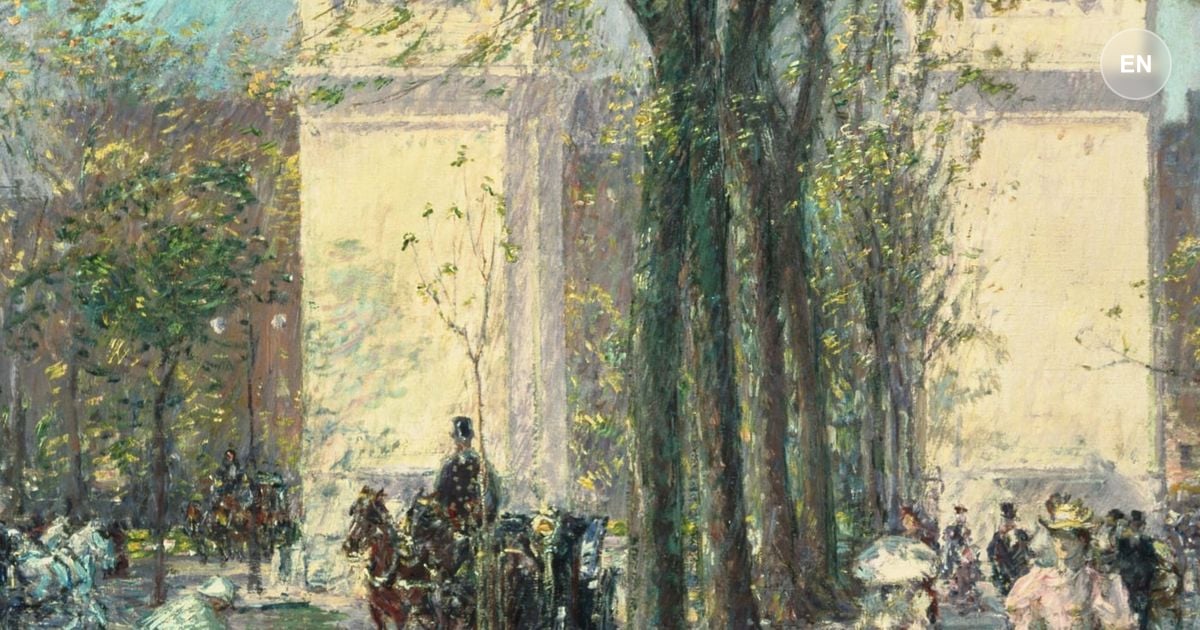
Catherine prefers the house in Washington Square to any other habitation. The year her father dies she will not go to the sea at all. The next year she stays so late that mid-August finds her still in the heated solitude of the Square. Mrs Penniman, usually eager for a change, is content with the ailantus-trees at the parlour window. Since her brother's death a vague oppression has lifted. She feels as free as in the season when the Doctor took Catherine abroad and left her at home to entertain Morris.
On a warm July evening the two women sit at the open window after tea. It is too hot for lamps or work. Lavinia hums on the balcony. Catherine rocks in white and uses a large palmetto fan. Then her aunt says she is going to surprise her. She has seen Morris Townsend. Catherine keeps still and hopes he was well. She would rather not see him. Lavinia has been bursting to speak the name after more than twenty years. She met him at Marian's and again in the street. He is changed, still handsome, a little sad, unsuccessful, briefly married in Europe to a woman who only flitted across his life.
He asked many questions. He had heard Catherine never married. He said she had been the real romance of his life. Catherine has listened with her eyes on the ground. At that phrase she asks her aunt to say no more. The subject pains her. She moves to the other window, hidden by the white curtains, and looks out into the warm darkness. The gulf of the past has opened. Feelings she had thought dead still have a certain vitality. She tells herself it will pass. Then her tears come, so silently that Mrs Penniman has no observation of them.
Catherine's violent physical reaction to hearing Morris's name after twenty years reveals something crucial about how we process emotional trauma. Her trembling, racing heart, and tears prove that buried pain doesn't disappear, it goes underground, preserved like a fossil in our nervous system. This pattern shows up everywhere in modern working life. The nurse who still flinches when doctors raise their voices, decades after a brutal supervisor. The retail worker who panics during performance reviews because of one toxic manager from years ago. The factory worker who overreacts to safety criticism because of childhood shaming. We tell ourselves we've 'moved on' because the daily ache fades, but what actually happens is emotional numbing. We build walls around wounds rather than processing them. Real healing requires feeling the emotion, understanding its message, and integrating the lesson. When you notice outsized reactions to small triggers, that's your nervous system pointing toward unfinished business. The question isn't whether you should be 'over it' by now, it's whether you're ready to stop being ambushed by your own history.
Explore this chapter with AI to uncover deeper meaning and practical takeaways.
AI Discussion