
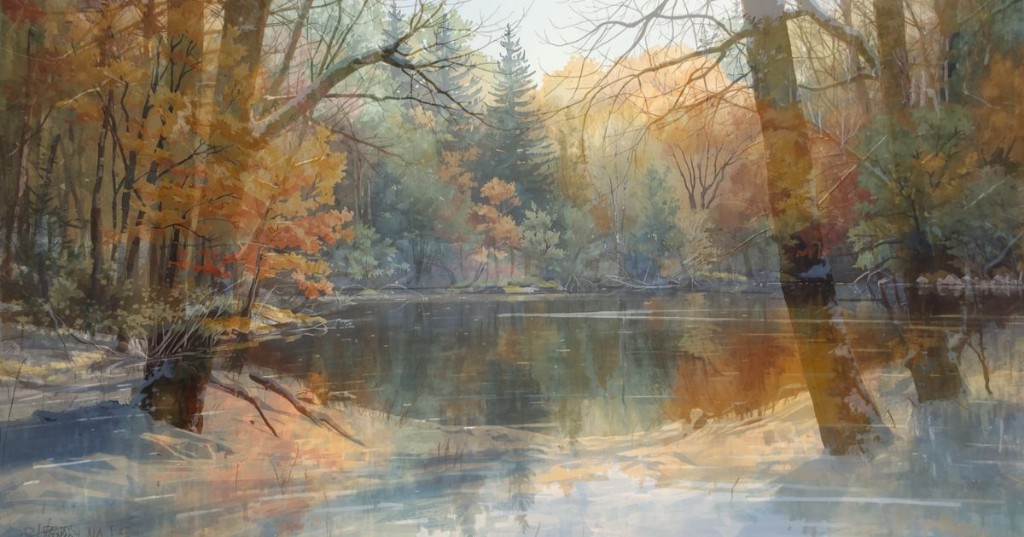
Thoreau's opening argument is not about the woods but about what ownership actually means, and the question provides the philosophical ground for everything that follows. Starting from his habit of walking the farms within twelve miles of Concord in pure imagination, pricing each one, cultivating its possibilities in his mind without ever signing a deed, he arrives at the central claim: beauty and value can be possessed completely through attention, without legal title. When the Hollowell farm deal dissolved, he walked away richer than if he had signed, carrying the landscape without a wheelbarrow.
That lesson about imaginary richness is the scaffolding for his second move: announcing that he is not writing an ode to dejection but a genuine report. On the Fourth of July, 1845, he moved into an unfinished cabin at Walden Pond, its walls of rough boards still cold at night, its timbers saturated with morning dew. The cabin connected him immediately to the wilder birds of the forest, and the pond in his first week looked to him like a mountain tarn, mist withdrawing from its surface like ghosts at dawn. The sense of cosmic distance from his old life, and of having landed somewhere permanently new and unprofaned, are inseparable from this physical description.
Wakefulness is the third concern. Thoreau treats each morning as a sacred interval distinct from the rest of the day, a heroic age compressed into an hour. He bathed in the pond daily as a religious exercise, and 'to be awake is to be alive' is not a slogan but his actual criterion for what the experiment is testing. Most people, he argues, are awake enough for physical labor but not for the poetic and divine life that every morning offers. Society compounds this sleepwalking with news, gossip, the penny-post, commerce, and the railroad's schedule, all of which keep men too busy to ask whether they are living at all. The railroad joke carries the sharpest edge: the men who 'ride' it are the Irish and Yankee workers buried under its sleepers.
That diagnosis of frantic civilized life sets up the chapter's most quoted declaration. Thoreau went to the woods to live deliberately, to strip life to its lowest terms, and to discover by direct experience whether it was sublime or merely mean. He wanted not resignation but knowledge: to drive life into a corner and report honestly. The closing pages pursue this as a sequence of images, burrowing through the accumulated mud of opinion and tradition until striking rock-bottom reality, a place that could serve as a foundation for a wall or a state. 'Time is but the stream I go a-fishing in,' he writes, and ends by saying he intends to mine for the richest vein in the nearby hills, with his head as hands and feet.
Two accomplishments run in parallel throughout: a biographical account of how the experiment began, and a philosophical argument about the kind of knowledge it is trying to produce. Thoreau is not trying to live cheaply or naturally. He is trying to find out what is real before dying.
Thoreau wrote Walden during America's first great economic boom, when railroads and industry promised unprecedented prosperity. Yet he noticed something troubling: the more people could theoretically own, the more frantically they worked to acquire it, often missing the life happening around them. His insight about imaginary ownership strikes at the heart of consumer culture, the gap between what advertisements promise and what purchases deliver. Today's version is even more intense. Curated online feeds show us constant images of lives we might want, homes we might buy, experiences we might have. The algorithm knows that keeping us wanting is more profitable than satisfying us. We scroll through dream kitchens while our own dinner burns, browse vacation photos while missing the sunset outside our window. Thoreau's experiment wasn't about rejecting all possessions, his cabin had furniture, tools, books. It was about testing which desires served him and which ones served someone else's profit margin. The minimalism movement often misses this nuance, turning simplicity into another form of performance. Thoreau's deeper insight is about attention: where you direct your awareness determines your experience of wealth or poverty. When you can appreciate what you already have access to, the library's books, the park's nature, the satisfaction of work well done, you become harder to exploit through manufactured desire.
Explore this chapter with AI to uncover deeper meaning and practical takeaways.
AI Discussion