
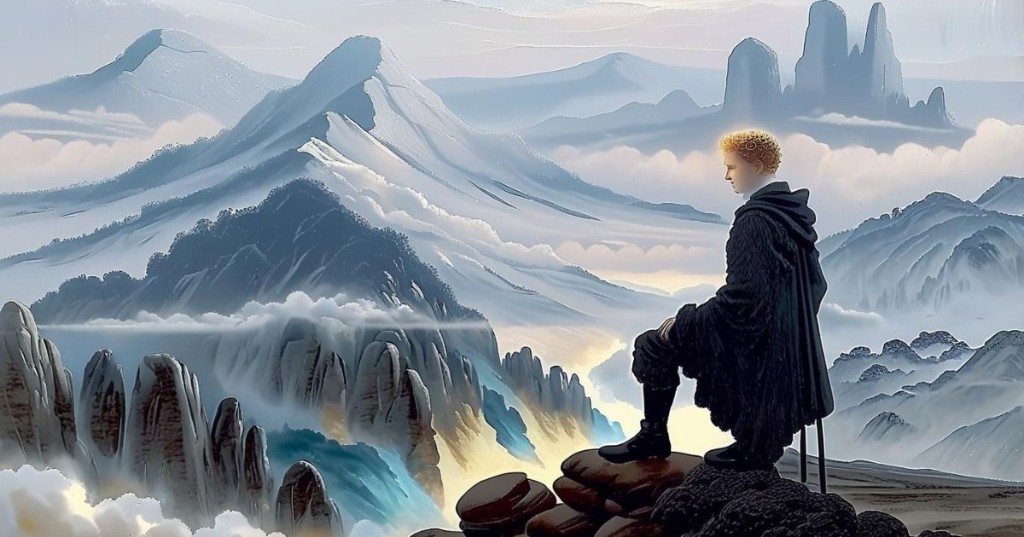
Zarathustra sits in his cave with old tablets broken around him and new ones only half written. He waits for the hour of his last descent, and he will not go down until the signs arrive: a laughing lion and a flock of doves. While he waits he tells himself his own story. When he first went among people he found them already sure they knew good and evil. They treated talk of virtue as a way to sleep. He woke that sleep by teaching that no one yet knows what is good and bad except the one who creates a goal for mankind and gives the earth a future. On that same path he picked up the word Superman. Man, he says, is a bridge and not a goal.
He puts up a new tablet and asks who will carry it into the valley. The noble soul does not want life for nothing. The first of a new kind are sacrificed to old idols, and their best is still too young for old tastes. He says the good can rarely be true, because being good in the old way is a sickness of the spirit. When winter freezes the stream, even clever people say that everything stands still and that good and evil are fixed bridges. Then the thawing wind comes like a furious bull and breaks the ice. Good and evil, he says, is an old illusion that once swung between fate and freedom, between soothsayers who said thou must and rebels who said thou wilt.
He looks at the old holy commands, thou shalt not rob and thou shalt not slay, and asks where the world has ever had better robbers than the people who made those laws. He pities the past because each new generation rewrites it as a bridge to itself. So he points his brothers toward a new nobility: not a title you can buy with traders' gold, but the work of sowing future peoples and new fountains. Against that he sets the weary sermon that nothing is worth willing. He calls it a sermon for slavery, hung up by ruined stomachs and preachers of death, and he tells his brothers to break that tablet too. Weariness and sloth write tables that sound alike and mean different things. A parasite will try to climb with anyone who is going higher. What is falling, he says, one should also push.
The greatest danger to the human future, he repeats, sits with the good and the just, the people who already believe they possess the right. Breaking their tables is how he sends man out onto the high sea. When the charcoal asks the diamond why it is so hard, he turns the question on his brothers. Creators have to be hard if they are going to write on the will of a thousand years. He asks his own will to spare him from small victories and keep him ripe for one great noon: a bow ready for its arrow, a sun ready for its own victory. The signs have not come. He is still sitting among the broken tablets.
Nietzsche's most provocative claim here is that 'good' people are actually dangerous—not because they're evil, but because they preserve systems that no longer work. Think about it: the person who never questions workplace policies, who always follows family traditions, who accepts relationship advice without testing it against their own experience. These 'good' people seem harmless, even admirable. But their unquestioning compliance keeps broken systems alive. The CNA who never questions why certain procedures waste time that could be spent with patients. The parent who disciplines their kids exactly how they were disciplined, regardless of whether it actually works. The friend who gives the same dating advice that led to their own failed relationships. This isn't about becoming rebellious or selfish. It's about recognizing that blind obedience—even to seemingly positive values—can prevent growth and change. The most 'moral' thing you can do might be to question the morality you inherited. When we stop examining our values, we become spiritual parasites, living off other people's thinking instead of developing our own judgment. Real goodness requires the courage to break old tablets when they no longer serve life. The question becomes: which of your 'shoulds' have you actually tested, and which are you following simply because someone else told you they were right?
Explore this chapter with AI to uncover deeper meaning and practical takeaways.
AI Discussion