
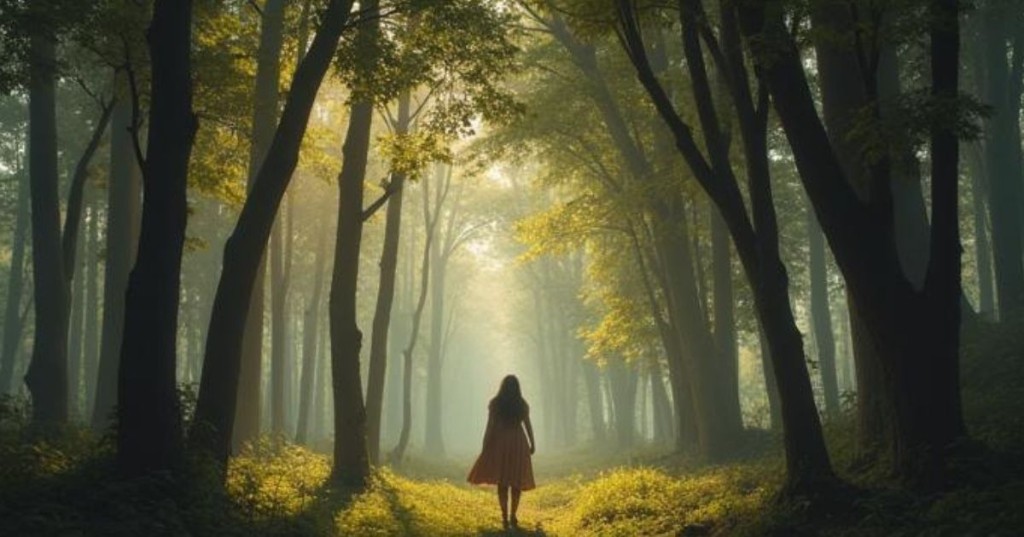
La Motte first meets the abbey as a man looking for a bed. Walking through the ruined chapel and nave at dusk, he sees the leaning pillars and thinks of his own decline: in a few years he too will be a subject of meditation for strangers. He returns to the carriage with nothing learned and orders Peter to drive on in the dark, against Peter's objection and Madame La Motte's pleas, until the carriage overturns on a hidden stump and the wheel breaks. No one is hurt, but there is no shelter, so La Motte proposes the ruins. Madame La Motte shudders and says she would rather stay in the night dews. He has already mastered his own reluctance and will not yield to hers. Inside, a noise sweeps down the great hall, and La Motte, ashamed of the fear he showed, mocks hers and insists on going on. Peter takes a light into the passage and comes back breathless to report that it was only owls and rooks. Past the tower door they find rooms far newer than the ruin around them, including a vaulted room behind a door barred with iron. They light a fire, pile stones against the door, and set Peter to watch, while La Motte privately wonders whether banditti use the place and tells no one.
At dawn Adeline watches the sun rise from a window and prays. Peter, setting off to find a wheelwright, remarks that nobody would think of looking for them here. La Motte has been thinking the same all night: a forest with liberty is not a bad home for a man who expects a prison. Madame La Motte objects, but he seldom consults his wife until he has decided. Exploring, he finds tower rooms that still hold a bedstead, tapestry and broken chairs, and in a closet a trap-door over a stair that ends in darkness. He shuts it again and says nothing. Peter is away all day and returns at dusk with bruised arms from a fight over a wheelwright's price, a few nails, and a basket of food, which La Motte grudgingly calls the only wise thing he has done. Now settled on staying, La Motte sends him back to Auboine to buy a cart of furniture and materials.
That evening Adeline tries to lift Madame La Motte's spirits by saying that comfort can be found in any situation. La Motte answers that the illusion is gone, and Adeline replies that he deceives himself by letting sorrow tint everything he sees. Peter's second trip brings the cart and a report on the abbey. It belongs to a nobleman who lives far away. It was said that someone was once brought there secretly and confined in the newer rooms, and nobody knows who he was or what became of him. For seventeen years the peasants have kept clear because of strange noises. La Motte sees that the furnished tower rooms match the story, and he keeps that to himself, because Peter's account has already made his family less willing to stay. Within weeks the lower rooms are comfortable, Madame La Motte makes the vaulted room her sitting room, and Adeline is given a chamber off the tower. On her first night there fear drives her to the door to call for Madame La Motte, but she hears La Motte speaking cheerfully below, blushes at herself and goes back to bed. The voice that steadies her belongs to the one person who has quietly matched the rumour to the rooms above.
Radcliffe understood something profound about human psychology: identical circumstances produce wildly different outcomes based on how we process them internally. In her abbey scene, every character faces the same reality, a crumbling refuge with an ominous past, but their experiences diverge completely. This wasn't just gothic atmosphere; it was keen observation of human nature. Modern research confirms what Radcliffe intuited: resilience isn't about pretending problems don't exist, it's about strategic attention management. Consider healthcare workers during the pandemic. Same impossible conditions, same exhaustion, same risks. Yet some burned out completely while others found unexpected meaning and community. The difference wasn't external, it was where they chose to direct their mental energy. Those who thrived didn't ignore the difficulties; they actively searched for elements they could control, appreciate, or build upon. They created small rituals of normalcy, celebrated tiny victories, and focused on helping others rather than dwelling on what they'd lost. This pattern appears everywhere: families facing foreclosure, students in underfunded schools, workers in toxic environments. The circumstances are real and often unfair, but within those constraints, we still choose what to notice, what to nurture, and how to respond. The question isn't whether life will force us into unexpected territory, it will. The question is whether we'll have the tools to find solid ground when it does.
Explore this chapter with AI to uncover deeper meaning and practical takeaways.
AI Discussion