
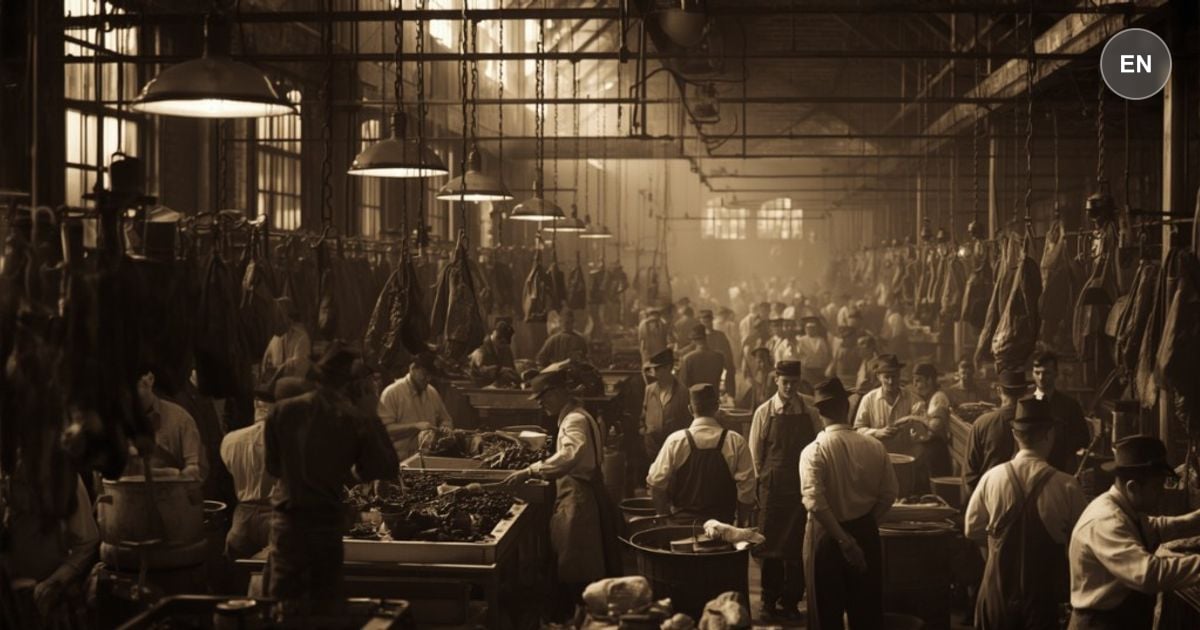
All summer the family toils until Jurgis and Ona can marry with decency, then November's feast leaves them more than a hundred dollars in debt. Love has barely opened when the lash of want drives them to work the morning after the wedding: exhausted Ona, sick Stanislovas at his lard machine, the household sour with children and cross adults. Jurgis clenches his fists and returns to the yards for her. The feast debt drives them to the yards the morning after the wedding.
Packingtown teaches a new war of each against all. Store windows lie, telegraph poles advertise lies, and the corporation that employs you is one gigantic lie. Ona loses a streetcar transfer through a rule designed to cheat riders who do not demand their rights; she walks to the yards in pouring rain and works two weeks with chills while a bitter forelady punishes her for wanting a wedding day. They live above a cesspool, drink watered milk with formaldehyde, and buy gypsum insect powder that cannot kill roaches. Ona loses a transfer and walks in rain to a bitter forelady.
Old Antanas coughs in a freezing pickle cellar until saltpeter eats through his boots and his feet ulcerate. He will not quit; he dies at home after hemorrhages, and the family strips the funeral to a hearse and one hack, Jurgis bargaining in front of witnesses so the undertaker cannot inflate the bill. Twenty-five years in the Lithuanian forest end in a Packingtown room with no money for decency. Antanas dies after saltpeter eats his boots; Jurgis bargains the undertaker publicly.
Winter comes as renovation for the packing machine: pneumonia, grippe, tuberculosis harvest the weakened, and thousands fight at the gates each dawn for the unfit one's job. Durham advertises two hundred ice cutters and three thousand men riot for twenty places. Blood freezes on the killing beds; men thaw their feet in steaming carcasses. Saloons offer the only heat, paid for in drinks and check-cashing traps. Jurgis takes one noon beer for Ona's sake and carries Stanislovas on his shoulders through blizzards while the demon cold waits in the cracks of their house. Saloons sell heat; blizzards force Jurgis to carry Stanislovas while rent and debt share one ledger.
Sinclair shows us something crucial: exploitation isn't just individual greed, it's systematic design. Every aspect of Jurgis's life, from wedding traditions to work conditions, is structured to extract maximum value while providing minimum benefit. This isn't accident or bad luck; it's architecture. Today's version looks different but functions identically. Healthcare systems profit from managing illness, not curing it. Housing markets extract deposits, fees, and rent while providing minimal maintenance. Gig economy platforms shift all risks to workers while taking cuts from every transaction. The genius of systematic extraction is that each piece seems reasonable alone, of course weddings cost money, of course transportation has fees, of course food costs what it costs. But together, they form an inescapable web where victims blame themselves for systemic design. When Jurgis can't afford his father's funeral, he thinks he failed. When Maria can't afford her uncle's medical care, she thinks she should work harder. But the system is designed to make basic human needs unaffordable for those who produce the wealth. Recognition changes everything. Once you see the pattern, you can't unsee it. You stop asking 'What's wrong with me?' and start asking 'Who profits from this problem persisting?' You stop trying to negotiate your way out of rigged games and start building strategies that account for systematic extraction. The question isn't whether these systems exist, they do. The question is whether you'll recognize them in time to navigate them.
Explore this chapter with AI to uncover deeper meaning and practical takeaways.
AI Discussion